Ongoing phenomenonCrop Circles
aka crop circles · crop circle · Mowing Devil
Geometric patterns appearing overnight in standing grain crops. Documented in English-language print since the 1678 "Mowing Devil" pamphlet. The modern wave begins in southern England in the late 1970s, with thousands of designs appearing across Wiltshire, Hampshire, and Oxfordshire. In September 1991 Doug Bower and Dave Chorley publicly admitted to making many of the early Wiltshire circles beginning in 1978.
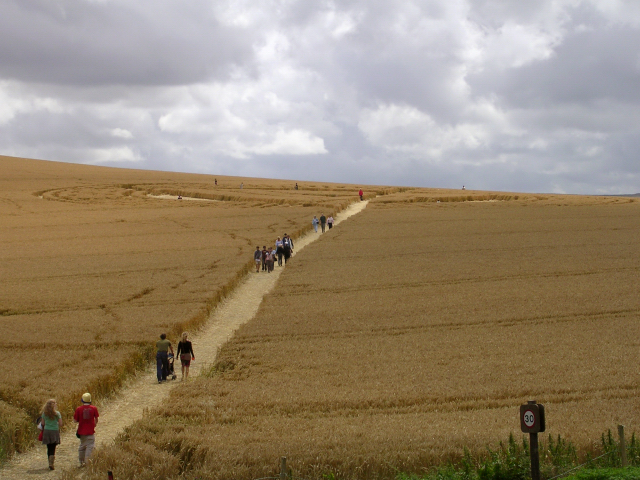
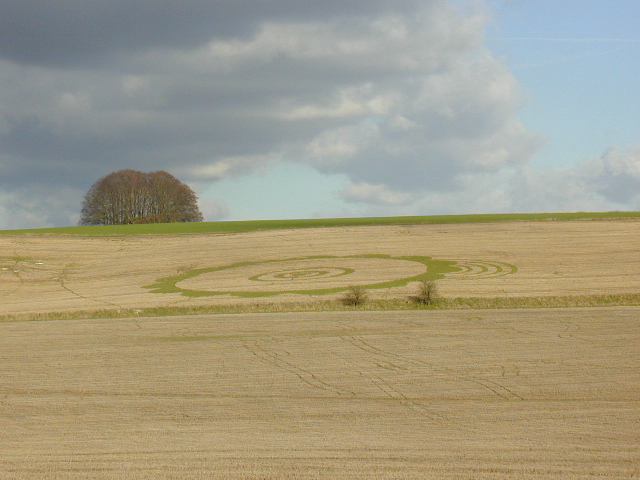
What's documented
Patterns of flattened standing grain appearing — typically overnight — in cultivated fields. The earliest known English-language record is the 1678 “Mowing Devil” woodcut pamphlet from Hertfordshire, which depicts a horned figure cutting a circular pattern in a field of oats. Sporadic 19th- and early-20th-century reports appear. The modern phenomenon begins in southern England in the late 1970s with simple single-circle and circle-with-satellite designs in Wiltshire fields, with the design complexity escalating sharply across the 1980s and 1990s into pictograms hundreds of meters across involving fractal geometry, Mandelbrot sets, and DNA-helix figures. On 9 September 1991, Today newspaper (UK) published the confession of Doug Bower and David Chorley of Southampton, two retired artists who said they had begun making circles together in 1978 using a wooden plank and rope, in part as a prank inspired by 1966 Tully Australia “saucer nest” reports. They demonstrated their technique on camera. From the early 1990s onward, the named “circle-maker” groups (the Circlemakers, John Lundberg’s group) have publicly produced complex designs on commission for advertising and television, demonstrating that the most elaborate designs are within human capability with simple tools and a few hours. The residual problem the hoax confession does not fully cover is concentrated in two areas: (1) Wiltshire circles appearing in fields under continuous observation by farmers and researchers — most famously the 1996 Stonehenge Julia Set, which appeared in a 45-minute window during daylight; (2) reported physical anomalies in the affected stems — bent rather than broken nodes, with mild expulsion-cavity damage consistent with rapid internal heating, reported by U.S. biophysicist W. C. Levengood in Physiologia Plantarum (1994, peer-reviewed). The Levengood node-expulsion claim has not been independently replicated to community satisfaction; it is the strongest residual claim and also the most contested.