IncidentWashington National Flap (19–20, 26–27 July 1952)
Radar at Washington National Airport, Andrews AFB, and Bolling AFB tracked unidentified objects over the White House and Capitol on two consecutive weekends; F-94 interceptors were scrambled and reported visual contact.
What's documented
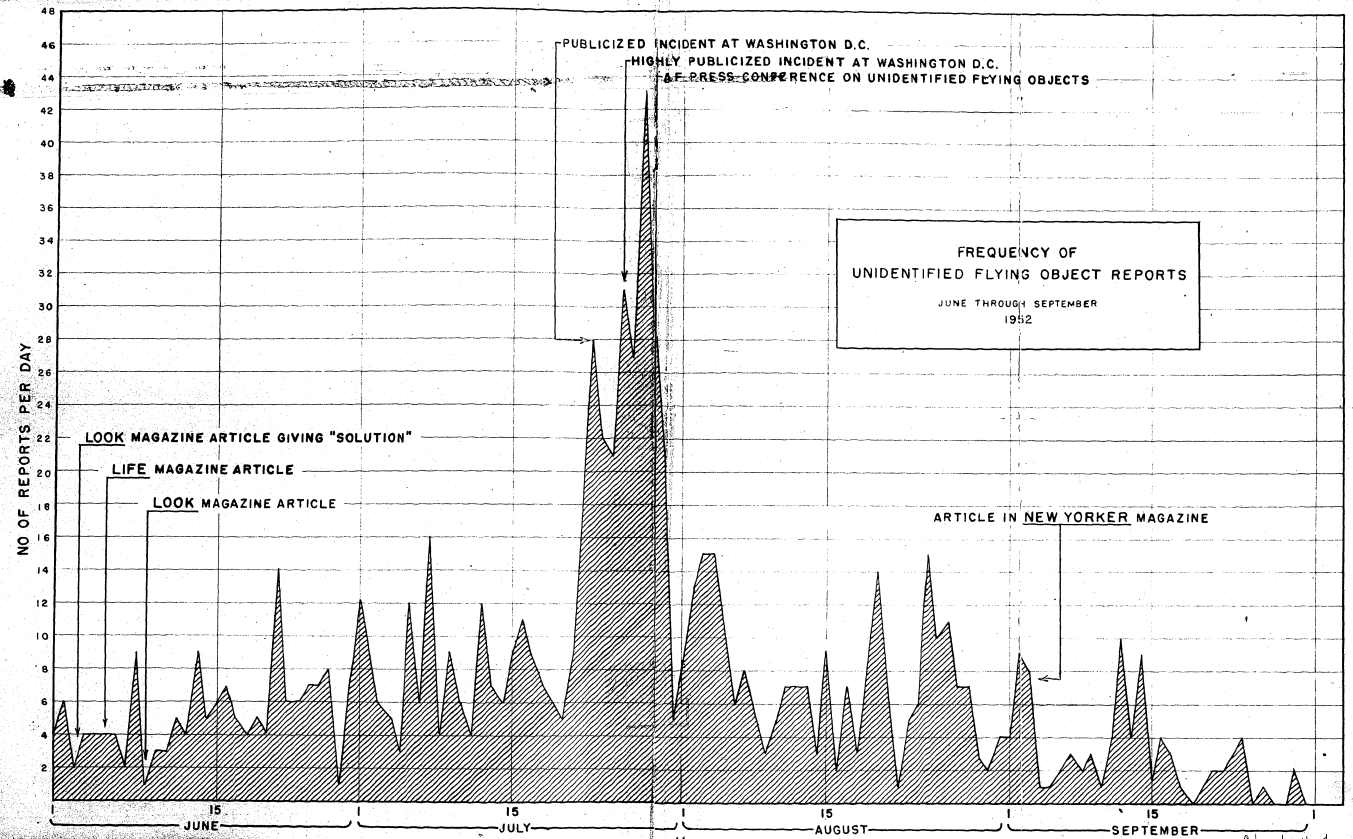
Beginning at 23:40 on 19 July 1952, air traffic controller Edward Nugent at Washington National observed seven slow-moving objects on his radar scope in an area where no aircraft were scheduled. Senior controller Harry Barnes independently confirmed the tracks. Objects were tracked simultaneously by Andrews AFB and Bolling AFB. The Air Force scrambled F-94 Starfires from New Castle AFB, Delaware. Over the following week, the same pattern repeated on the night of 26–27 July. Maj. Gen. John Samford convened the largest Pentagon press conference since World War II on 29 July 1952; the official explanation given was ‘temperature inversion.’ Capt. Edward Ruppelt, then head of Project Blue Book, later wrote that he did not consider the inversion explanation adequate.
Notable & intriguing
-
On the night of 19–20 July 1952, controllers at Washington National (Edward Nugent and Harry Barnes), Andrews AFB, and Bolling AFB simultaneously tracked unidentified targets moving at 100–130 mph that would occasionally accelerate to over 7,000 mph and disappear from the scope.
Project Blue Book file, case 1501; CAA controller statements, 21 July 1952
-
F-94 pilot Lt. William Patterson reported on 26 July 1952: 'I saw several bright lights. I was at my maximum speed, but even then I had no closing speed. They were above me and to my left, and they were closing on me.'
Lt. Patterson statement, ADC, 28 July 1952; Project Blue Book case 1502
-
The 29 July 1952 Pentagon press conference held by Maj. Gen. John Samford was the largest press conference held at the Pentagon since the end of World War II; the official cause was given as 'temperature inversion.'
Pentagon press conference transcript, 29 July 1952; The Washington Post, 30 July 1952, p. 1
-
Capt. Edward Ruppelt, then director of Project Blue Book, later wrote that the Air Weather Service meteorologists at the conference 'specifically said that there were no inversions strong enough to cause the radar returns.'
Capt. Edward J. Ruppelt, *The Report on Unidentified Flying Objects*, 1956, ch. 13