Kyshtym Region / Mayak Production Association
55°43′N, 60°33′E — Chelyabinsk Oblast, Russia — Ural Mountains nuclear-industrial region; closed cities of Ozyorsk and Kyshtym
What's documented
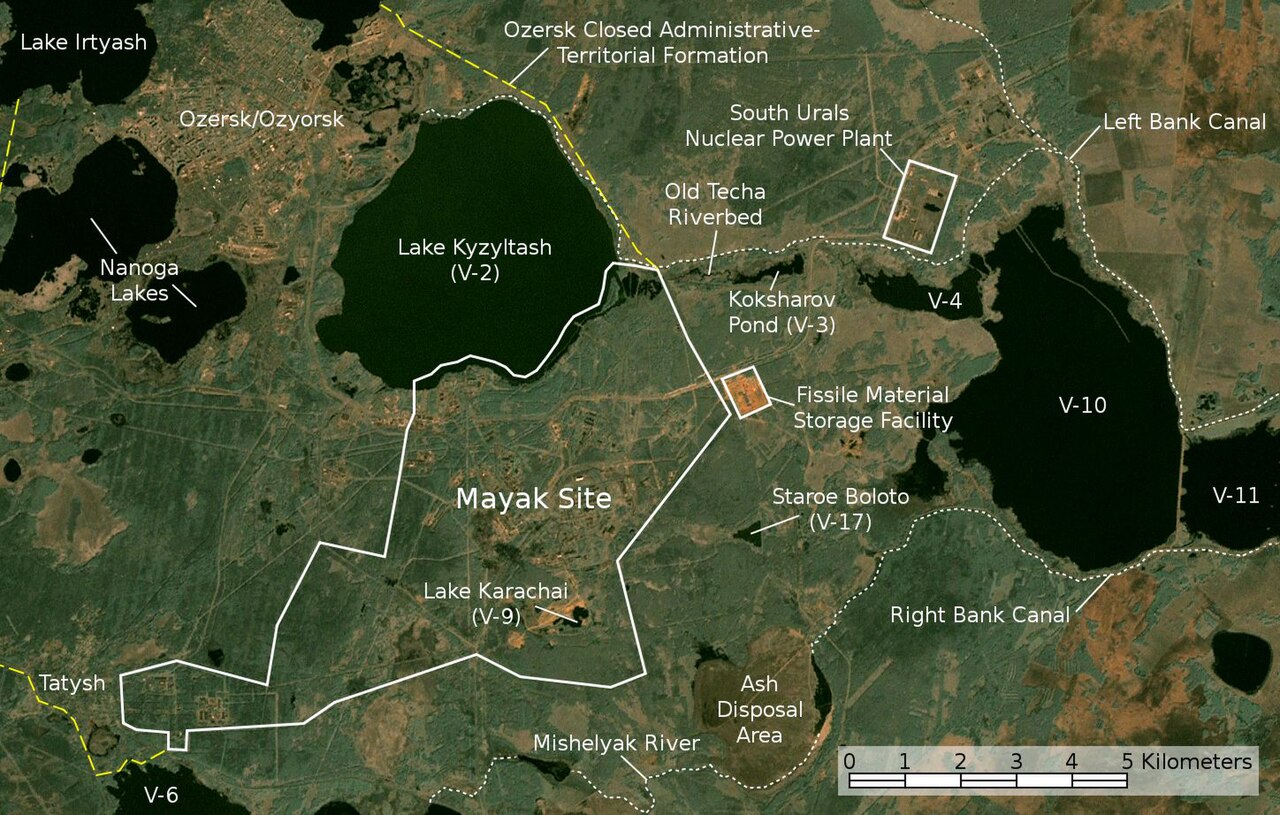
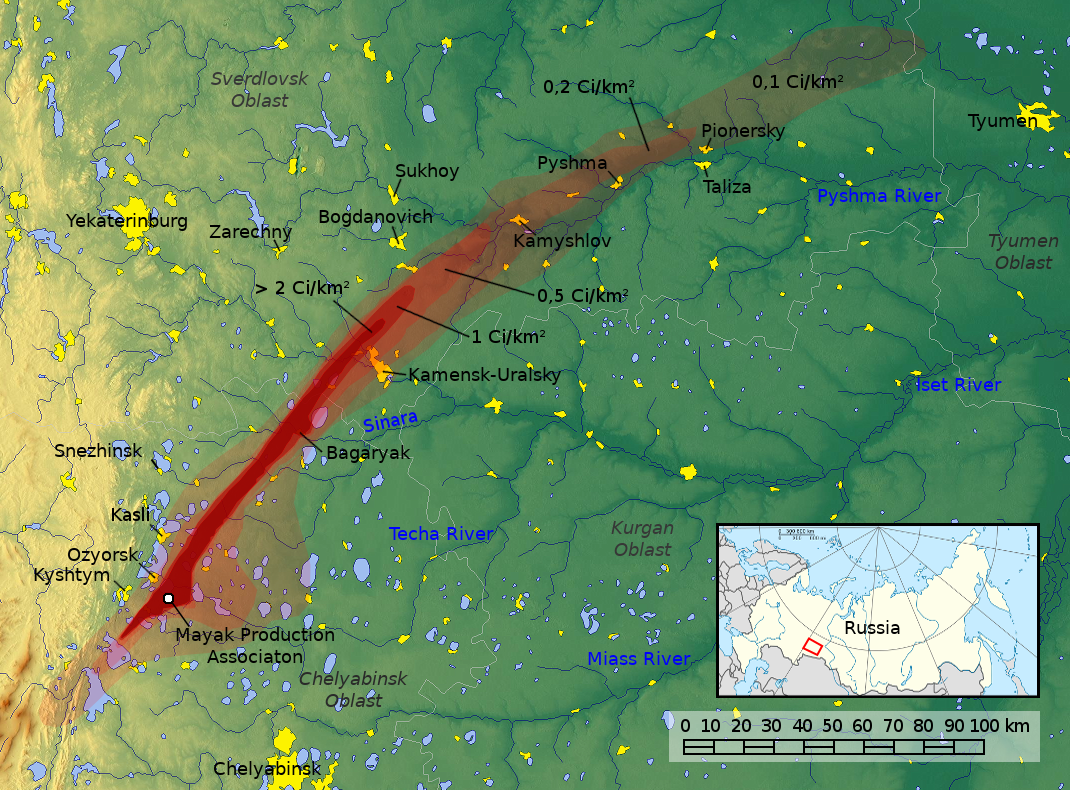
The Kyshtym region of Chelyabinsk Oblast hosts the Mayak Production Association, the Soviet Union's first plutonium-production complex, established 1946-48 near the closed city of Ozyorsk (then Chelyabinsk-65). On 29 September 1957, a cooling-system failure caused a chemical explosion in a high-level radioactive waste tank at Mayak, contaminating the surrounding region with ~20 MCi of activity — the third-worst nuclear accident on record, after Chernobyl and Fukushima. The accident was concealed until 1976 when it was disclosed by exiled Soviet biologist Zhores Medvedev.
Notable & intriguing
-
The 1957 Kyshtym disaster contaminated an area of ~20,000 km² with fallout from a high-level radioactive waste tank explosion. The East-Ural Radioactive Trace (EURT) remains contaminated; portions are closed to public access. The accident was classified Level 6 on the INES scale (Chernobyl and Fukushima were Level 7).
IAEA INES classification; Medvedev, 'Nuclear Disaster in the Urals' (1979)
-
In May 1996, retired Kyshtym pensioner Tamara Prosvirina, in her 70s, was reported to have brought home a small humanoid corpse — colloquially called 'Alyoshenka' (Little Alex) — found near the village of Kaolinovy. The 25 cm body featured an elongated cranium and four-fingered hands. The body was filmed by local Kyshtym TV reporter Pavel Mukhortikov before disappearing in 1996. Tamara Prosvirina was struck and killed by a truck on 5 August 1999.
Kyshtym Television footage, May 1996; Russian Ministry of Internal Affairs Chelyabinsk Oblast file 99-1184
-
Forensic genetic analysis of cells retrieved from the original Alyoshenka video material was conducted in 2004 by the Center for Molecular Genetics of the Russian Academy of Sciences and (separately) by the Ekaterinburg-based Center for the Forensic Identification. The Ekaterinburg analysis (Dr. Irina Yermolayeva) concluded the sample was human; the AN RAN result was inconclusive. The corpse itself has never been recovered.
Yermolayeva forensic genetic report, 2004; segments aired on REN-TV 'Tainstvennaya Rossiya,' 2010
Public-record imagery