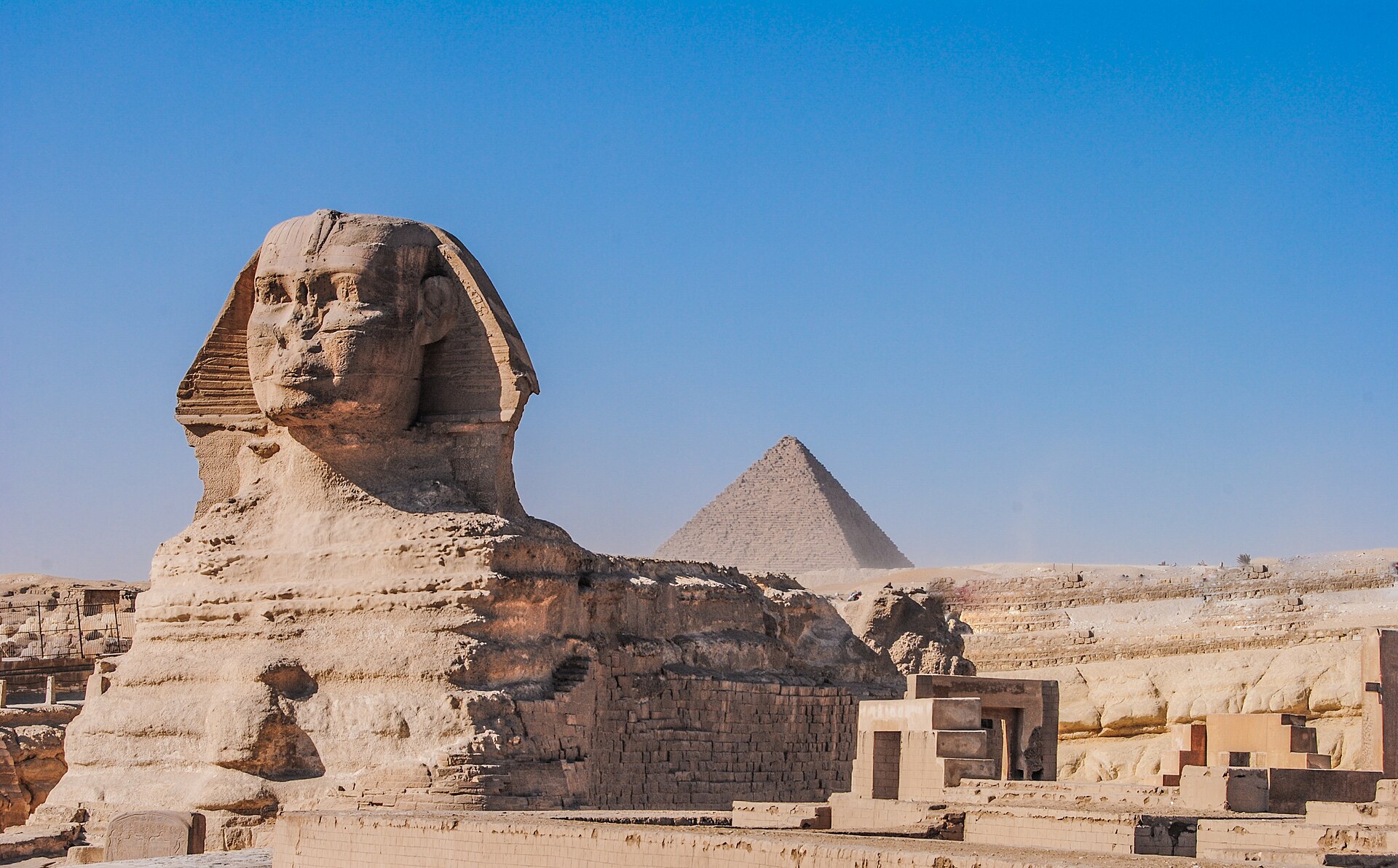
Great Sphinx of Giza
A limestone lion-bodied, human-headed colossus on the Giza plateau, conventionally dated to Khafre's reign (c. 2500 BC) and a favorite of Ancient Aliens for the disputed 'water-erosion' redating.
The Great Sphinx is a single-piece monument carved from the natural bedrock of the Giza plateau, measuring about 73 metres long and 20 metres high. Egyptologists overwhelmingly attribute it to the Fourth Dynasty pharaoh Khafre, around 2500 BC, based on its placement within Khafre’s pyramid complex, its alignment with his causeway and valley temple, and stylistic links between the face and Khafre’s statuary. Mark Lehner’s detailed mapping of the statue and enclosure underpins this consensus.
The show’s favorite hook is the ‘water-erosion hypothesis.’ In 1991 geologist Robert Schoch, working with author John Anthony West, argued that the weathering on the Sphinx enclosure walls is rounded and vertical — the signature of heavy rainfall rather than wind-blown sand — and that such rainfall last fell on Giza thousands of years before Khafre, implying the Sphinx is far older. On Ancient Aliens this older date is folded into the ancient-astronaut hypothesis as evidence of a vanished pre-Egyptian high civilization.
The Egyptological and geological mainstream rejects the redating. The Sphinx is carved from soft, layered Mokattam limestone that weathers rapidly through salt crystallization (haloclasty) and groundwater capillary action — processes that can produce the observed profile in far less time without ancient rainfall. Lehner and geologist James Harrell note that Schoch’s model ignores the enclosure’s lithology, and that no material culture, tools, or inscriptions support a civilization capable of such a carving in the 8th millennium BC. The integrated Khafre complex remains decisive.