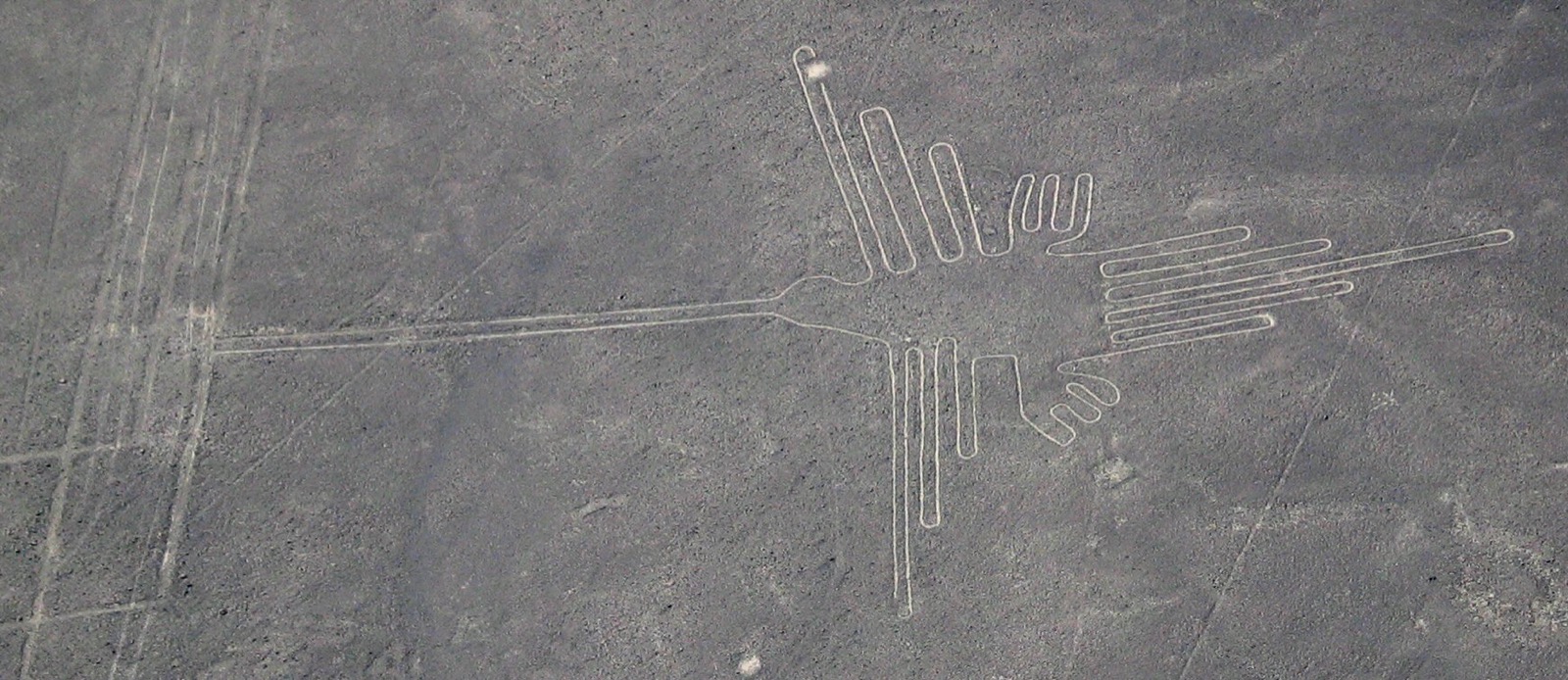
Nazca Lines
Vast geoglyphs in the Peruvian desert made by the Nazca culture (c. 500 BCE–500 CE); von Däniken read them as alien runways, and Joe Nickell reproduced the largest figures with stakes and string in days.
The Nazca Lines are several hundred geoglyphs etched into the Nazca Desert of southern Peru, made by the Nazca culture between roughly 500 BCE and 500 CE (with an earlier Paracas phase). They were produced by a simple, well-understood method: removing the reddish-brown, iron-oxide-coated surface pebbles to expose the pale yellow-grey subsoil 10–15 cm beneath. More than 70 animal and plant figures survive — a 93 m hummingbird, a 134 m condor, a spider, a monkey — alongside long straight lines and geometric forms.
Erich von Däniken’s Chariots of the Gods? (1968) made them famous to the ancient-astronaut audience by reading the long straight lines as landing strips for spacecraft — an idea repeated on Ancient Aliens. The reading collapses on contact with the desert floor: runways need a hard graded surface, not lines scraped a few centimetres into soft ground, and the figural geoglyphs are meaningless as airstrips. Von Däniken himself later conceded the lines “could have been laid out… from a model using a system of coordinates.”
The mainstream account treats them as ritual and astronomical works of the Nazca. The mathematician Maria Reiche spent decades mapping them; the skeptic Joe Nickell and a small team reproduced even the largest figures using only period-appropriate stakes and cord — no aerial assistance, within days — which is the cleanest possible refutation of the “you’d need to see them from the air” premise. Catalogued as evidence cited for the hypothesis that does not survive examination.
Sources
Relationships
Supporting content