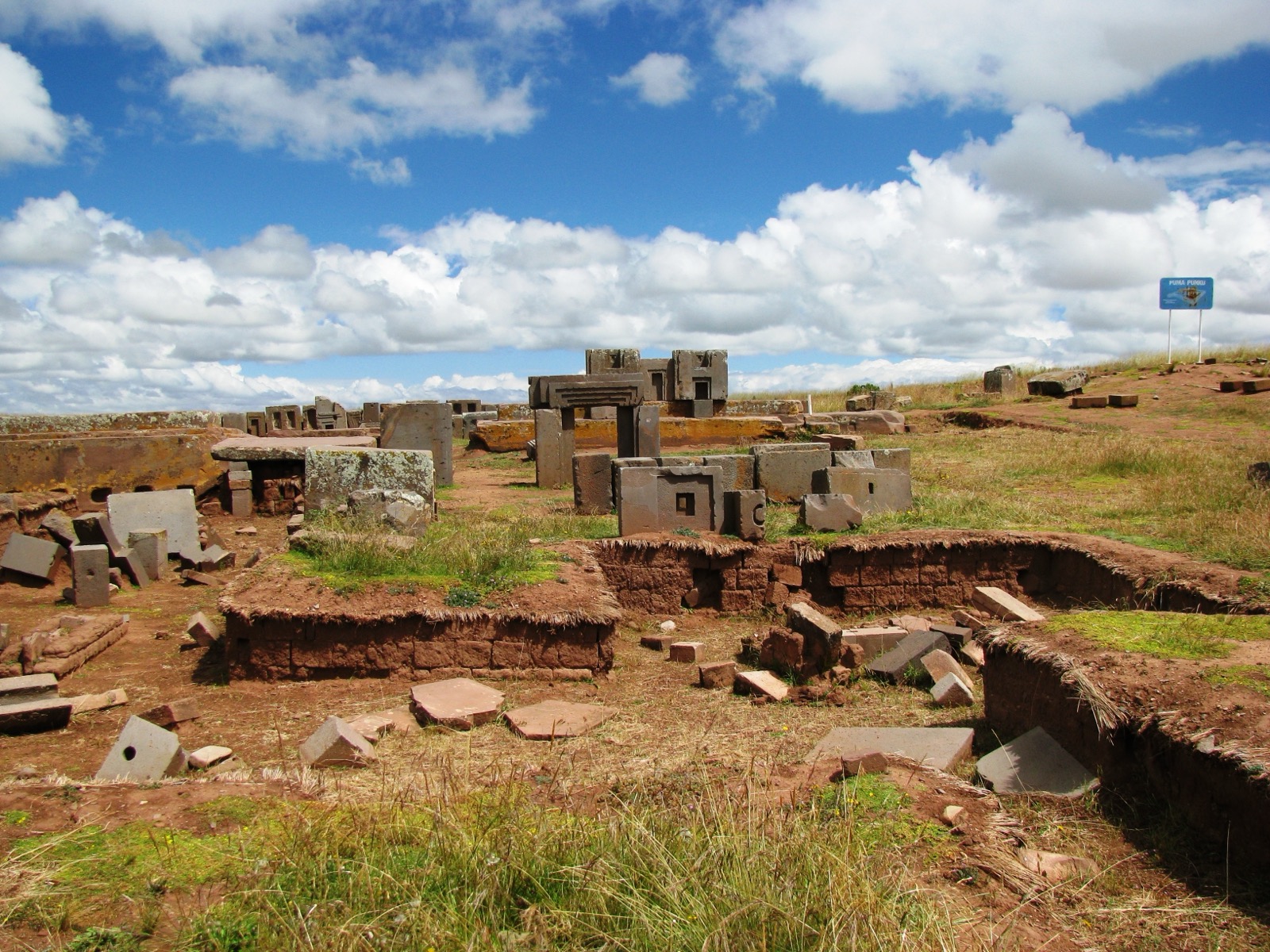
Puma Punku
A precision-stoneworked platform mound in the Tiwanaku complex near Lake Titicaca, Bolivia (built c. AD 536–600); its andesite 'H-blocks' are a staple of ancient-astronaut claims, and a staple of their refutation.
Puma Punku (“Gate of the Puma”) is part of the Tiwanaku archaeological complex in the Bolivian altiplano near Lake Titicaca, built by the Tiwanaku civilization. Radiocarbon dating of organic material in the lowest mound layer places initial construction at roughly AD 536–600, with the stone superstructure somewhat later. Its largest red-sandstone foundation block runs about 7.8 × 5.2 m and weighs on the order of 131 tonnes; the sandstone came from quarries some 10 km away, the finer andesite facing stones from the Copacabana Peninsula ~90 km across the lake.
What draws the cameras is the precision: the famous “H-blocks,” interlocking andesite pieces with sharp interior 90° angles, drilled blind holes, and T-shaped sockets that once held bronze cramps poured to bind the stones. Ancient-astronaut proponents cite this geometric exactness and the high-altitude setting as beyond Andean capability — a regular subject on Ancient Aliens.
The archaeology answers the claim directly. The archaeologist Stella Nair reproduced the carving with stone tools (flint, obsidian, agate), reaching comparable precision in roughly 25 working hours for a skilled artisan; Protzen and Nair documented the full technique. And the “no antecedents” premise is simply false: precursor sites at Chiripa (c. 550 BC–AD 100) and Pukara show the local architectural evolution that leads to Tiwanaku. The mystery is manufactured by omission; the masonry is a triumph of the Tiwanaku, not evidence of visitors. Filed here as evidence cited for the hypothesis — and, on inspection, against it.
Sources
Relationships
Supporting content