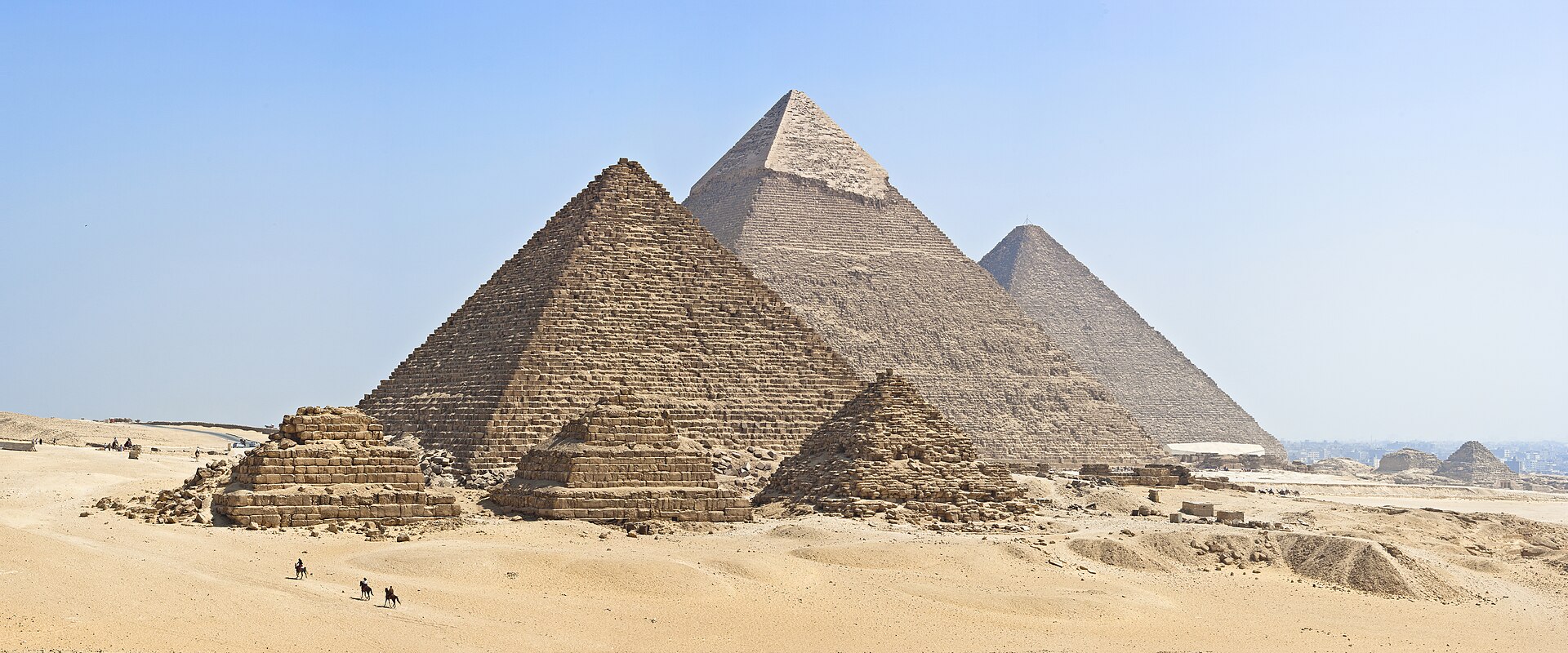
Pyramids of Giza
The Old Kingdom royal necropolis on the Giza plateau — three pyramids built as pharaonic tombs in the 26th century BC, and a perennial staple of Ancient Aliens.
The Giza complex was built during Egypt’s Fourth Dynasty (c. 2613–2498 BC). The largest, the Great Pyramid, was commissioned by pharaoh Khufu around 2580–2560 BC; the second and third belong to his successors Khafre and Menkaure. They were royal tombs, part of larger mortuary complexes with causeways, temples, and boat pits. Archaeology has recovered the supporting infrastructure directly: workers’ villages, bakeries and breweries at Giza, quarry sites, and — at Wadi al-Jarf on the Red Sea — the Diary of Merer, a Fourth Dynasty papyrus logbook describing a work gang ferrying Tura limestone to Giza for the Great Pyramid. The builders were skilled, organized, paid laborers, not slaves, and certainly not anonymous.
On Ancient Aliens and across the ancient-astronaut hypothesis, the pyramids are presented as too precise, too heavy, and too astronomically aligned for Bronze Age people — the casing joints fitted to fractions of a millimeter, the near-perfect cardinal orientation, and the rough alignment of the three pyramids likened to Orion’s Belt are cited as evidence of extraterrestrial engineering or ‘lost’ high technology.
None of this requires aliens. The precision is real but achievable with sighting rods, plumb lines, water leveling, copper tools, and immense labor over roughly two decades; experimental archaeology has reproduced the relevant cutting and hauling techniques. The cardinal alignment is explained by simple stellar/solar surveying methods. The ‘Orion correlation’ is a loose visual match that does not hold up to rigorous astronomical analysis, and it ignores that each pyramid is an individual king’s tomb built across different reigns. The mainstream account is supported by inscriptions, the Merer papyri, and the surrounding settlement evidence — a thoroughly human, documented project.
Sources
Relationships
Supporting content