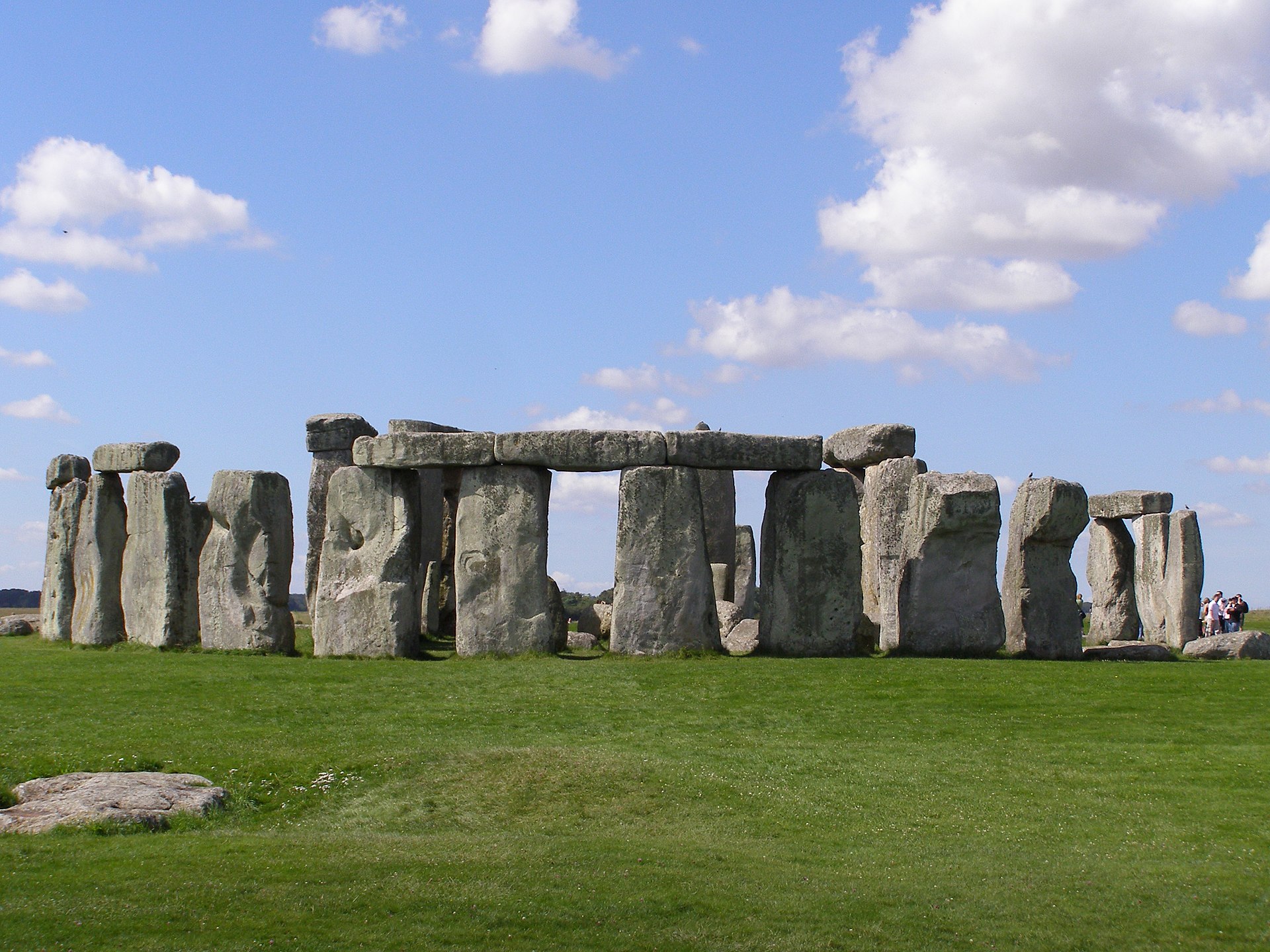
Stonehenge
A Neolithic-to-Bronze-Age stone circle on Salisbury Plain whose Welsh-sourced bluestones make it a recurring Ancient Aliens case for 'impossible' long-distance stone transport.
Stonehenge was built in stages over roughly 1,500 years, beginning around 3000 BC with a circular earthwork enclosure and culminating in the great sarsen trilithons and the bluestone settings. The huge local sarsens were dragged from the Marlborough Downs about 25 km north. The smaller ‘bluestones’ were quarried in the Preseli Hills of west Wales, some 225 km (140 miles) away; excavations at Carn Goedog and Craig Rhos-y-felin recovered Neolithic quarrying tools and date extraction to roughly 3400–3200 BC. Recent work even suggests some stones first stood in a dismantled Welsh circle at Waun Mawn.
On Ancient Aliens, the bluestones drive the argument: moving multi-ton blocks 140 miles with antler picks and rope is portrayed as beyond Neolithic people, and the circle’s solstice alignments are recast as an alien observatory — a classic move within the ancient-astronaut hypothesis.
The mainstream view needs no help from above. The bluestones weigh on the order of 2–4 tons each, well within the reach of sledges, rollers, timber tracks, and a large coordinated workforce, and experimental reconstructions have moved comparable loads. The solstice alignment reflects sophisticated but entirely human sky-watching, common across Neolithic Europe. Far from unexplained, Stonehenge is one of the best-studied prehistoric monuments in the world, with its quarries, building sequence, and the nearby Durrington Walls builders’ settlement all documented.
Sources
Relationships
Supporting content