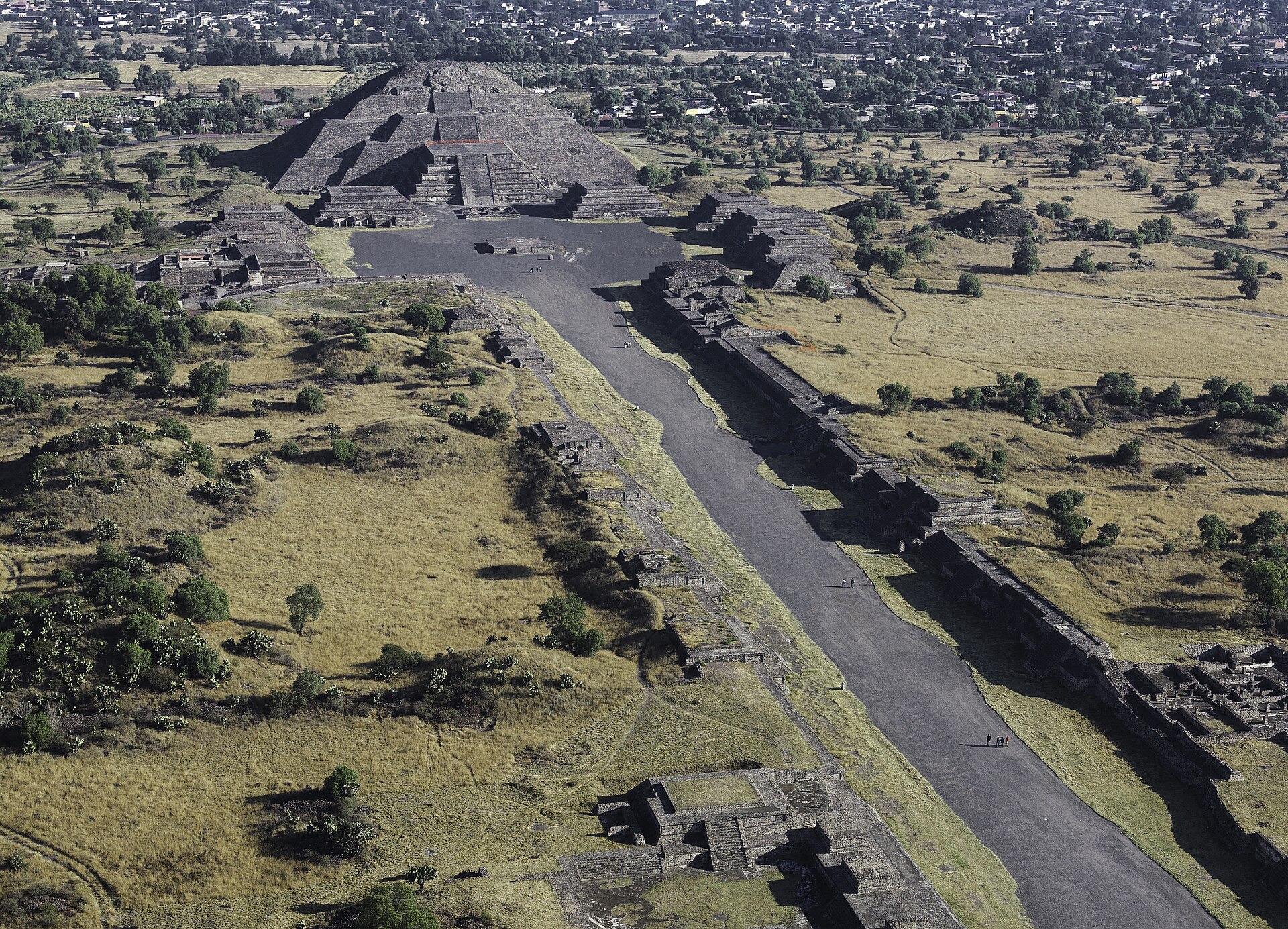
Teotihuacan
A vast pre-Aztec metropolis in the Valley of Mexico, peaking c. 100–550 AD, cited by Ancient Aliens for the sheets of mica and pools of liquid mercury found in its structures.
Teotihuacan was one of the largest cities of the ancient Americas, covering some 20 square kilometres and home to perhaps 100,000–125,000 people at its height between roughly 100 and 550 AD. Its builders laid out a planned grid along the ‘Avenue of the Dead,’ dominated by the Pyramid of the Sun, the Pyramid of the Moon, and the Temple of the Feathered Serpent. The Aztecs encountered it already in ruins centuries later and gave it its Nahuatl name. In 2015, archaeologist Sergio Gómez found pools of liquid mercury, along with large sheets of mica, jade, and pyrite mirrors, inside a sealed tunnel beneath the Temple of the Feathered Serpent — most likely ritual deposits symbolizing water and the underworld.
On Ancient Aliens, the mica (a modern electronics material) and the liquid mercury are framed as evidence of advanced or extraterrestrial technology, feeding the broader narrative of the ancient-astronaut hypothesis.
Neither material is anomalous. Mica occurs naturally in Mesoamerica and was used decoratively and ritually; its presence reflects trade and symbolism, not circuitry. Liquid mercury was produced in the ancient Americas by heating cinnabar (mercury sulfide), the bright-red mineral Mesoamericans prized as a pigment, and mercury or cinnabar has been found in other Maya ritual contexts. The most parsimonious reading, supported by the excavators, is symbolic and funerary — a shimmering ‘underworld river’ — not an extraterrestrial power source.
Sources
Relationships
Supporting content