Battle of Los Angeles historically-pivotal-explained
On the night of 24-25 February 1942 — eleven weeks after Pearl Harbor
and a day after a Japanese submarine shelled the California coast — U.S.
anti-aircraft batteries fired more than 1,400 shells over Los Angeles at
targets never confirmed to exist. No enemy aircraft were downed, no
bombs fell, and five civilians died from blackout car crashes and
stress. The official explanation is "war nerves" / false alarm, most
likely set off by a stray weather balloon; the event's later fame rests
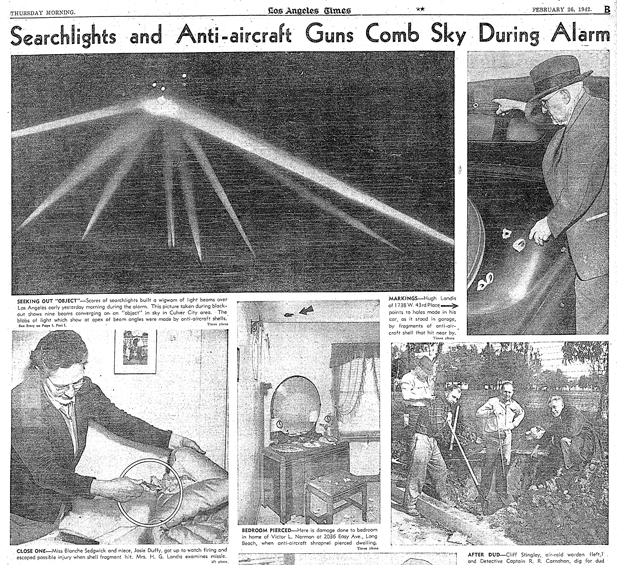
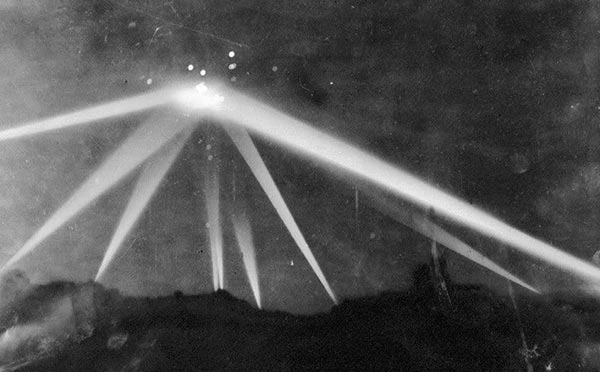
on a retouched Los Angeles Times photograph absorbed into UFO lore
decades afterward.
The Battle of Los Angeles is the corpus's reference case for wartime
mass misperception and for how a documented event gets retrofitted into
UFO mythology. It is a real armed overreaction with real deaths, on a
West Coast genuinely primed for invasion — and its later fame rests
almost entirely on one retouched newspaper photo and a same-day
contradiction between two Cabinet secretaries. It anchors the
distinction the corpus exists to enforce: the difference between what is
documented (a false-alarm barrage) and what is overlaid afterward (an
extraterrestrial reading that did not exist until after 1947).
Timeline
1942-02-23
The Japanese submarine I-17 shells the Ellwood oil field near Santa
Barbara — the real event two days prior that primed the West Coast for
an invasion scare.
primary source: Wikipedia; Smithsonian
1942-02-24_1918
An initial air-raid alert is called at 7:18 p.m. and lifted at 10:23
p.m. — a tense but uneventful first warning.
primary source: Wikipedia
1942-02-25_0225
Air-raid sirens sound across Los Angeles County and a blackout is
imposed. Around 3:06 a.m. a balloon carrying a red flare is reported
over Santa Monica, and four anti-aircraft batteries open fire; at 3:16
a.m. the 37th Coast Artillery Brigade begins firing.
primary source: 1983 Office of Air Force History (via Wikipedia)
1942-02-25_0414
Artillery fire ceases after roughly an hour and over 1,400 shells
(official narrative: 1,440 rounds). The "all clear" sounds at 7:21
a.m. and the blackout is lifted. No bombs were dropped, no aircraft
downed, no wreckage found.
primary source: Wikipedia
1942-02-25_day
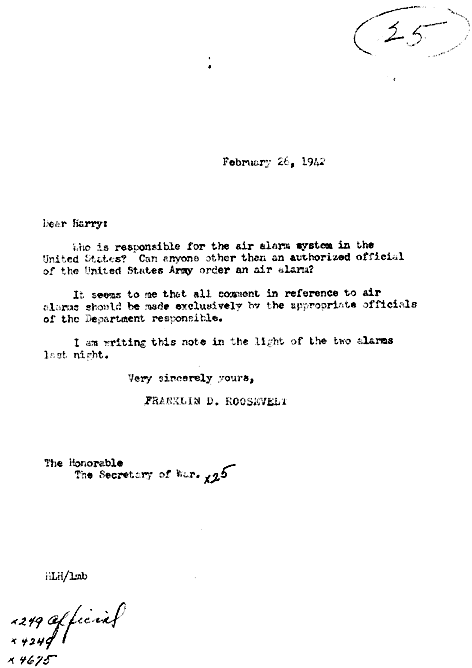
Navy Secretary Frank Knox calls the episode a "false alarm"
attributable to "war nerves." War Secretary Henry Stimson publicly
contradicts him, suggesting as many as 15 aircraft — possibly
commercial planes flown by enemy agents — were over the city; he later
backtracks. This same-day contradiction is the root of every later
cover-up and UFO narrative.
witnesses: Frank Knox (Secretary of the Navy) · Henry L. Stimson (Secretary of War)
primary source: History.com; Military.com; Wikipedia
1949
The U.S. Coast Artillery Association concludes a meteorological
balloon aloft started the shooting and that "once the firing started,
imagination created all kinds of targets."
primary source: Wikipedia (1949 Coast Artillery Association)
1983
The Office of Air Force History analysis ties the trigger to a
balloon-with-red-flare and searchlight/flak confusion — i.e., "war
nerves." (Note: contrary to a common framing, the 1983 analysis points
AWAY from real enemy aircraft; post-war Japanese records confirm no
overflight that night.)
primary source: 1983 Office of Air Force History (via Wikipedia); Military.com
Named personnel
- Frank Knox — Secretary of the Navy; called the episode a 'false alarm' driven by 'war nerves' on 25 February rank at time: · later: His original line was vindicated by the 1949 and 1983 analyses role: author of the explanation that became the consensus
- Henry L. Stimson — Secretary of War; publicly contradicted Knox with the '15 aircraft / enemy agents' claim, then walked it back rank at time: role: the source of the discredited enemy-aircraft reading and of the official contradiction
- Col. John G. Murphy — Coast Artillery Corps; frequently cited skeptical eyewitness rank at time: · later: Wrote that 'cold detachment disclosed no planes of any type in the sky — friendly or enemy' primary witness to: the absence of any confirmable aircraft during the barrage
- Rep. Leland M. Ford — Congressman (Santa Monica) who demanded an investigation, calling the event 'complete mystification' rank at time: role: the political pressure that kept the event in the record
- Brett Holman — Military-history historian whose 2011 analysis of a less-retouched copy of the LA Times photograph concludes the 'object' is a searchlight-lit cloud, with the surrounding blobs as flak bursts rank at time: role: the case's principal photo analyst
Sensor record
- Anti-aircraft fire-control radar + searchlights on 37th Coast Artillery Brigade, LA air defenses no confirmed aircraft acquired; searchlight beams converged on shell bursts and, per the leading reading, a drifting balloon — the convergence that produced the famous photograph documentation: AA brigade records; the 1983 OAFH analysis
- Press photography on Los Angeles Times (26 Feb 1942) the iconic image of searchlights on a luminous 'object'; the published photo was heavily retouched, a routine 1942 practice — the only physical 'evidence' of a craft documentation: the LA Times photo; Holman's comparison with a less-retouched archive copy
Object — reported
shape
no confirmed object; the photographed 'object' is the intersection of multiple searchlight beams on what analysis identifies as a cloud or drifting balloon, ringed by anti-aircraft shell bursts (flak)
size
indeterminate; the apparent 'object' is an optical convergence, not a measured body
surface features
none established; the published image's apparent solidity is partly an artifact of newsprint retouching
observed behaviors
- no movement attributable to a craft; the barrage continued against targets that 'imagination created' once firing began (1949 Coast Artillery account)
- no bombs dropped, no aircraft downed, no wreckage recovered — the defining negative facts
- the only casualties were indirect: three deaths in blackout car crashes and two stress-related heart attacks
Theories that invoke this case (3)
The textbook reading the evidence supports: a real military
overreaction under invasion fear, in which searchlight-lit shell
bursts and a drifting balloon were perceived as enemy aircraft, and
"imagination created all kinds of targets" once firing began.
The folkloric overlay: the retouched 1942 photo became a cornerstone
"UFO" image, with the searchlight convergence read as a solid craft.
The corpus records that this reading is entirely post-1947 and rests
on a known-retouched newspaper photo.
The institutional-contradiction reading: the same-day Knox ("false
alarm") versus Stimson ("15 aircraft") split is what seeded decades of
cover-up suspicion — a case of official mismessaging generating
durable mythology rather than concealing a craft.
Theories that do NOT invoke this case — and why
no material, wreckage, or instrumented object ever existed to analyze
no phenomenology beyond a searchlight-and-flak barrage and a retouched photograph
no entity observed
Conventional explanations advanced — and their status
War nerves / false alarm
proponents: Frank Knox (1942) · 1949 Coast Artillery Association · 1983 Office of Air Force History
The dominant, official explanation. A jittery air defense, days after a real submarine shelling, fired at perceived targets that were never confirmed.
A stray / lost weather (or pilot) balloon as the specific trigger
proponents: 1949 Coast Artillery Association · 1983 OAFH
The best-supported specific cause — the 1983 account ties the opening fire to a balloon carrying a red flare over Santa Monica. Stated as likely; no balloon was ever recovered, so the trigger is inferred, not documented.
Japanese reconnaissance or psychological-warfare overflights
proponents: Henry Stimson (1942)
Discredited. Post-war Japanese records confirm no aircraft flew over LA that night, and the 1983 analysis points toward balloons and misperception, not enemy aircraft.
Extraterrestrial craft (the modern UFO reading)
proponents: post-1947 UFO writers; popular media
A cultural artifact, not evidence. It rests on the retouched LA Times photo; Holman's analysis of a less-retouched copy reads the 'object' as a searchlight-lit cloud, and the ET interpretation did not exist until after the 1947 birth of the UFO era.
Where further investigation has leverage
- Forensic publication of the original (less-retouched) LA Times negative, which Holman reports exists in the archives, to settle definitively whether the 'object' is cloud/flak or something structured.
- A contemporaneous launch/recovery log for a meteorological or pilot balloon over the LA basin matching the ~3 a.m. red-flare sighting, to harden the leading trigger from 'likely' to 'documented'.
- Any recovered wreckage, bomb damage, or documented downed aircraft from that night — none has ever surfaced, and Japanese records affirmatively deny an overflight.
Corpus status
historically-pivotal-explained
Mainstream-explained: a false-alarm barrage driven by war nerves, most
likely triggered by a stray balloon and compounded by searchlights
catching shell bursts. No enemy aircraft, bombs, or wreckage were ever
found; the only deaths were indirect. The event's enduring fame is a
post-1947 folkloric overlay on a newspaper photograph that was admittedly
retouched before publication. Pivotal as a case study in wartime
misperception and in how the documented record and the UFO overlay must be
kept apart.
status history (1)
2026-06-09 · unannotated → historically-pivotal-explained
— initial annotation sweep (Epic J.F4)
Threads of evidence
This case is one node in the connections that run across the record. It appears in 1 thread: