Ghost Rockets under-corroborated
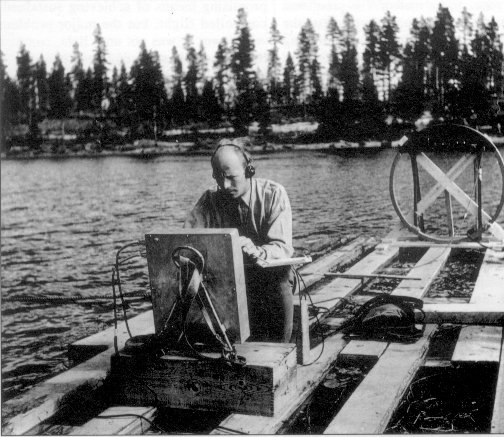
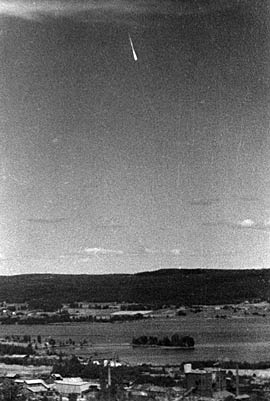
The "ghost rockets" were a wave of roughly 2,000 reports of rocket- or
missile-shaped objects over Scandinavia between February and December
1946, peaking in August. The Swedish military mounted what was
effectively the first major modern government investigation of an
aerial-anomaly wave; the U.S. sent observers (including Gen. James
Doolittle and David Sarnoff). Meteors explained most reports, but a
residue of radar-tracked, maneuvering, lake-crashing cases was never
resolved and no wreckage was ever recovered.
The ghost rockets are the corpus's first instance of the STATE turning
its apparatus on an aerial-anomaly wave: a dedicated Defence Staff
committee, radar, trajectory plotting, and physical lake-dredging,
roughly a year before Kenneth Arnold. They sit between the wartime foo
fighters and Project Sign in the pre-saucer continuum, and they carry
the era's defining Cold War frame — with Peenemunde's V-weapon
facilities now in the Soviet zone, the dominant hypothesis was Soviet
missile testing, making this an intelligence problem as much as a
curiosity. It is the template for the government-investigation arc the
corpus traces forward to AARO.
Timeline
1946-02-26
The first widely cited ghost-rocket reports, made by Finnish
observers — the conventional start of the wave.
primary source: Wikipedia; CUFOS
1946-05_to_1946-12
The main reporting window: roughly 2,000 sightings logged over Sweden
and neighbors. A secondary summary cites the Defence Staff receiving
nearly 1,000 reports, of which ~225 were deemed credible on the basis
of multiple witnesses, radar, or photographs (the precise figure is
lower-confidence).
primary source: Wikipedia; CUFOS
1946-07-19
The best-known "crash": a gray, rocket-shaped object reported diving
into Lake Kolmjarv in far-northern Sweden. The military sealed the
area, and officer Karl-Gosta Bartoll led a ~3-week search that
recovered no wreckage — only a disturbed patch of lake bottom. (Some
popular accounts misplace this near Nykoping in the southeast; the
lake is in Norrbotten, far north.)
witnesses: Karl-Gosta Bartoll (Swedish Air Force, led the lake search)
primary source: Wikipedia; Military Wiki
1946-08-09_to_1946-08-11
The peak of the wave — coinciding with the Perseid meteor shower
peak, central to the meteor explanation.
primary source: Wikipedia; CUFOS
1946-08-20
Gen. James "Jimmy" Doolittle and David Sarnoff arrive in Stockholm —
officially private business, but per intelligence accounts dispatched
to assess the situation; they are briefed that rockets had been
tracked on radar.
witnesses: Gen. James Doolittle (U.S. observer) · David Sarnoff (RCA / U.S. observer)
primary source: Sign Oral History Project; bibliotecapleyades briefing doc
1946-08-22
A Central Intelligence Group memo (Vandenberg) concludes the "weight
of evidence" points to Peenemunde as the launch origin, based on
radar course-plotting toward the Gulf of Bothnia. Sarnoff is later
quoted (NYT, 30 Sept) saying he is "convinced that the 'ghost bombs'
are no myth but real missiles."
primary source: CIA Reading Room doc, 23 Aug 1946; Wikipedia
1946-10-10
The Swedish Defence Staff issues a public statement: clear,
unambiguous observations had been made that "cannot be explained as
natural phenomena, Swedish aircraft, or imagination" — the key
"unexplained residue" admission.
primary source: Wikipedia; reproduced in EDN summary
1946-12-03
A Swedish committee memo reports examining ~30 pieces of recovered
debris, later identified as meteorite fragments — i.e., the recovered
material was natural, not technological.
primary source: EDN summary; Wikipedia
1948-11-04
A later U.S. Air Force document (declassified 1997) records that
Swedish Air Intelligence officials thought the phenomena reflected "a
high technical skill which cannot be credited to any presently known
culture on earth" — a minority of investigators leaning toward an
extraordinary reading.
primary source: Wikipedia; CUFOS
Named personnel
- Karl-Gosta Bartoll — Swedish Air Force officer who led the Lake Kolmjarv search rank at time: · later: Said the object likely 'disintegrated itself', possibly a lightweight magnesium alloy that would break up easily primary witness to: the fruitless ~3-week dredging of the reported crash site
- Eric Malmberg — Air engineer and secretary of the Swedish Defence Staff ghost-rocket committee rank at time: · later: Said decades later the committee was sure the objects did NOT originate in the USSR, yet behaved like a cruise-missile-type weapon no one possessed in 1946 role: the inside view of the official investigation
- Gen. James 'Jimmy' Doolittle & David Sarnoff — U.S. figures in Stockholm (Aug 1946) reportedly assessing the situation; Sarnoff publicly called the objects 'real missiles' rank at time: role: the U.S. intelligence interest in the wave
- Lt. Gen. Hoyt S. Vandenberg — Director of the Central Intelligence Group; authored/oversaw the 22 Aug 1946 memo favoring the Peenemunde-origin theory rank at time: · later: As USAF Chief of Staff he later rejected Project Sign's pro-ET 1948 'Estimate of the Situation' — a direct personnel link between the two eras role: the U.S. intelligence assessment, and a thread to Project Sign
Sensor record
- Ground radar (Swedish military) on Swedish air-defense radar numerous accounts of objects tracked on radar; one secondary figure cites ~200 sightings verified with radar returns (lower-confidence); the Oct 10 statement notes equipment registering objects of unknown nature documentation: Defence Staff committee records (not fully public)
- Trajectory plotting + visual reports on the Defence Staff committee; ~2,000 civilian and military observers rocket/cigar-shaped objects in horizontal flight at speeds inconsistent with meteors, some apparently maneuvering and diving into lakes documentation: committee plots; the ~225 'credible' subset
- Physical recovery (lake dredging) on Bartoll's Kolmjarv search team NEGATIVE — no wreckage from the reported crashes; the ~30 recovered fragments elsewhere proved meteoritic documentation: search reports; Dec 1946 debris memo
Object — reported
shape
rocket-, missile-, or cigar-shaped; sometimes winged; often fireball-like or with a flaming tail. The Kolmjarv object was described as 'a gray, rocket-shaped object with wings'.
size
not reliably fixed; described as large, missile-scale
surface features
often a luminous head or flaming tail; near-silent flight in many reports
observed behaviors
- horizontal flight at slow speeds inconsistent with meteors
- apparent maneuvering and course changes
- diving or crashing into lakes — followed by fruitless underwater searches
- the August peak coinciding with the Perseids — the single strongest pointer toward a large natural (meteor) component
Theories that invoke this case (3)
The natural-phenomenon reading the evidence most supports for the bulk
of the wave: intense Perseid-season meteor and bolide activity,
misperceived and amplified by post-war anxiety, with meteoritic
fragments the only recovered material.
The Cold War reading: a secret missile program (the CIG memo's
Peenemunde/Soviet hypothesis). Invoked heavily at the time, never
substantiated — the USSR lacked the capability, the Swedish committee
concluded the objects were not Soviet, and post-Cold-War archives show
no matching launches.
The minority extraordinary reading: the 1948 U.S. note recording
Swedish officials' view of a technology "not creditable to any
presently known culture on earth", applied to the radar-tracked,
maneuvering residue.
Theories that do NOT invoke this case — and why
no entity observed — a missile/rocket-form aerial wave
no associated phenomenology beyond the aerial objects and their reported crashes
every physical recovery attempt failed; the only material found was meteoritic
Conventional explanations advanced — and their status
Meteors / bolides (especially the August Perseids)
proponents: Swedish military evaluators · CUFOS (for the bulk)
The consensus best explanation for most individual reports. The August peak coincides with the Perseids; recovered fragments were meteoritic; military evaluators classified an estimated ~80-90% of sightings as natural phenomena or misperception.
Soviet tests of captured German V-weapons from Peenemunde
proponents: CIG/Vandenberg 22 Aug 1946 memo · David Sarnoff (publicly)
Never substantiated; now largely rejected. The 1946 USSR lacked the range/maneuver capability; the Swedish committee concluded the objects were not Soviet; and post-Cold-War Soviet archives show no matching launches.
Mass misperception / post-war anxiety reporting
proponents: general historiography; CUFOS
A plausible amplifier folded into the meteor-plus-misidentification majority; not independently quantified.
Genuine unknowns
proponents: Swedish Defence Staff (10 Oct 1946 statement)
A real, officially-acknowledged residue 'that cannot be explained as natural phenomena, Swedish aircraft, or imagination', with radar registering objects of unknown nature — but small, and never evidenced as craft.
Where further investigation has leverage
- The full Swedish Defence Staff committee files (sighting logs, trajectory plots, radar strip-charts) for a rigorous modern reanalysis of the ~225 'credible' cases against 1946 Perseid and aircraft data.
- The complete U.S. chain — the actual 22 Aug 1946 CIG memo text and supporting radar course-plots, plus the Doolittle/Sarnoff debrief reports referenced in Loren Gross's documentary history.
- A definitive, citable archival negative finding from Soviet/Russian records on 1946 Peenemunde-area activity, to formally close the missile hypothesis.
- Modern sonar / sub-bottom profiling of the Lake Kolmjarv impact area, to test whether anything large was ever there.
Corpus status
under-corroborated
What is firmly established runs in two directions. The bulk of the
~2,000 reports is well explained as meteors and misperception — the
August peak coincides with the Perseids and the only recovered material
was meteoritic — and the wave's most famous hypothesis, Soviet/Peenemünde
missile tests, is positively refuted (the USSR launched no such missiles
within range of Sweden in 1946, and post-Cold-War archives show no
matching launches). What that prosaic stack does not cover is the residue
the official investigators themselves flagged: the Swedish Defence
Staff's 10 October 1946 statement that clear observations had been made
that "cannot be explained as natural phenomena, Swedish aircraft, or
imagination," including radar-tracked cases. Treating that residue as a
mere administrative artifact of incomplete case-closure is one reading,
but it disposes of the evidence rather than explaining it, and it rests
on 1946-era records that are incomplete rather than on a positive account
of what was tracked. No craft was ever recovered, so the residue is not
evidence of anything exotic either. Filed as under-corroborated: the bulk
is explained and the missile theory refuted, but the
officially-acknowledged unexplained core — radar tracks and credible
multi-witness cases — remains genuinely open rather than closed.
status history (3)
2026-06-09 · unannotated → phenomenologically-open
— initial annotation sweep (Epic J.F4)
2026-06-14 · phenomenologically-open → historically-pivotal-explained
— adversarial re-audit — The 1946 wave is best explained by intense Perseid-season meteors + daytime contrails amplified by war-nerves reporting bias; the famous Sov
2026-07-01 · historically-pivotal-explained → under-corroborated
— propagating the 2026-07-01 neutrality re-audit (commit 6f8e407) from the dive dossier; the historical entry had silently diverged
Threads of evidence
This case is one node in the connections that run across the record. It appears in 1 thread: