Gimbal Video disputed-optical-artifact
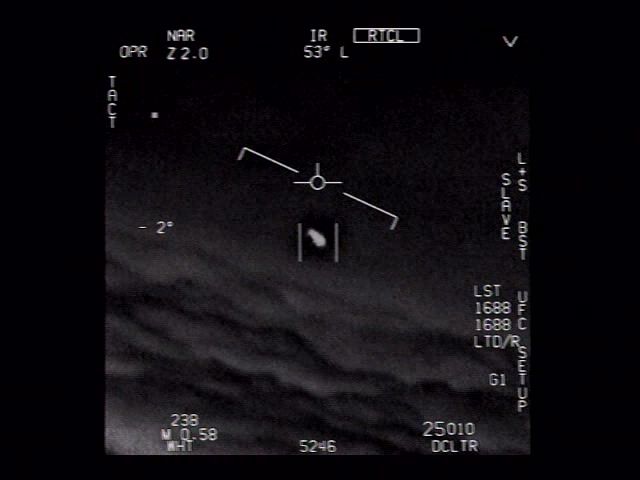
Gimbal is a ~34-second ATFLIR infrared clip recorded by a USS Theodore
Roosevelt F/A-18 crew off the U.S. East Coast in January 2015, showing a
saucer/lozenge-shaped object that appears to halt and dramatically rotate
in mid-air while pilots remark on a "whole fleet" of contacts. Surfaced
by the NYT / To The Stars Academy in December 2017 and officially released
by the Pentagon in April 2020, it remains officially unidentified —
though skeptic Mick West argues the rotation is an infrared glare artifact
of the camera's gimbal mechanism, a heavily contested claim.
Gimbal is the most dramatic of the three Pentagon videos, because of the
apparent rotation that proponents cite as non-conventional flight, and
because the cockpit audio captures multiple aviators reacting in real time
to a FORMATION on radar — not a single blip. It became a centerpiece of
the case that the U.S. government should formally study UAP, feeding the
UAP Task Force and the 2021 ODNI assessment. It is the corpus's prime test
of the instrument-artifact-versus-real-craft question, and a caution against
reading a contested skeptical hypothesis as a settled official resolution.
Timeline
2015-01-21
Recorded by an F/A-18 from the USS Theodore Roosevelt strike group in
the Atlantic warning areas off the East Coast, at ~25,000 ft, ownship
~0.58-0.61 Mach. Cockpit audio: "There's a whole fleet of them" and
"They're all going against the wind. The wind's 120 knots to the west."
witnesses: USS Theodore Roosevelt F/A-18 aircrew (not all publicly named)
primary source: Wikipedia (Pentagon UFO videos); cockpit-audio transcripts
2017-12-16
The New York Times publishes Gimbal (with FLIR1), and To The Stars
Academy releases it publicly, tied to the NYT exposure of the AATIP
program. (GoFast follows separately in March 2018.)
primary source: New York Times, 16 Dec 2017; TTSA
2020-04-27
The Pentagon officially authenticates and releases Gimbal, FLIR1, and
GoFast, confirming they are genuine Navy recordings of objects that
"remain unidentified."
primary source: DoD statement, 27 April 2020
2021-06-25
The ODNI Preliminary Assessment covers 144 reports; 18 showed "unusual
movement patterns" (objects moving against the wind, abrupt maneuvers) —
language consistent with the Gimbal pilots' reports. The report does not
resolve Gimbal.
primary source: ODNI Preliminary Assessment, 25 June 2021
2017_onward
Mick West publishes the rotating-glare hypothesis on Metabunk (a "Gimbal
Glare Explainer" and ATFLIR gimbal-tracking simulations). Critics dispute
it; a 2023 arXiv flight-path reconstruction treats the object as
physically real. As of the 2024 Senate materials, AARO has issued NO
formal Gimbal resolution — it remains officially unresolved.
primary source: Metabunk (Mick West); arXiv 2306.08773; AARO Senate materials (Nov 2024)
Named personnel
- Ryan Graves — Former Navy F/A-18 pilot (VFA-11, USS Theodore Roosevelt); says aviators saw such objects routinely off Virginia Beach rank at time: · later: Recalled the Gimbal object trailed a 'loose wedge formation of four to six objects'; testified to Congress 26 July 2023; founded Americans for Safe Aerospace primary witness to: the broader Roosevelt-era encounter pattern around the Gimbal recording
- Christopher Mellon — Former Deputy Assistant Secretary of Defense for Intelligence; helped route the videos to the press rank at time: role: surfaced the footage into the public record
- Luis Elizondo — Former head of AATIP; resigned October 2017; associated with To The Stars Academy, which publicized the videos rank at time: role: the institutional surfacing of the AATIP context
- Mick West — Science writer and skeptic (Metabunk); principal author of the 'rotation is glare' explanation and ATFLIR gimbal-mechanism simulations rank at time: role: the leading prosaic-explanation analyst
Sensor record
- AN/ASQ-228 ATFLIR (Advanced Targeting Forward-Looking Infrared) on USS Theodore Roosevelt F/A-18F the ~34-second infrared clip of a dark (Black-Hot) saucer/lozenge form that appears to halt and rotate ~90 degrees mid-clip; the rotation is the signature feature and the focus of the glare debate documentation: the publicly released Gimbal video
- Airborne radar / situational-awareness page on the same aircraft (and others in the area) multiple simultaneous contacts — the 'whole fleet' the crew reacted to; the radar 'fleet' is what the single-glare explanation has the hardest time accounting for documentation: cockpit audio; not publicly released as raw radar data
Object — reported
shape
a dark, smooth saucer / lozenge / oval form against a cooler background, with hard, apparently metallic edges in the infrared
size
unestablished — the ATFLIR provides angle and the clip lacks a clean range solution, so no size can be fixed
surface features
featureless in IR; the apparent structure is a thermal silhouette
observed behaviors
- appearing to slow, hover, then rotate ~90 degrees about an apparent axis mid-clip — the signature anomaly
- the crew's report of a 'whole fleet' of contacts on radar / the SA page, and of objects holding station against a ~120-knot wind
- the rotation NOT tracking the horizon during aircraft banks (the object's apparent turn is tied to the camera frame, not the world) — the core of the glare argument
- camera 'bumps' immediately preceding the rotation, consistent with the ATFLIR gimbal traversing a roll-axis singularity
Theories that invoke this case (3)
The proponent reading: a metallic-looking object that halts and
rotates while a formation holds station against a strong wind, on a
military sensor — taken as non-conventional flight if the rotation is
a real object's motion.
The optical reading the corpus weights heavily: the rotating shape may
be infrared GLARE from a distant conventional jet's engines, smeared by
the optics and rotated by the ATFLIR's gimbal de-rotation mechanism —
a sensor/optics artifact, not a craft.
The cautious reading: if the radar 'fleet' is real and independent of
the IR glare, some real objects were present, and the case is a data
point demanding the raw radar and pod telemetry rather than a verdict.
Theories that do NOT invoke this case — and why
no entity observed — an aerial sensor target
no associated phenomenology beyond the infrared video and radar contacts
an instrument recording by professional aircrew, not a mass-perception event
Conventional explanations advanced — and their status
ATFLIR rotating-glare artifact (the rotation is camera-bound glare, not a turning object)
proponents: Mick West (Metabunk)
The leading prosaic explanation. West argues the bright shape is engine glare from a distant jet, and the 'rotation' occurs when the ATFLIR gimbal crosses a roll-axis singularity and the de-rotation mechanism corrects, so the glare (fixed to the glass) rotates relative to the screen. Supported by: the shape not rotating with the horizon during banks, camera bumps preceding the rotation, and documented glare in FLIR1. A HYPOTHESIS, not an official resolution.
Counterarguments to the glare model
proponents: various Metabunk critics; the arXiv 2306.08773 authors
Critics argue the glare model does not fully reproduce the shape change, that ATFLIR's optics may not produce such glare, and that it cannot explain the simultaneous RADAR 'fleet'. West concedes he does not fully 3D-position the object and the clip ends before the gimbal traversal completes.
A genuine unidentified craft
proponents: To The Stars Academy; some analysts
The proponent position. Rests on the apparent rotation and the radar fleet being real object behavior rather than artifact. Unresolved on the public data.
Where further investigation has leverage
- Release of the full-length, uncut ATFLIR video and the synchronized radar / SA-page data showing the 'fleet', to test whether multiple objects existed independently of the IR sensor.
- The raw ATFLIR pod telemetry (gimbal angles, de-rotation log, exact azimuth/elevation/roll), to confirm or refute that the rotation coincides with a gimbal singularity.
- Corroborating second-sensor data (a second aircraft's ATFLIR, ship radar tracks) at the same time and place.
- A reproducible optical-bench or engineering demonstration that ATFLIR glare can or cannot produce the observed sharp-edged rotating shape.
Corpus status
disputed-optical-artifact
Officially authenticated and still officially unidentified — AARO has issued
no Gimbal resolution, unlike GoFast. The leading prosaic explanation (an
ATFLIR rotating-glare artifact) is technically serious and well-argued, and
is the corpus's weighted reading for the visual rotation; but it is a
contested HYPOTHESIS, not an official resolution, and it has the hardest
time accounting for the simultaneous radar 'fleet'. The honest status is a
disputed optical artifact whose decisive test is the unreleased raw radar
and pod telemetry.
status history (1)
2026-06-09 · unannotated → disputed-optical-artifact
— annotated before the 2026-06-09 sweep; history begins at seeding