GoFast Video disputed-optical-artifact
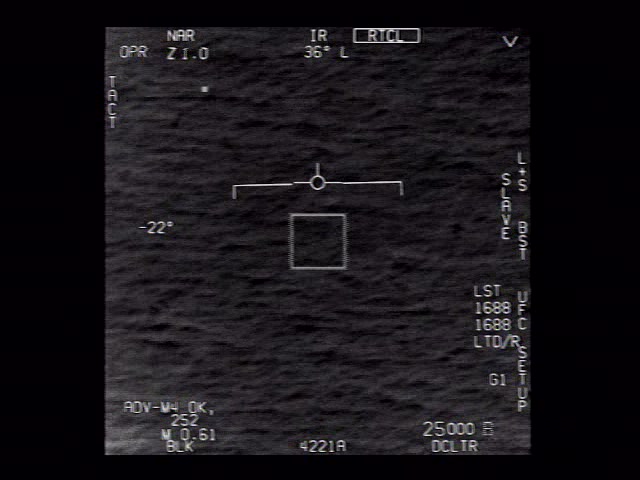
GoFast is an ATFLIR infrared clip recorded by a USS Theodore Roosevelt
F/A-18 in January 2015 off the U.S. East Coast, showing an object that
appears to race low and fast just above the ocean. Surfaced by To The
Stars Academy in March 2018 and officially released by the Pentagon in
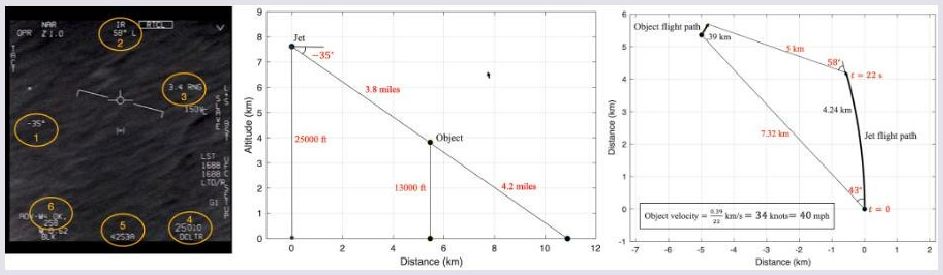
April 2020, its on-screen geometry actually implies the object is at
altitude (~13,000 ft) and moving slowly — the apparent speed is a
parallax illusion produced by the fast-moving jet, a conclusion reached
independently by skeptic Mick West and, in February 2025, by the
Pentagon's AARO.
GoFast is the corpus's cleanest example of how a UAP video can look
extraordinary yet resolve to mundane physics once the displayed sensor
data is run through trigonometry. It is the case where the official
government office (AARO) and the leading skeptic (Mick West) converge,
making it the strongest counterweight to sensational framing — and a
cautionary tale about trusting visual impression over geometry. It is the
first of the three famous Pentagon videos that AARO has formally written
up as resolved.
Timeline
2015-01-21
Recorded by an F/A-18 from the USS Theodore Roosevelt strike group in
the Atlantic off the East Coast; on-screen range to target reads ~4.4
nautical miles, ownship ~350-400 knots. The crew get audibly excited
("Woo-hoo!") as they lock the apparently fast, low object.
witnesses: USS Theodore Roosevelt F/A-18 aircrew
primary source: Wikipedia (Pentagon UFO videos); AARO methodology
2018-03-09
To The Stars Academy releases GoFast as the third of its videos —
separately from FLIR1 and Gimbal, which went out with the NYT story in
December 2017.
primary source: TTSA; Metabunk
2020-04-27
The Pentagon officially authenticates and releases all three videos
including GoFast; the objects "remain unidentified."
primary source: DoD statement, 27 April 2020
2018_to_2021
Mick West and Metabunk publish parallax and triangulation analyses
(later via the "Sitrec" simulator), using the displayed azimuth,
elevation, range, and the aircraft's velocity to back out the object's
true position — a slow object at ~13,000 ft, not a fast one at the
surface. Early triangulation gives roughly 30-50 knots.
primary source: Metabunk (Mick West)
2024-11-19
AARO Director Jon Kosloski presents the GoFast parallax findings to the
Senate, alongside other resolved cases.
primary source: DefenseScoop; AARO Senate slides (Nov 2024)
2025-02-06
AARO publishes its formal GoFast Case Resolution Card / Methodology,
concluding (with high confidence) no anomalous flight characteristics:
the object is at altitude moving slowly, consistent with the winds
aloft, and the dramatic apparent speed is motion parallax. AARO modeled
it at roughly 5-92 mph after subtracting windspeed (~45 mph central
estimate). The object's exact identity (a balloon or bird) is not
positively confirmed — only that its kinematics are unremarkable.
primary source: AARO GoFast Case Resolution, 6 Feb 2025; CBS News
Named personnel
- Dr. Jon Kosloski — Director of AARO; publicly presented the GoFast parallax resolution to the Senate (Nov 2024) rank at time: role: the official resolution of the case
- Mick West — Science writer and skeptic (Metabunk); first widely-credited analyst to compute the high-altitude, slow result via on-screen angular data; developed the Sitrec tool rank at time: role: the independent analysis that AARO's resolution later matched
- Ryan Graves — USS Theodore Roosevelt F/A-18 pilot who contextualizes GoFast within the routine Roosevelt-era encounters rank at time: role: the pilot-witness context
- To The Stars Academy (Mellon / Elizondo / DeLonge) — Surfaced and publicized the footage rank at time: role: the public release of the video
Sensor record
- AN/ASQ-228 ATFLIR on USS Theodore Roosevelt F/A-18F (ownship ~350-400 knots) infrared track of a small object appearing to skim fast over the ocean; on-screen range ~4.4 nm; the displayed azimuth/elevation/range are exactly the data that resolve the case by triangulation documentation: the publicly released GoFast video; AARO's geospatial model
Object — reported
shape
a small, featureless infrared blob; no resolved structure
size
indeterminate; never positively identified, though the kinematics are consistent with a balloon or bird drifting at altitude
surface features
none resolved
observed behaviors
- APPEARING to race fast and low over the water — the visual impression that named the clip
- ACTUALLY at ~13,000 ft moving slowly (roughly 45 mph central estimate, after wind subtraction) — the apparent speed is motion parallax from the fast camera platform
- the narrow elevation angle to a target 4.4 nm away placing it at altitude, not at the surface — the decisive geometric fact
- no abrupt maneuvers or anti-wind station-keeping once the geometry is corrected — i.e. no anomalous flight characteristics
Theories that invoke this case (3)
The broadened mundane reading the corpus endorses, and the one AARO and
Mick West converge on: a slow object at altitude (plausibly a balloon
or bird) whose dramatic apparent speed is purely motion parallax — an
optical/geometric effect, not anomalous flight.
The institutional reading: GoFast is the first of the three famous
videos AARO formally resolved, making it the model of how the official
apparatus is supposed to de-anomalize a sensational clip with published
methodology.
The proponent reading the case was originally marketed under (a fast,
low object with no visible propulsion) — recorded by the corpus as the
framing that the geometry overturned.
Theories that do NOT invoke this case — and why
the resolved geometry shows unremarkable kinematics — there is no anomalous physical behavior left to explain
no entity observed
no associated phenomenology beyond a misread infrared track
Conventional explanations advanced — and their status
Parallax — a slow object at altitude that only LOOKS fast
proponents: Mick West (Metabunk, ~2018) · AARO (6 Feb 2025)
The strong, now-OFFICIAL explanation, and a rare convergence of the leading skeptic and the government office. Using the displayed angles, range, and the jet's velocity, the object resolves to ~13,000 ft moving slowly with the winds aloft; the apparent speed is motion parallax. AARO assessed no anomalous flight characteristics with high confidence.
A balloon or bird drifting at altitude
proponents: AARO (candidate identities); Metabunk
The likely identity of the (non-anomalous) object, discussed but not positively confirmed — only the kinematics are settled, not the exact object.
A genuine fast, low, propulsion-less craft
proponents: To The Stars Academy (original framing)
Overturned by the geometry. The 'unidentified' label persisted 2020-2024, but AARO's parallax resolution removed the anomaly; the weaker residual claim is only that the object was never positively ID'd.
Where further investigation has leverage
- Release of the full ATFLIR clip and pod telemetry (continuous range/azimuth/elevation), so the triangulation does not depend on a few legible frames.
- Independent reproduction of AARO's geospatial / trig model with fully published inputs (the methodology card is a start).
- Corroborating radar or second-aircraft track establishing the object's range independent of the optical parallax.
- A positive object ID (a recovered balloon flight log, a bird identification, a drone), which would convert 'non-anomalous motion' into a fully closed case.
Corpus status
disputed-optical-artifact
Effectively resolved: both the leading skeptic (Mick West, 2018) and the
Pentagon's own office (AARO, Feb 2025) conclude the object is at altitude
moving slowly, and the dramatic apparent speed is motion parallax from the
fast jet — no anomalous flight characteristics. The exact identity (a
balloon or bird) is not positively confirmed, which is the only sense in
which it remains "open." The corpus files it as the cleanest case of
geometry beating visual impression, and the model of how the apparatus is
supposed to de-anomalize a sensational clip.
status history (1)
2026-06-09 · unannotated → disputed-optical-artifact
— annotated before the 2026-06-09 sweep; history begins at seeding