David Grusch House Oversight testimony (26 July 2023) apparatus-event
A former National Reconnaissance Office and National Geospatial-
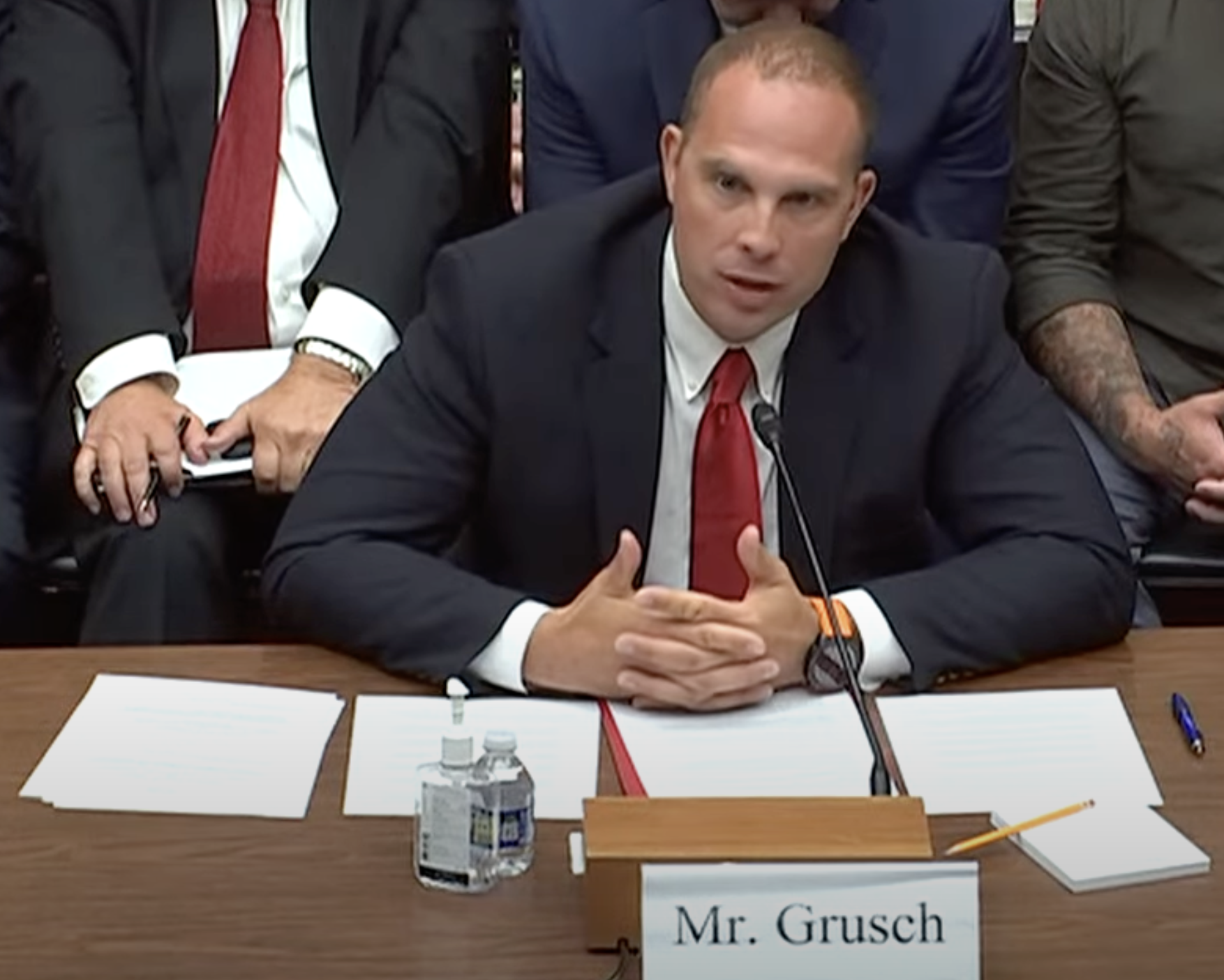
Intelligence Agency officer, David Charles Grusch, testified under oath
before a House Oversight subcommittee that the United States operates a
decades-long, concealed program to retrieve and reverse-engineer
craft of 'nonhuman' origin — claims he says are based on the testimony
of officials he interviewed and which he has provided to the Intelligence
Community Inspector General, but for which he presented no physical
evidence in open session.
The 26 July 2023 hearing is the highest-status point the disclosure
process has reached in the public record: a sworn claim of a concealed
retrieval program, made by a named officer with an active security
clearance history, ruled an 'urgent and credible' complaint by the
Intelligence Community Inspector General, and heard in a congressional
committee room. It is also the corpus's cleanest worked example of the
epistemic gap the whole field turns on — the distance between a
credible-process claim (this followed every formal whistleblower channel)
and a corroborated fact (the underlying material has never been shown).
Every theory in the corpus that touches institutional concealment routes
through this hearing.
Timeline
2019-2021_approx
Maj. David Grusch (USAF, ret.) serves as the National Reconnaissance
Office's representative to the UAP Task Force, and from 2021 to 2022 as
the National Geospatial-Intelligence Agency's co-lead for UAP analysis.
In this role, by his account, he is tasked with investigating UAP and
comes to be told by other officials of a concealed retrieval program.
witnesses: David Charles Grusch (then a serving intelligence officer)
primary source: Grusch biography as stated in his testimony and The Debrief reporting
2022-05
Grusch files a complaint with the Intelligence Community Inspector
General (ICIG) and provides classified information to the ICIG and to
the congressional intelligence committees, alleging illegal withholding
of information from Congress regarding a UAP retrieval program.
primary source: ICIG correspondence referenced in The Debrief, June 2023
2022-07
The ICIG finds Grusch's complaint of reprisal 'credible and urgent,'
a statutory determination that routes the complaint to the
congressional intelligence committees. (The 'credible and urgent'
finding concerns the reprisal complaint's processing, not a finding
that the underlying retrieval-program claim is true — a distinction
frequently collapsed in coverage.)
primary source: ICIG determination as reported by The Debrief, June 2023
2023-06-05
The Debrief publishes 'Intelligence Officials Say U.S. Has Retrieved
Craft of Non-Human Origin,' by Leslie Kean and Ralph Blumenthal (the
same journalists behind the 2017 NYT AATIP article). Grusch goes public
by name with his allegations; the story is picked up worldwide.
primary source: The Debrief, 5 June 2023
2023-07-26
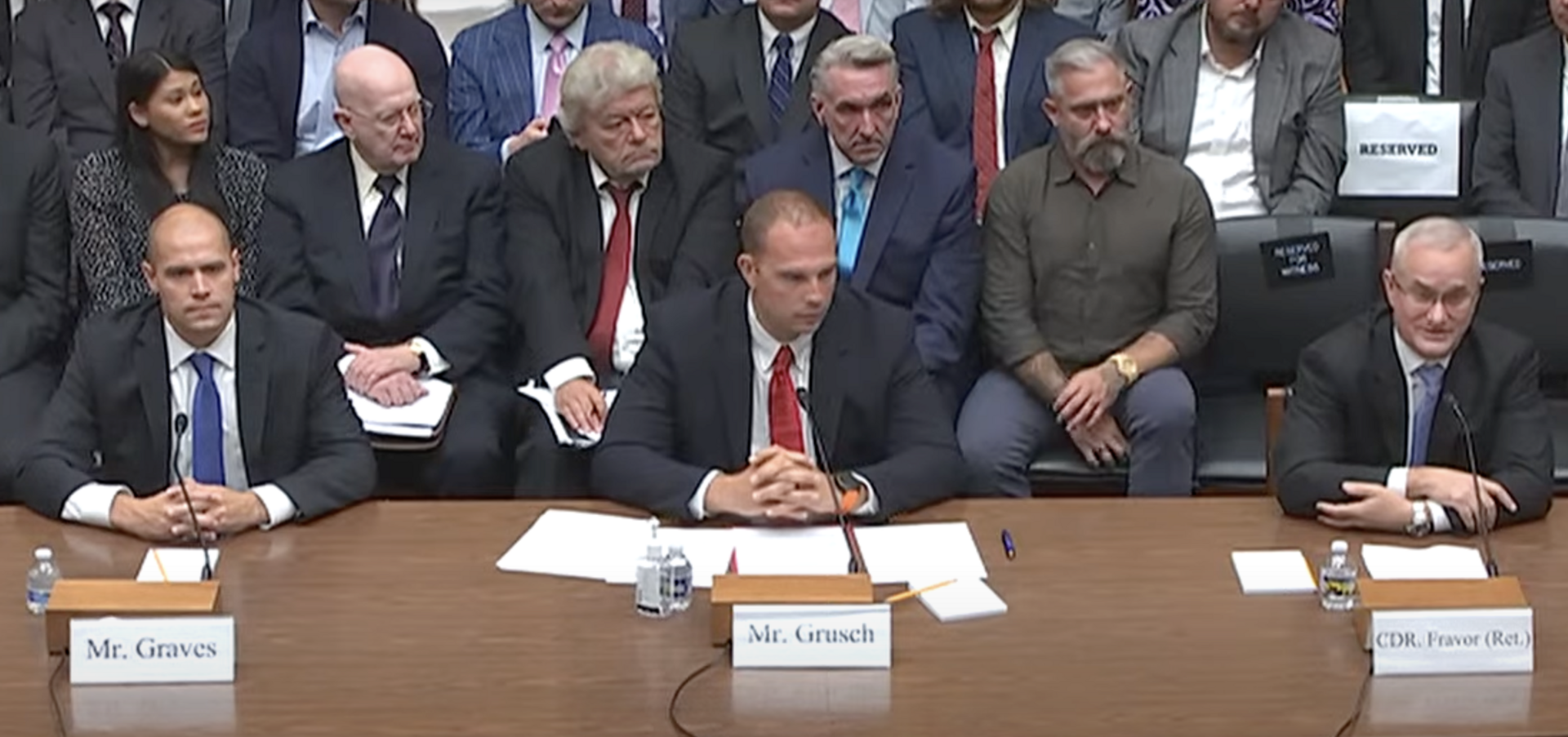
The House Oversight Subcommittee on National Security, the Border, and
Foreign Affairs holds 'Unidentified Anomalous Phenomena: Implications
on National Security, Public Safety, and Government Transparency.'
Three witnesses testify under oath: David Grusch, retired Navy
Cdr. David Fravor (the Nimitz pilot), and former Navy pilot Ryan Graves.
Grusch testifies he was informed of a 'multi-decade' program to retrieve
and reverse-engineer craft of nonhuman origin, that he interviewed
officials with direct knowledge, and that 'biologics' were recovered
from some craft. He repeatedly states he cannot give specifics in open
session but has provided them to the ICIG and Congress in classified
settings.
witnesses: David Charles Grusch · Cdr. David Fravor (ret.) · Ryan Graves
primary source: House Oversight Subcommittee hearing transcript and video, 26 July 2023
2023-07-26
Fravor recounts the 2004 Nimitz encounter (see the nimitz deep dive);
Graves frames the 2014–2015 Roosevelt encounters as a flight-safety
and aircrew-reporting problem (see the roosevelt deep dive). Members of
both parties express frustration at the Department of Defense's refusal
to provide a witness or classified briefing for the hearing.
primary source: Hearing transcript, 26 July 2023
2023-07-27
The Department of Defense, via spokesperson Sue Gough, states that
investigators have 'not discovered any verifiable information to
substantiate claims that any programs regarding the possession or
reverse-engineering of extraterrestrial materials have existed in the
past or exist currently' — AARO's standing position.
primary source: DoD statement, 27 July 2023
2023-07
The Senate, led by Majority Leader Chuck Schumer and Sen. Mike Rounds,
introduces the UAP Disclosure Act of 2023 as an amendment to the FY2024
National Defense Authorization Act, proposing a records-review board
modeled on the JFK Assassination Records Collection Act and an
'eminent domain' provision over recovered material. (See the
schumer-rounds-2023 corpus entry.)
primary source: UAP Disclosure Act of 2023; Congressional Record, July 2023
2024-03
AARO's Historical Record Report Volume 1 concludes that no evidence
supports the existence of recovered-nonhuman-craft programs, and
addresses (without naming Grusch) the category of claims he advanced.
Grusch's allegation and AARO's denial remain the two unreconciled
poles of the public record.
primary source: AARO Historical Record Report Volume 1, March 2024
Named personnel
- David Charles Grusch — Former USAF officer (Afghanistan combat veteran); NRO representative to the UAP Task Force; NGA co-lead for UAP analysis (2021–2022) rank at time: Major (USAF, ret.); GS-15-equivalent civilian intelligence officer · later: Public whistleblower; the central witness of the hearing primary witness to: the alleged concealed retrieval program — by his account, secondhand, via officials he interviewed; he states he did not personally see craft or biologics
- Cdr. David Fravor (ret.) — Nimitz Tic-Tac pilot; co-witness rank at time: primary witness to: firsthand account of the 2004 Nimitz encounter (see nimitz deep dive)
- Ryan Graves — Former Navy F/A-18 pilot; co-witness; founder of Americans for Safe Aerospace rank at time: primary witness to: firsthand account of the 2014–2015 Roosevelt encounters (see roosevelt deep dive)
- Rep. Tim Burchett (R-TN) and Rep. Robert Garcia (D-CA) — Subcommittee members who drove the hearing rank at time: role: Bipartisan congressional sponsorship of the inquiry
- Leslie Kean and Ralph Blumenthal — Journalists rank at time: role: Surfaced Grusch's claims (The Debrief, June 2023); the same pair surfaced AATIP (NYT, 2017)
- Inspector General of the Intelligence Community (ICIG) — Statutory whistleblower-complaint authority rank at time: role: Found Grusch's reprisal complaint 'credible and urgent,' routing it to Congress
Theories that invoke this case (5)
The strongest single data point for the disclosure-imminence reading:
a sworn congressional claim of a concealed program, plus a legislative
response (the UAP Disclosure Act) modeled on the JFK records framework.
Read as evidence the government is being forced toward disclosure.
The skeptical-institutional reading. Grusch's claims are secondhand;
some argue the 'crash retrieval' lore he reports could itself be a
decades-old counterintelligence construct (the Bennewitz-style seeding
of disinformation), making Grusch a sincere transmitter of a planted
narrative rather than a witness to a real program.
The literal reading. If the retrieval-and-'biologics' claim is true at
face value, it is the ETH's strongest institutional corroboration —
contingent entirely on evidence not yet produced.
The mundane-concealment reading. A genuinely concealed program may
exist but concern terrestrial advanced aerospace or misattributed
foreign technology, with 'nonhuman' framing arising from compartmented
misunderstanding.
The institutional-handling reading. The hearing is itself the object
of study: how a claim moves from a compartmented program through the
ICIG, into journalism, into a hearing room, and into legislation — the
machinery of the record-production process.
Theories that do NOT invoke this case — and why
the event is a documented institutional process (sworn testimony, statutory complaint, legislation), not a phenomenology report subject to a mass-psychology reading
no phenomenology at the center of the case; the claim concerns material craft and concealment, not anomalous perceptual events
no entity sighting; the 'biologics' claim is reported secondhand and unverified, not an observed encounter
no time-displacement element in the testimony
Conventional explanations advanced — and their status
Grusch is a sincere witness relaying secondhand claims that are themselves false or planted
proponents: AARO (implicitly) · Mick West · various skeptics
The most parsimonious skeptical reading consistent with Grusch's apparent sincerity: he believes what he was told, but what he was told may be untrue or a deliberate construct. Cannot be confirmed or refuted without the classified material he provided to the ICIG. Overlaps directly with the counterintelligence-product hypothesis.
The claims are true and the evidence is being lawfully withheld in classified channels
proponents: Grusch · UAP-disclosure advocates
Consistent with Grusch's own framing and with the existence of a routed ICIG complaint, but unverifiable from the open record. The 'credible and urgent' ICIG finding pertains to the reprisal complaint's processing, not to the truth of the retrieval claim.
AARO's denial is accurate; no such program exists
proponents: Department of Defense · AARO
AARO's March 2024 report is the formal government position. Critics (including AARO's own statutory sponsor, Sen. Gillibrand) called the report 'incomplete'; AARO did not have access to, or did not address, every compartmented program Grusch alleges. The denial and the allegation remain unreconciled.
Where further investigation has leverage
- Declassification or congressional release of the specific information Grusch provided to the ICIG and the intelligence committees in classified session.
- On-record, named testimony from any of the ~40 officials Grusch states he interviewed — the secondhand structure of his claim is its central evidentiary weakness.
- Operation of the UAP Disclosure Act's proposed records-review board (or an equivalent), which would convert the question from testimony to documents.
- An AARO or independent accounting that explicitly addresses each program Grusch named, rather than a categorical denial.
- Resolution of whether any 'crash retrieval' lore Grusch encountered traces to documented disinformation operations (the Bennewitz precedent), which would distinguish the counterintelligence-product reading from a real program.
Corpus status
apparatus-event
Testimony, unverified. The highest-status testimony event in the corpus: a sworn congressional
claim of a concealed nonhuman-craft retrieval program, made by a named
officer with a routed ICIG complaint, met by a categorical Department of
Defense denial. What is documented — the claim, the process, the
legislative response — is solid; what is established about the underlying
material is nothing. The case is the corpus's reference point for the gap
between a credible process and a corroborated fact.
status history (1)
2026-06-09 · unannotated → apparatus-event
— initial annotation sweep (Epic J.F4)
Suggested watching
interview · 2023 · C-SPAN / YouTube
House Oversight Subcommittee on National Security — UAP Hearing
The July 26 2023 hearing with Grusch, Fravor, and Graves under oath.
Threads of evidence
This case is one node in the connections that run across the record. It appears in 2 threads:
The Leslie Kean disclosure nexus
— Kean and Blumenthal broke the Grusch claims in The Debrief (2023).
The crash-retrieval claim lineage
— The modern apex: sworn House testimony asserting a multi-decade craft-retrieval program — delivered on second-hand authority, with the underlying evidence held in classified channels.