Mexico City Eclipse UFO disputed-optical-artifact
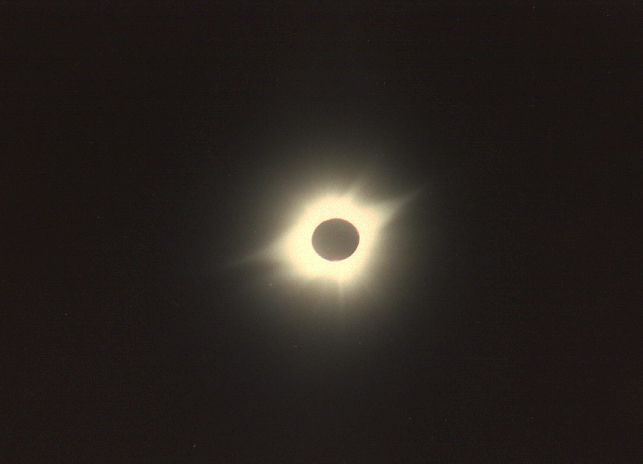
During the total solar eclipse over Mexico City on 11 July 1991,
numerous people videotaped a bright object hanging in the darkened
daytime sky. Promoted heavily by TV journalist Jaime Maussan, it
launched a multi-year Mexican "UFO wave" and became one of the first
mass-camcorder UFO events. The leading and well-supported explanation is
that the object was the planet Venus — naked-eye visible near the Sun
once an eclipse darkens the sky — and Maussan is a discredited promoter
later tied to the 2023 "Nazca alien mummies" hoax.
The Mexico City eclipse UFO is the corpus's reference case for the dawn
of the video-UFO era and for a single celestial explanation confronting
mass enthusiasm. The 1991 eclipse coincided with the spread of consumer
camcorders, so dozens of people filmed the sky at once and a similar
object appears across many independent clips — the very feature
promoters cite as proof. But that is exactly what a distant point-source
like Venus produces: no parallax, the same sky position from everywhere.
It is also the headwater of Jaime Maussan's decades of UFO media, much
of it later debunked — a case study in how a mundane event becomes a
durable myth under a motivated promoter.
Timeline
1991-07-11
A total solar eclipse crosses Mexico, with totality over Mexico City
(one of the longest total eclipses of the 20th century, greatest
duration ~6m 53s). During totality, when the sky darkens, observers
videotape a bright object. Cameraman Guillermo Arreguin is commonly
named as an early videographer (his name and exact location are
contested across sources).
witnesses: Guillermo Arreguin (named early videographer — sourcing weak)
primary source: Wikipedia (eclipse); UFO advocacy sources for the videographer
1991-07_mid
About a week later, Jaime Maussan broadcasts the footage on his
Televisa program; thousands of viewers call in claiming the same
sighting and submit their own tapes. Roughly 17 independent videos
from ~17 locations are reportedly collected. (These counts and the
"~40,000 witnesses" figure trace to promotional sources, not
independent audits, and are presented as claimed.)
witnesses: Jaime Maussan (TV journalist and promoter)
primary source: UFO Casebook; RationalWiki (secondary); flagged as advocacy-sourced
1991-1999
A sustained "Mexican UFO wave" follows through the 1990s — thousands
of reported sightings and videos around Mexico City, fueled by
camcorder proliferation and Maussan's broadcasts.
primary source: Wikipedia (UFO sightings in Mexico)
1990s_skeptical
Amateur astronomer Tim Printy publishes a detailed analysis
concluding the object in almost all the tapes is Venus — at ~40%
illumination (a crescent/half-disc phase), 35 arcseconds across, a few
degrees from the star Regulus, east of the Sun and visible once
totality darkened the sky. Robert Sheaffer endorses the Venus reading.
primary source: astronomyufo.com (Printy); Skeptical Inquirer (Sheaffer)
2023-09-13
Maussan presents two small "non-human" bodies to the Mexican Congress
under oath, claiming ~1,000-year-old Nazca-region remains. On 12
January 2024 Peruvian forensic archaeologist Flavio Estrada declares
the specimens fabricated dolls of animal and human bones and calls
Maussan's group "pseudo-scientists." This caps a long pattern (the
2015 Roswell slides, the Metepec creature, a 2016 'demon fairy') that
is why his 1991 promotion is treated with deep suspicion.
primary source: CBS News; Smithsonian; Wikipedia
Named personnel
- Jaime Maussan — Mexican journalist / TV personality and ufologist; the promoter who broadcast the eclipse footage and built his career on the wave rank at time: · later: Documented serial promoter of fabrications: the 2015 Roswell slides, the Metepec creature, a 2016 'demon fairy', and the 2023 Nazca 'alien mummies' — credibility very low role: the figure who converted a celestial misidentification into a national phenomenon
- Guillermo Arreguin — Named across sources as the early videographer whose footage Maussan aired rank at time: role: the originating clip — though his name and location are contested and weakly sourced
- Tim Printy — Amateur astronomer and UFO skeptic; author of the principal Venus analysis rank at time: role: the technical case for the mundane explanation
- Robert Sheaffer — Skeptical Inquirer UFO columnist who endorsed the Venus identification rank at time: role: framed the episode as the start of the Mexican 'UFO Blitz'
- Flavio Estrada — Peruvian forensic archaeologist who declared Maussan's 2024 Nazca mummies fabricated rank at time: role: the most recent confirmation of Maussan's unreliability
Sensor record
- Consumer VHS camcorders (mass, uncoordinated) on dozens of independent eyewitnesses across Mexico City a bright object in the darkened totality sky, appearing in the same sky position across widely separated locations — consistent with a distant celestial body, not a nearby craft documentation: the submitted videotapes; ~17 reportedly collected (advocacy-sourced)
- Astronomical cross-check (planetarium / ephemeris) on Tim Printy's analysis matched the object's phase (~40% illuminated), size (35 arcsec), and position (near Regulus, east of the Sun) to Venus; identified a thin dark line under the disc as a camcorder CCD artifact, not a craft base documentation: astronomyufo.com
Object — reported
shape
a shiny, metallic, disc- or domed-disc-shaped object — consistent with Venus at ~40% illumination (a crescent/half-disc phase) seen through camcorder zoom
size
apparent; never fixed by parallax — Venus subtended ~35 arcseconds that day
surface features
an apparent 'dark line/shadow' beneath the disc, attributed to a CCD artifact the camera inserts beneath any bright point against a blank sky
observed behaviors
- appeared to hover in the same area of the darkened sky from widely separated locations — i.e., NO parallax, the signature of a distant celestial body
- apparent jitter and 'movement' attributable to extreme zoom and hand motion, not the object
- in some frames a nearby star (Regulus) and Mars appear in astronomically correct relative positions — strong evidence the bright object is Venus
- no credentialed astronomer actively observing the eclipse reported any anomalous object
Theories that invoke this case (3)
The closest fit to the mundane reading the corpus endorses, broadened
to celestial optics: a bright natural object (Venus) made visible by
the eclipse and rendered disc-like by camcorder optics and a CCD
artifact — an optical, not a craft, phenomenon.
The promoter position (Maussan and allies): many independent cameras,
many locations, the same metallic 'craft' — taken as proof of a real
object. The corpus records that this is exactly the pattern a distant
point-source produces, and that the chief promoter is discredited.
The mass-enthusiasm reading: a televised prompt during a once-in-a-
lifetime eclipse, plus new camcorders, manufactured a wave of
submissions around a single celestial misidentification.
Theories that do NOT invoke this case — and why
no material, instrument data, or close-range record — only zoomed camcorder footage of a distant point of light
no entity observed — a single bright aerial object
no associated phenomenology beyond the videotaped light
Conventional explanations advanced — and their status
The planet Venus
proponents: Tim Printy · Robert Sheaffer (Skeptical Inquirer)
The leading, mainstream explanation, and well-supported. Venus was at ~40% phase, 35 arcsec, a few degrees from Regulus, east of the Sun, and visible once totality darkened the sky; the disc shape (crescent phase), the 'shadow' (CCD artifact), the absence of parallax (same position everywhere), and the stellar companions in some frames all fit. Sources hedge only to 'most, if not all' clips.
Jupiter or other celestial objects (for a subset of tapes)
proponents: Printy; general skeptical position
Jupiter was also east of the Sun and visible; some clips may show it or other bright objects. Secondary.
Conventional aircraft, balloons, or misidentification
proponents: general skeptical position
Plausible for a subset of the many uncoordinated submissions, which were not a single observation.
Hoax / promotional inflation
proponents: skeptics, re: the broader wave
Not the explanation for the 1991 eclipse object itself, but central to the broader wave — Maussan solicited and amplified submissions, and at least one later flagship video (the 1997 'Las Lomas' saucer) is widely regarded as CGI.
Where further investigation has leverage
- A credentialed astronomer's contemporaneous (11 July 1991) report of an anomalous object — none exists, which is itself telling.
- Frame-by-frame photometry/astrometry from an independently-provenanced original tape showing the object's position is INCONSISTENT with Venus's known ephemeris, or showing genuine parallax between two precisely-located, time-synced cameras.
- A clip demonstrating angular motion relative to the background stars (Regulus / Mars) that Venus could not produce.
- Independent (non-Maussan, non-advocacy) verification of the '17 videos / 17 locations / ~40,000 witnesses' provenance, which currently traces only to promotional sources.
Corpus status
disputed-optical-artifact
The leading explanation — the planet Venus, made naked-eye visible by the
eclipse and rendered disc-like by camcorder optics — is well supported and
accounts for the object's appearance, its hovering in the same sky position
from everywhere (no parallax), the 'shadow' beneath it (a CCD artifact),
and the correctly-placed stars in some frames. The case is not a credible
unknown; it is a mass misidentification amplified by a once-in-a-lifetime
eclipse, new camcorders, and a promoter (Maussan) whose later career is a
catalogue of fabrications. Its lasting weight is as the opening of the
video-UFO era, not as evidence.
status history (1)
2026-06-09 · unannotated → disputed-optical-artifact
— initial annotation sweep (Epic J.F4)
Threads of evidence
This case is one node in the connections that run across the record. It appears in 1 thread: