Puma Punku conventional-explanation-suffices
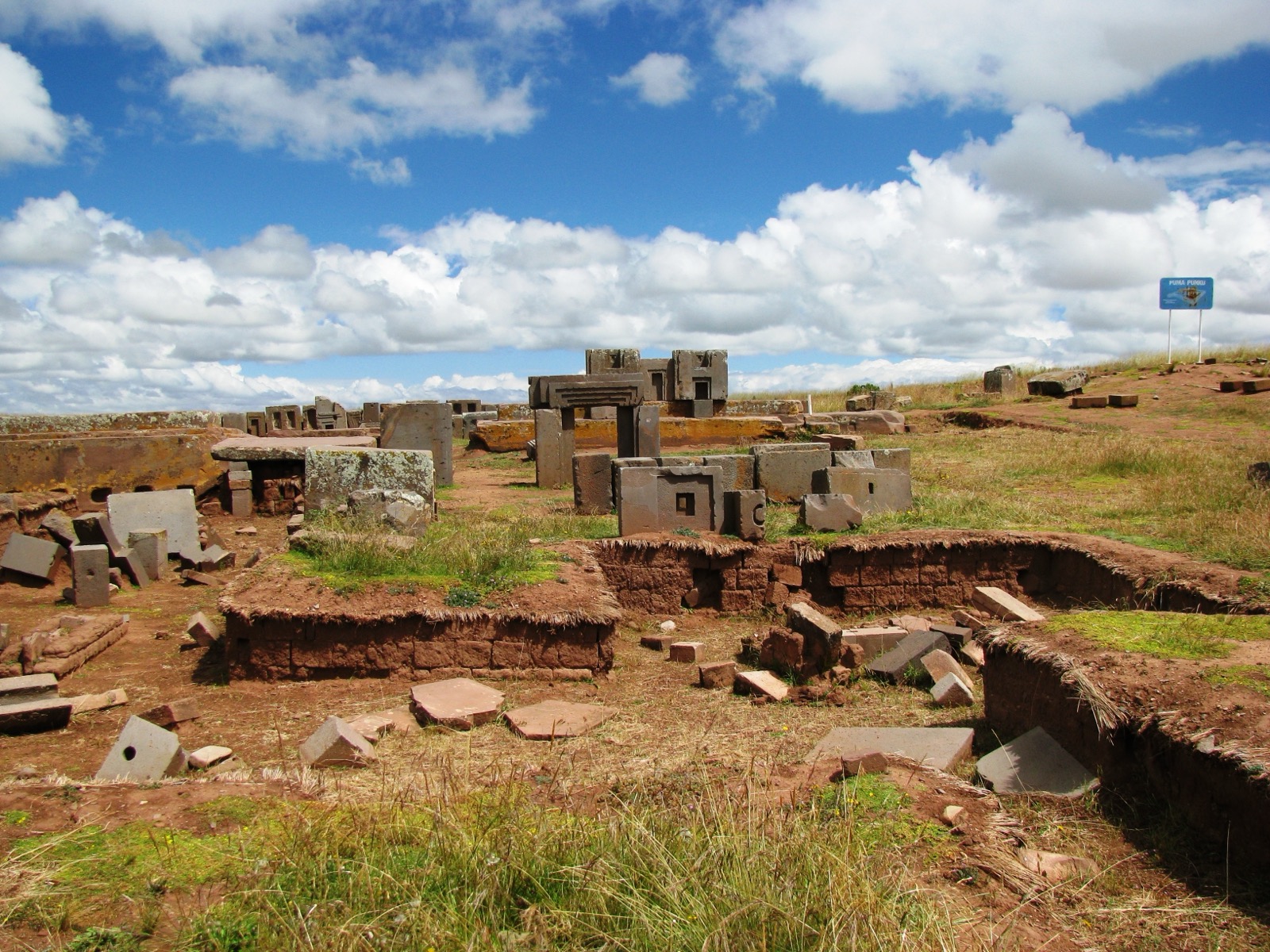
A Tiwanaku platform mound near Lake Titicaca whose interlocking andesite 'H-blocks' are the single most-shown 'impossible' masonry on Ancient Aliens — and which experimental archaeology reproduces with stone tools.
Puma Punku is the genre's favourite 'machined by aliens' exhibit. It is the right place to show the full anatomy of the claim and its refutation: precision masonry, a 'no antecedents' assertion, and the two independent ways the assertion fails — replication and local developmental sequence.
Timeline
c. AD 536–600
Initial construction, per radiocarbon dating of organic material in the lowest mound layer (1510 ±25 BP); stone superstructure somewhat later.
primary source: Vranich; Tiwanaku radiocarbon programme
19th–20th c.
European and Bolivian surveys document the scattered andesite blocks; the precision joints draw early 'lost technology' speculation.
primary source: Posnansky and later surveys
2000s
Protzen and Nair document the masonry technique; Stella Nair experimentally reproduces the joints with stone tools.
witnesses: Stella Nair · Jean-Pierre Protzen
primary source: Protzen & Nair, The Stones of Tiahuanaco
Named personnel
- Stella Nair — Architectural historian / experimental archaeologist rank at time: Scholar of Andean architecture primary witness to: Replication of Puma Punku's precision joints using flint, obsidian, and agate
Object — reported
shape
size
surface features
observed behaviors
Theories that invoke this case (1)
The geometric precision, hard andesite, and high-altitude setting are presented as beyond Andean capability — implying machine tools or non-human builders.
Theories that do NOT invoke this case — and why
No contemporary phenomenology; the claim is about deep-time construction, not present-day craft.
Conventional explanations advanced — and their status
Sophisticated stonemasonry by the Tiwanaku civilisation. Sandstone hauled ~10 km, andesite ~90 km across Lake Titicaca; joints cut with hard stone tools and bound with cast-bronze cramps. The precision is skill and time, not exotic technology.
proponents: Jean-Pierre Protzen · Stella Nair · mainstream Andean archaeology
Accepted.
The 'no antecedents' premise is false: precursor sites at Chiripa (c. 550 BC–AD 100) and Pukara show the local architectural evolution leading to Tiwanaku.
proponents: Andean archaeology
Accepted; directly refutes the AAH 'out of nowhere' framing.
Where further investigation has leverage
- Further provenance and tool-mark analysis continues to close the (already small) gap between documented technique and observed precision.
- Wider publication of the Chiripa/Pukara developmental sequence undercuts the 'no antecedents' rhetoric at the source.
Corpus status
conventional-explanation-suffices
The masonry is a Tiwanaku achievement. Replication with period tools and a documented local antecedent sequence together dissolve the 'impossible' framing. Catalogued as evidence cited for the ancient-astronaut hypothesis that, examined, tells against it.