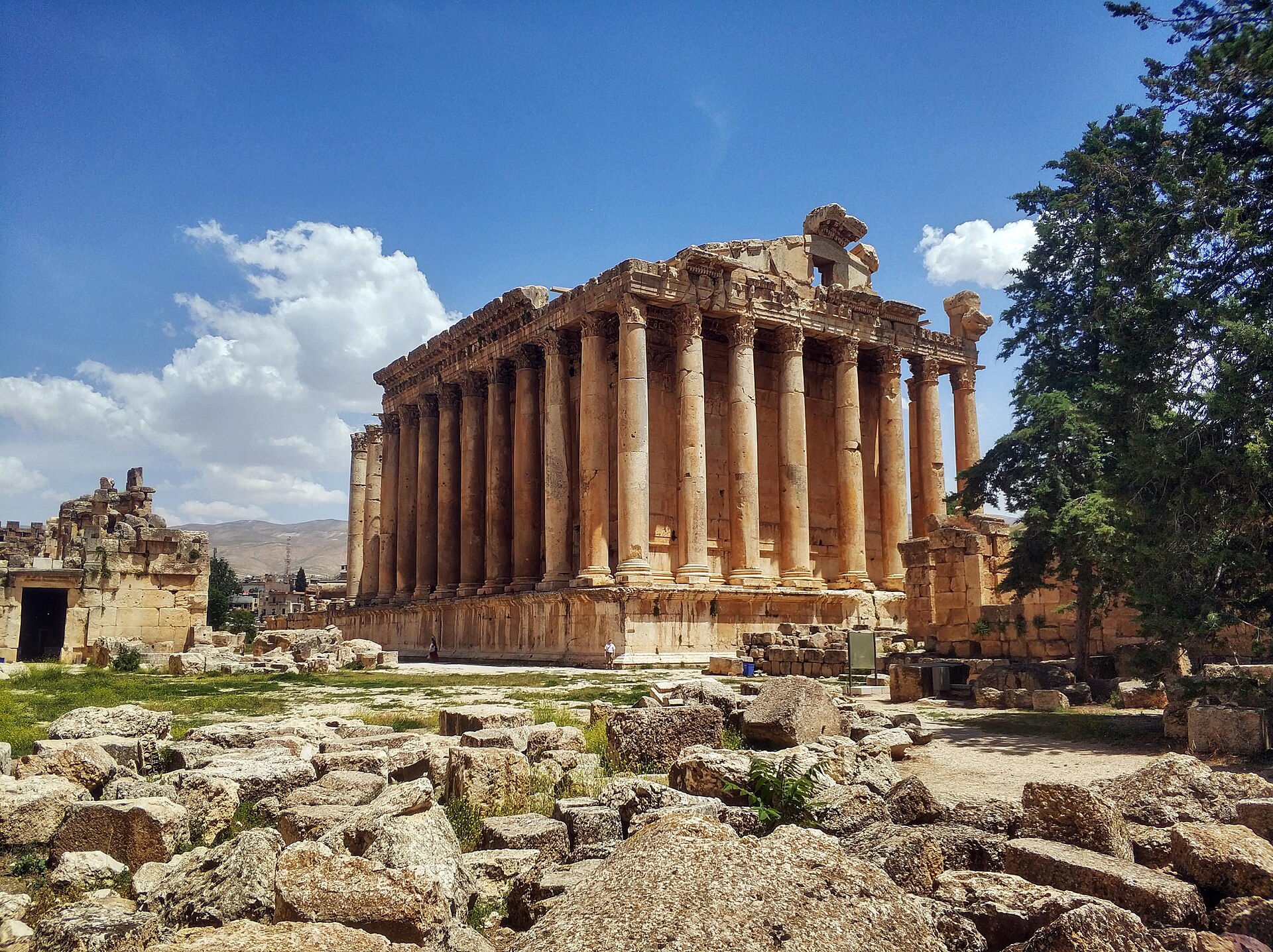
Baalbek
A Roman temple complex in Lebanon famous for the Trilithon — three ~800-ton limestone blocks in the Temple of Jupiter podium — and a recurring Ancient Aliens case for 'impossible' megaliths.
Baalbek, the Roman colony of Heliopolis, holds one of the largest temple complexes of the empire, anchored by the Temple of Jupiter (begun in the 1st century BC and built across the 1st–2nd centuries AD). Its podium incorporates the Trilithon: three colossal limestone blocks each roughly 19 metres long and estimated at 800–1,000 metric tons. The quarry lies about 900 metres away, where the ‘Stone of the Pregnant Woman’ and an even larger block still lie partly cut, weighing an estimated 1,000–1,650 tons. These are among the heaviest worked stones humans have ever moved.
On Ancient Aliens, Baalbek is presented as a site that could not have been built by Romans at all: the stones too heavy for any ancient crane or muscle-power, the platform too old — proponents of the ancient-astronaut hypothesis often claim a far older, pre-Roman or extraterrestrial ‘foundation’ that the Romans merely built atop.
The archaeological record places the construction firmly in the Roman period and within human capability. Romans were prolific movers of monoliths, and the Trilithon blocks sit only about 6 metres above the quarry and a short distance away, requiring sledges, rollers, ramps, levers, and capstans rather than aliens. The unfinished quarry stones are precisely the evidence against a lost super-civilization: they show ordinary quarrying in progress, abandoned because of cracks or logistics, exactly as one would expect from a labor-intensive but conventional building project.
Sources
Relationships
Supporting content