Project Blue Book apparatus-event
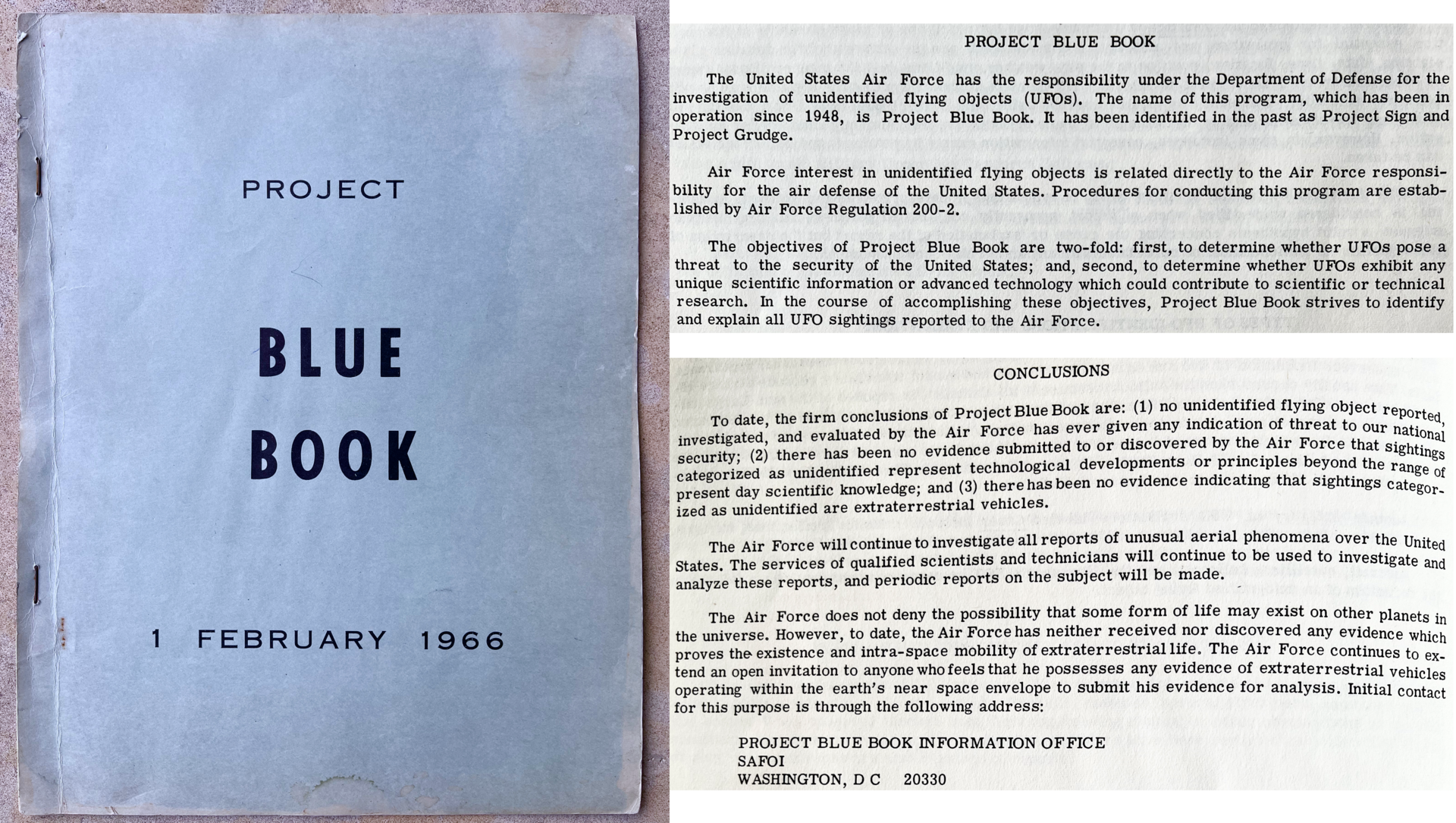
Project Blue Book was the longest-running official U.S. Air Force study
of UFOs, headquartered at Wright-Patterson AFB. Over seventeen years it
evaluated 12,618 sighting reports, of which 701 remained "unidentified,"
before being terminated in December 1969 on the recommendation of the
Condon Report. Its first director, Edward Ruppelt, coined the term "UFO."
Blue Book was the U.S. government's primary public face on UFOs for nearly
two decades and produced the still-cited official numbers (12,618 / 701).
It is the central case study in the corpus for the tension between genuine
investigation and a "debunking" public-relations posture — embodied by its
own consultant J. Allen Hynek, who began as a skeptic and ended as the
program's most credible critic. It is the trunk of the investigative
spine, the program every mid-century case in the corpus passed through.
Timeline
1952-03-01
Project Grudge is renamed Project Blue Book, with Capt. Edward Ruppelt
as its first director — the start of what is often called the program's
"golden age" of relatively serious investigation. Ruppelt coins the
term "UFO" to replace "flying saucer."
primary source: Wikipedia; Ruppelt (1956)
1952-07-19
The Washington, D.C. radar-visual flap (19-20 and 26-27 July) — the
signature case of Ruppelt's tenure. It forces the largest Pentagon
press conference since WWII (29 July, Maj. Gen. Samford's
temperature-inversion explanation) and directly triggers the CIA's
Robertson Panel.
primary source: Wikipedia; Ruppelt (1956)
1953-01
The Robertson Panel recommends an official debunking posture; Blue
Book's staff is cut from roughly ten to three, and the program pivots
from investigation toward public-relations management. Investigation
quality degrades sharply after this point.
primary source: Robertson Panel report; Haines (CIA, 1997)
1966-03
The Michigan "swamp gas" controversy: Hynek's hastily-offered
explanation for a wave of sightings becomes a public embarrassment and
intensifies pressure for an independent scientific study — leading to
the University of Colorado (Condon) contract in October 1966.
primary source: Wikipedia; Hynek
1968-1969
The Condon Report (delivered Nov 1968, released Jan 1969) concludes
further study cannot be justified; a National Academy of Sciences panel
endorses it. On 17 December 1969 the Air Force announces Blue Book's
termination, citing Condon and the NAS.
primary source: Condon Report (1968); History.com
Named personnel
- Capt. Edward J. Ruppelt — First director of Blue Book (1952-53); coined the term 'UFO' rank at time: · later: His 1956 book is the corpus's chief institutional narrator for the 1947-56 period and an internal skeptic of several official verdicts role: the program's most credible early voice
- Dr. J. Allen Hynek — Astronomer and scientific consultant for the program's entire life (Sign through Blue Book) rank at time: · later: Moved from skeptic to critic; called Blue Book largely a 'public relations exercise'; created the Close Encounter classification and founded CUFOS in 1973 role: the insider whose arc embodies the program's central tension
- Maj. Hector Quintanilla — Last Blue Book director (1963-closure) rank at time: role: presided over the debunking-era program through its termination
- Maj. Gen. John Samford — USAF Director of Intelligence who fronted the 29 July 1952 press conference rank at time: role: the public face of the temperature-inversion verdict on the Washington flap
Theories that invoke this case (3)
The 701 unresolved cases — including the program's own best-documented
'unknowns' — are cited as the residue the official closure decision did
not explain, and thus as the institutional record's strongest open door.
The post-1953 pivot from investigation to debunking, on the Robertson
Panel's recommendation, is the canonical example of the official
apparatus managing public perception rather than resolving the question.
Blue Book IS the apparatus: its statistics, its gaps, and the gap
between its files and its public posture are the corpus's primary text
for how the state metabolized the phenomenon.
Theories that do NOT invoke this case — and why
a study program, not a creature report
the program's output is statistics and assessments, not phenomenology
the institution doing the studying, not a mass-perception event
Where further investigation has leverage
- Un-redacted Blue Book case files: the National Archives hold ~37 cubic feet of case files on 94 rolls of 35mm microfilm (publication T-1206), some with witness names redacted.
- Modern re-analysis of the 701 unknowns against better weather, satellite, and air-traffic data than 1950s-60s investigators had — to test whether the residue reflects investigative limits or genuine anomalies.
- Still-classified CIA / Robertson Panel collateral records that shaped Blue Book's post-1953 posture.
- The program's own best 'unknowns' (e.g., Lakenheath-Bentwaters 1956, the RB-47 1957 case) re-examined with the original raw data.
Corpus status
apparatus-event
Firmly documented: Blue Book ran 1952-1969, evaluated 12,618 reports, left
701 "unidentified," and closed on 17 December 1969 with three official
conclusions — no threat to national security, no evidence of technology
beyond known science, and no evidence the unknowns were extraterrestrial
vehicles. Interpretive and contested: whether the post-1953 debunking
posture was suppression or PR management, and whether the 701 unknowns
reflect investigative limits or genuine anomalies. The trunk of the
investigative spine, and the program against which the corpus's mid-century
cases are read.
status history (1)
2026-06-09 · unannotated → apparatus-event
— annotated before the 2026-06-09 sweep; history begins at seeding
Suggested watching
series · 2019 · History / Peacock / various
Project Blue Book
History Channel dramatization with Aidan Gillen as Hynek. Cases are composites; the institutional texture of Blue Book is approximated.
documentary · 1979 · various / YouTube
UFOs Are Real
Includes Hynek discussing Blue Book on camera from his post-Blue-Book vantage.
Threads of evidence
This case is one node in the connections that run across the record. It appears in 1 thread: