Falcon Lake Incident (20 May 1967) under-corroborated
Amateur prospector Stefan Michalak reported approaching a landed,
chrome-surfaced craft near Falcon Lake, Manitoba, and being burned by a
blast of hot gas from a vented panel. He walked out ill, was hospitalized,
and bore a grid-patterned chest burn for years; the landing site showed
radioactivity more than ten times background. Canada's joint
RCMP/RCAF/medical investigation closed the case as 'unknown.'
Falcon Lake is the corpus's strongest physical-injury case and one of the
most analytically tractable in the entire record: the evidence is not a
light in the sky but a patterned burn on a man's torso that persisted for
years, a documented course of radiation sickness-like illness, and a
landing site with measurably elevated radioactivity sampled by the Atomic
Energy Control Board. It was investigated jointly by three Canadian
agencies and closed 'unknown' in a fully declassified national file. Its
central weakness — a single primary witness — is balanced by physical
evidence no other close-encounter case in the corpus matches.
Timeline
1967-05-20T12:15-0500_approx
While working a quartz claim in Whiteshell Provincial Park near Falcon
Lake, Stefan Michalak — a Polish-Canadian industrial mechanic and
amateur geologist — sees two glowing red disc-shaped objects descend.
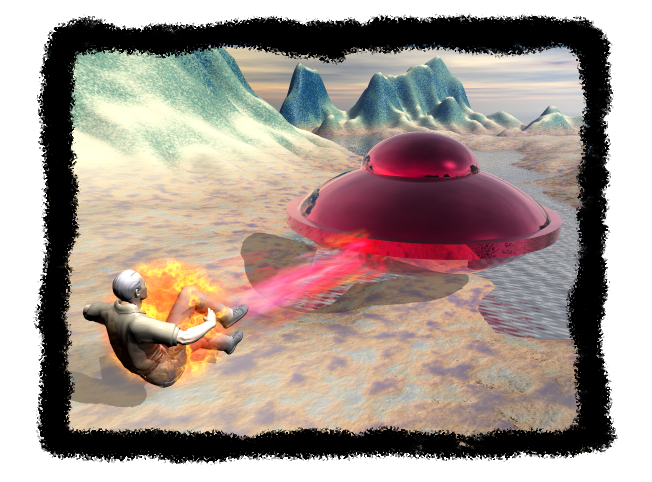
One lands on a rock outcrop ~45–50 m away; the other departs. Michalak
sketches the landed craft over ~30 minutes from cover: ~12 m across,
domed, with a chrome-like reflective surface and articulated panels.
witnesses: Stefan Michalak (sole primary witness)
primary source: Michalak's account; DND file (RG 77)
1967-05-20T12:45-0500_approx
Michalak approaches the craft. He reports warmth from the surface,
voices inside that he first takes for human, and tries several
languages (English, Polish, French, Russian, German) without response.
He looks through an open hatch at what he describes as lights and
panels.
witnesses: Stefan Michalak
primary source: Michalak's account; DND file
1967-05-20T12:50-0500_approx
As Michalak steps back, a panel rotates to expose a grid-like vent that
emits a blast of hot gas, setting his shirt alight and burning his
chest. The craft lifts off. He is left nauseated and disoriented.
witnesses: Stefan Michalak
primary source: Michalak's account; medical records
1967-05-20_afternoon_to_evening
Michalak walks roughly 20 miles out to the highway and back to Winnipeg,
vomiting and suffering severe headache, and is hospitalized the same day
at Misericordia Hospital, treated by Dr. Howard Frankel. He presents
with a grid-pattern burn on his torso consistent with the vent he
described.
witnesses: Dr. Howard Frankel (Misericordia Hospital)
primary source: Misericordia Hospital records; DND file
1967-05-22_onward
The RCMP, RCAF, and Canadian Forces Medical Service open a joint
investigation. Michalak's symptoms (nausea, weight loss, recurrent
gastric problems, the persistent burn) are documented over months;
follow-up later includes the Mayo Clinic (1968).
witnesses: RCMP, RCAF, and Canadian Forces Medical Service investigators
primary source: DND file (RG 77)
1967-06-01
Michalak relocates the landing site with RCMP Cpl. G. A. Solotki and
Sgt. R. Hawkes. They document a ~4.6 m circular depression of scorched
moss and lichen on the outcrop.
witnesses: RCMP Cpl. G. A. Solotki · RCMP Sgt. R. Hawkes
primary source: DND file; RCMP site report
1967-06-22
The Atomic Energy Control Board collects soil from the depression and
records elevated radioactivity — on the order of ~50 mR/hr at the
center, more than ten times the area background — with the contamination
localized to the site. Some samples are radium-bearing, which fuels both
the anomaly reading and a contamination-artifact debate.
witnesses: Atomic Energy Control Board samplers
primary source: AECB radiation analysis in the DND file
1967-1968
Dr. Geoffrey W. Pearson (RCAF Surgeon General's office) and others
investigate over roughly six months. The Department of National Defence
closes the case officially as 'unknown.' The full file (RG 77) is later
declassified through Library and Archives Canada — one of the few fully
public national-government UFO files.
witnesses: Dr. Geoffrey W. Pearson (RCAF)
primary source: DND file (RG 77), Library and Archives Canada
Named personnel
- Stefan Michalak — Industrial mechanic and amateur prospector; sole primary witness rank at time: · later: Maintained his account until his death in 1999; bore the chest burn for years primary witness to: the landed craft, the hatch interior, and the burning gas blast
- Dr. Howard Frankel — Physician, Misericordia Hospital, Winnipeg rank at time: role: Treated Michalak the day of the event; documented the patterned burn and acute symptoms
- RCMP Cpl. G. A. Solotki and Sgt. R. Hawkes — Royal Canadian Mounted Police investigators rank at time: role: Located and documented the scorched-ground landing site
- Atomic Energy Control Board (samplers) — Canadian nuclear regulator rank at time: role: Measured the elevated site radioactivity — the case's hardest physical datum
- Dr. Geoffrey W. Pearson — RCAF Surgeon General's office rank at time: role: Led the medical/scientific investigation; the case closed 'unknown'
- Chris Rutkowski and Stan Michalak — Researcher and Michalak's son; authors of 'When They Appeared' (2018) rank at time: role: Compiled and published the family archive and the case documentation
Sensor record
- Human body (as physical-effect record) on Stefan Michalak a grid-pattern chest burn matching the described vent, plus persistent radiation-sickness-like illness over months/years documentation: Misericordia Hospital and Mayo Clinic records; the DND file
- Radiation survey (Atomic Energy Control Board) on the landing-site depression ~50 mR/hr at the center, >10x area background; localized to the site; some radium-bearing samples documentation: AECB analysis in the DND file
- Site documentation (RCMP) on the rock outcrop a ~4.6 m circular scorched depression of moss and lichen documentation: RCMP site report; photographs in the DND file
Object — reported
shape
disc with a domed top, articulated/rotating panels, and a chrome-like reflective surface
size
~12 m across (Michalak's estimate and sketch)
surface features
an opening hatch revealing lights/panels; a grid-like exhaust vent on a rotating panel; warm to the touch; emitted a sulphur/burning-electrical smell
observed behaviors
- descending and landing on a rock outcrop while a second object departed
- emitting voices/sounds from within; surface warm
- venting a blast of hot gas through a grid panel that burned the witness
- lifting off and departing, leaving scorched, radioactive ground
Theories that invoke this case (4)
The strongest fit: a real physical object that produced measurable
physical effects — a patterned burn, radiation sickness-like illness,
and a radioactive ground trace — i.e. a hard materials/physics problem,
whatever its ultimate origin.
The literal reading: a structured craft with occupants/automation,
taken at face value with the physical and medical evidence as support.
The mundane-but-classified reading: an experimental craft whose exhaust
injured a bystander. Counter-argument: no program of record matches the
craft or the locale, and a sanctioned test would not produce an open
'unknown' national file and a years-long medical mystery.
The institutional-handling reading: a three-agency joint investigation,
AECB radiation sampling, Mayo Clinic follow-up, and a fully declassified
file — a near-complete study of how a government documents a physical-
injury case.
Theories that do NOT invoke this case — and why
the case turns on physical injuries and a radioactive ground trace, not on perception; a psychological reading cannot produce a patterned burn or contaminated soil
concrete physical and medical effects, not anomalous perceptual experience
no creature element; a craft-and-injury case
no time-displacement narrative
Conventional explanations advanced — and their status
Hoax (self-inflicted burn; fabricated craft)
proponents: skeptics · some early investigators
Partly strained, partly supported — and the re-audit sharpens a chronology the case usually blurs. There are TWO distinct burn sets: the ACUTE injury documented at hospital on 23 May 1967 was 'several round and irregular shaped burns the size of a silver dollar' — NOT a grid; the famous neat GRID-pattern marks appeared only in January 1968, ~8 months later, and the Mayo Clinic examiner (Aug 1968) recorded they were 'diagnosed as obviously factitial' (self-inflicted), while finding no major mental illness. So the most distinctive 'exotic' evidence is the later, suspect set. A full hoax of the acute event would still require deceiving hospital/RCMP/RCAF/AECB staff, so deliberate top-to-bottom fraud stays low-probability — but the signature grid burn is the least trustworthy element, not the strongest.
Radioactive site contamination is a natural/industrial artifact (radium), unrelated to any craft
proponents: skeptical analysts
The strongest skeptical line on the hardest datum: some samples were radium-bearing, raising the possibility of pre-existing or introduced contamination rather than a craft signature. The corpus treats the radiation evidence as real but ambiguous in origin — anomalous, not unambiguously exotic.
Misidentification / intoxication (Michalak had been drinking)
proponents: Philip Klass-style skepticism
Does not address the documented physical burn, the localized site damage, or the radiation readings; weak as a complete account.
Single-witness unreliability
proponents: general skeptical position
A valid limitation — there is one primary witness — but the case is unusual precisely because it does not rest on testimony alone; the burn, the illness, and the site are independent of Michalak's narrative.
Where further investigation has leverage
- Modern re-analysis of the archived AECB soil samples (isotopic signature) to distinguish a radium-contamination artifact from an anomalous source.
- Independent medical review of the full Misericordia and Mayo Clinic records to characterize the burn and illness against known radiation/thermal injury profiles.
- Complete release and indexing of the DND RG 77 Falcon Lake file, including any site photographs and the Pearson assessment.
- Re-survey of the landing site (if relocatable) for residual contamination or trace metals.
Corpus status
under-corroborated
The corpus's strongest physical-injury case: a patterned burn, documented
radiation-sickness-like illness, and a radioactive landing site,
investigated by three Canadian agencies and closed 'unknown' in a fully
declassified file. The single-witness narrative and the ambiguous origin of
the site radioactivity (some samples radium-bearing) are the real
weaknesses, and a deliberate hoax is hard to reconcile with the breadth of
physical evidence. The corpus holds it under-corroborated: the physical
effects are real and well-documented; their cause is unestablished.
status history (1)
2026-06-09 · unannotated → under-corroborated
— initial annotation sweep (Epic J.F4)
Threads of evidence
This case is one node in the connections that run across the record. It appears in 2 threads:
The electromagnetic-effects signature
— A grid-pattern burn, radiation-sickness-like illness, and a radioactive landing site.
The physical-trace material problem
— Stefan Michalak's grid-pattern burns and the scorched ground: real, medically-documented injury and a real burnt site — unexplained, yet pointing to no specific source.