Japan Airlines Flight 1628 (17 November 1986) under-corroborated
A Boeing 747 cargo freighter on the Paris–Anchorage–Tokyo run reported
being paced for nearly 50 minutes over eastern Alaska by luminous
objects — two small ones and a third the captain described as the size
of 'two aircraft carriers.' The crew's onboard radar painted the large
object; Anchorage Air Route Traffic Control simultaneously tracked an
unidentified primary return near the 747. An FAA official preserved the
data and briefed the FAA Administrator, CIA, and FBI.
JAL 1628 is the corpus's clearest civil-aviation radar-visual case and
its best-documented instance of evidence-handling as the real story.
The crew were senior professionals (a 10,000-hour former fighter pilot
in command); the encounter was tracked on the aircraft's radar and on
FAA ground radar; and the chain of custody runs through a named FAA
division chief, John Callahan, who retained the recordings, briefed the
Administrator and intelligence agencies, was instructed to treat the
briefing as if it had not occurred, and later released the materials.
It is the case where the institutional-handling layer is documented
almost as well as the sighting.
Timeline
1986-11-17T17:11-0900
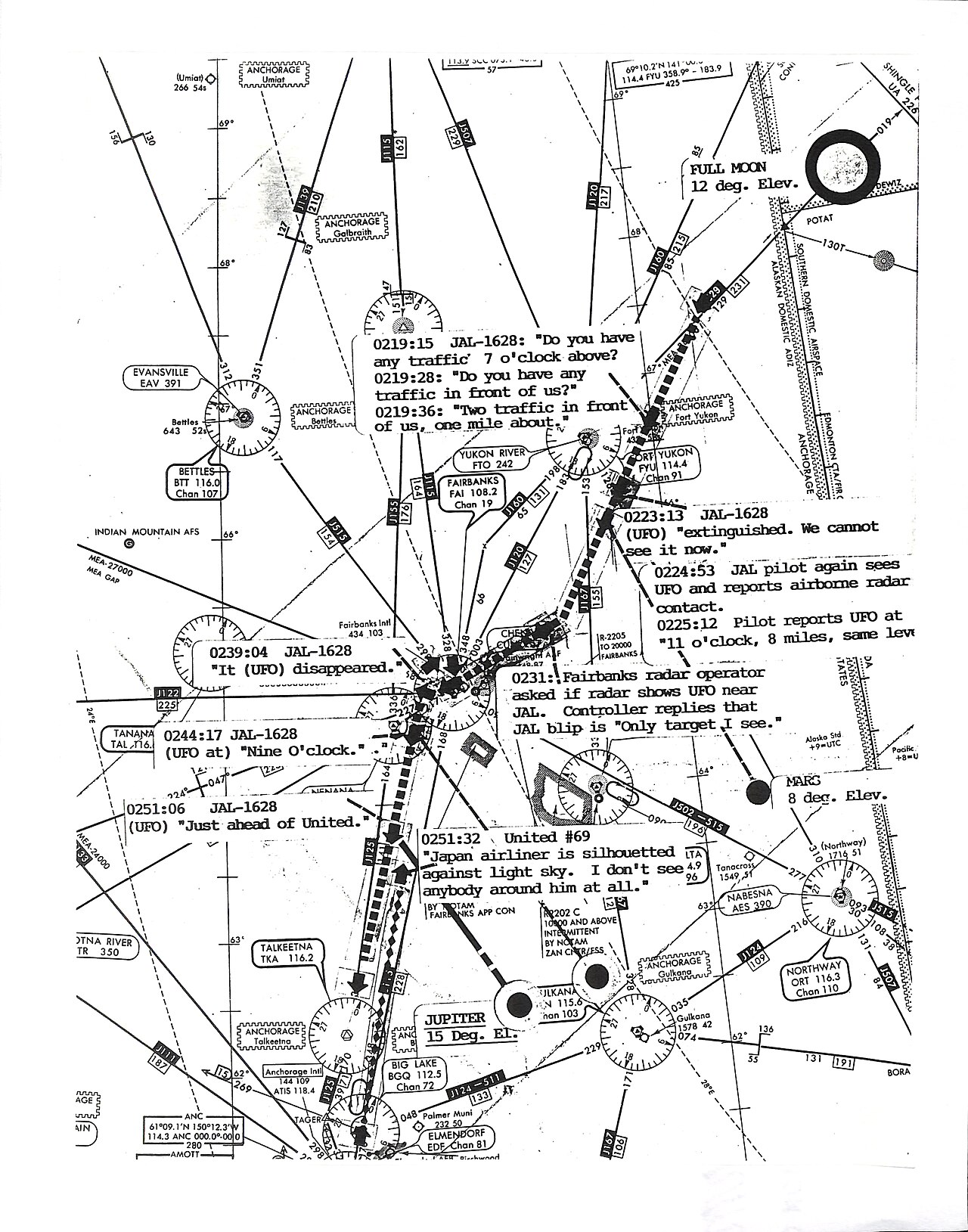
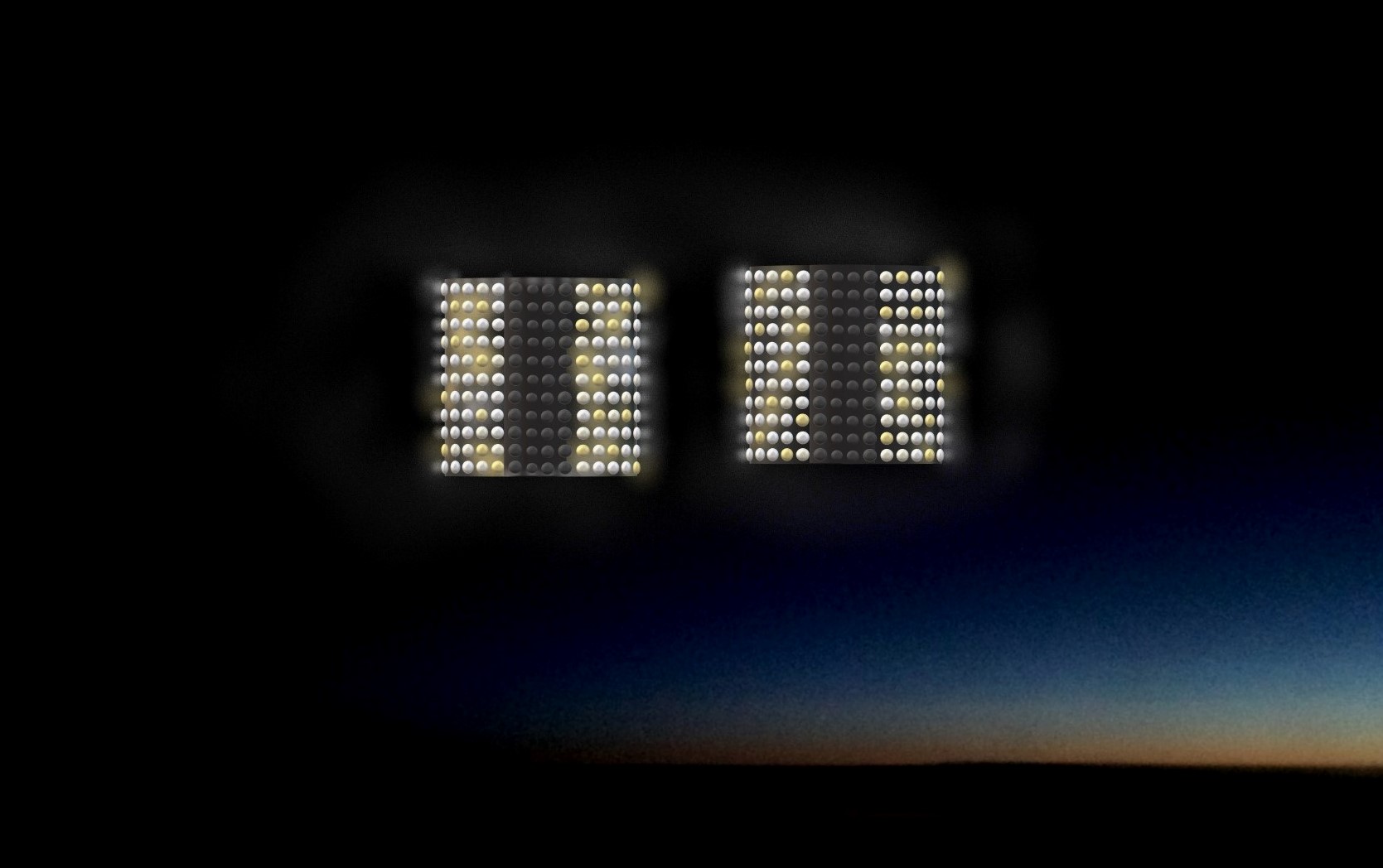
JAL Flight 1628, a Boeing 747-200F cargo aircraft (carrying French
wine, Reykjavík–Anchorage leg), cruising at FL350 over eastern Alaska
~150 nm east of Fort Yukon, encounters two small luminous objects that
pace the aircraft off its left side. Captain Kenju Terauchi, First
Officer Takanori Tamefuji, and Flight Engineer Yoshio Tsukuba all
observe them.
witnesses: Capt. Kenju Terauchi (10,000-hour senior captain; ex-JASDF fighter pilot) · First Officer Takanori Tamefuji · Flight Engineer Yoshio Tsukuba
primary source: FAA investigation file; crew statements
1986-11-17T17:19-0900_approx
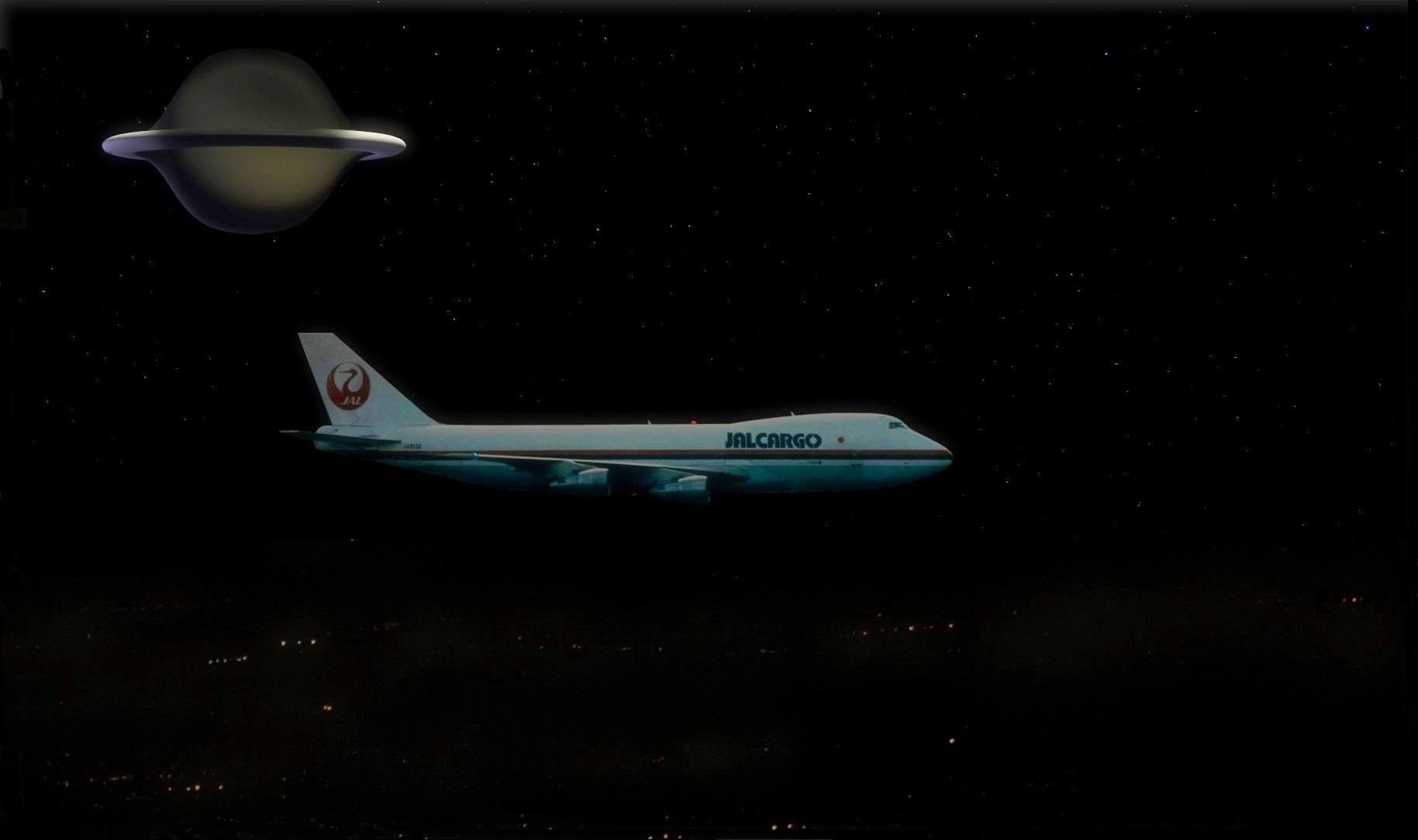
A third, much larger object appears — Terauchi describes it as walnut-
or Saturn-shaped and 'the size of two aircraft carriers.' The crew's
onboard weather radar paints a target at roughly 7.5 nautical miles in
the object's direction.
witnesses: Capt. Terauchi and crew
primary source: FAA file; Terauchi's report and sketches
1986-11-17T17:20-0900_approx
The crew report the objects to Anchorage Air Route Traffic Control
Center. Controller Carl Henley tracks an unidentified primary (skin-
paint) return near JAL 1628's position on FAA radar. Anchorage requests
confirmation from a nearby United Airlines flight and a military
aircraft and vectors JAL 1628 through turns and a descent to test
whether the object follows; it reportedly continues to pace the 747.
witnesses: Anchorage ARTCC controller Carl Henley
primary source: FAA radar data; ATC transcripts
1986-11-17T18:00-0900_approx
After roughly 50 minutes, the objects depart as JAL 1628 approaches
the Anchorage area. The aircraft lands without incident.
primary source: FAA file; crew statements
1987-01-05
FAA Division Chief John Callahan (Quality Assurance and Investigations)
and FAA Administrator Donald Engen review the radar data and cockpit
voice in a Washington, D.C. meeting attended by representatives of the
CIA, FBI, and President Reagan's Scientific Study team. By Callahan's
account, the attendees were told the meeting 'never took place' and the
material was to be treated as secret; Callahan retained copies.
witnesses: John Callahan (FAA Division Chief)
primary source: Callahan's on-record accounts (2001 Disclosure Project; Kean 2010)
1987-03-05
FAA spokesman Paul Steucke announces the agency's public conclusion:
the secondary radar returns may have been a 'split image' artifact
caused by precipitation, and the FAA cannot confirm a solid object.
primary source: FAA public statement, 5 March 1987
2001-2010
After retirement, Callahan publicly disputes the split-image
explanation, stating the recordings he retained show clear separation
between the JAL transponder return and the unidentified primary target.
He testifies at the 2001 National Press Club 'Disclosure Project' event
and provides materials to journalist Leslie Kean for her 2010 book.
witnesses: John Callahan
primary source: Disclosure Project, 2001; Kean, 'UFOs' (2010)
Named personnel
- Capt. Kenju Terauchi — Pilot-in-command, JAL 1628 rank at time: Senior Captain (~10,000 flight hours; former Japan Air Self-Defense Force fighter pilot) · later: Primary witness; gave detailed sketches; reported further sightings afterward (which skeptics cite against him) primary witness to: the three objects, the large object's form, and the onboard-radar paint
- First Officer Takanori Tamefuji — First officer, JAL 1628 rank at time: primary witness to: the luminous objects pacing the aircraft
- Flight Engineer Yoshio Tsukuba — Flight engineer, JAL 1628 rank at time: primary witness to: the objects (with somewhat more reserved descriptions than the captain)
- Carl Henley — Anchorage ARTCC air traffic controller rank at time: primary witness to: the unidentified primary radar return near JAL 1628
- John Callahan — FAA Division Chief, Quality Assurance and Investigations rank at time: · later: On-record whistleblower-style witness to the FAA/CIA/FBI briefing and the retained data role: Preserved and ultimately surfaced the radar/voice chain of custody
- Donald Engen — FAA Administrator (1986–1987) rank at time: role: Reviewed the data in the 5 January 1987 closed meeting
Sensor record
- Boeing 747 onboard weather radar on JAL 1628 painted a target at ~7.5 nm in the direction of the large object documentation: crew report; FAA file
- FAA Anchorage ARTCC primary (skin-paint) radar on ground tracked an unidentified primary return near JAL 1628's position documentation: FAA radar data retained by Callahan; ATC transcripts
- Military radar (ROCC/Elmendorf, reported) on ground reportedly queried during the event; results contested in the public record documentation: referenced in FAA correspondence; not fully released
- Mark 1 eyeballs on JAL 1628 cockpit two small luminous objects and one large walnut/Saturn-shaped object documentation: crew statements and Terauchi sketches
Object — reported
shape
two small objects with arrays of lights; one large object Terauchi described as walnut- or Saturn-shaped
size
the large object 'the size of two aircraft carriers' (Terauchi); the small objects much smaller
surface features
luminous; the small objects' lights described as flickering like exhaust ports
observed behaviors
- pacing the 747 off its left side and maintaining position
- the small objects making sudden movements; one large object trailing
- continuing to pace the aircraft through controller-requested turns and a descent
- registering on both onboard and ground radar (per the crew and Henley/Callahan)
Theories that invoke this case (5)
The standard reading: structured luminous objects pacing an airliner
with performance beyond conventional aircraft, reported by senior
aircrew and correlated on radar.
The cautious reading: real objects and real radar returns whose nature
is undetermined, treated as a sensor-and-physics question rather than a
confirmed exotic craft.
The institutional reading: Callahan's documented FAA/CIA/FBI briefing
and 'this never happened' instruction are cited as concrete evidence of
official concealment machinery — a key data point for the managed-
disclosure narrative.
The mundane-but-classified reading: a covert aircraft over a remote
Alaskan corridor. Counter-argument: no known platform matches the
reported size, the pacing of a 747, and the radar behavior.
The institutional-handling reading: the case's best-documented layer
is the evidence chain itself — retention, briefing, public 'split-image'
framing, and later release — a near-complete record-production study.
Theories that do NOT invoke this case — and why
professional aircrew plus onboard and ground radar correlation make a mass-psychology reading untenable
no perceptual phenomenology; a radar-visual aerial case
no entity sighting
no time-displacement narrative
Conventional explanations advanced — and their status
Misidentification of bright planets — Jupiter (mag ~-2.6, ~10-12 deg up) and Mars — for the small luminous objects, with the apparent pacing an artifact of the 747's own heading changes
proponents: Philip J. Klass · Robert Sheaffer · James Oberg (planet/observer line)
The leading skeptical account for the two small lights. Jupiter was exceptionally bright and low off the aircraft's left/southeast that night; at ~10 deg elevation it would appear near the pilot's own altitude, and a bright planet pacing a turning aircraft is a classic misidentification. Strong for the small objects; weaker as a sole account of the single large structured object Terauchi described — but note the crew (Tamefuji, Tsukuba) reported only 'lights,' not the giant craft, so the large-object datum rests almost entirely on the captain.
Moonlight reflected off turbulent ice-crystal cloud (Klass's revised account for the larger/flame-colored display)
proponents: Philip J. Klass (March 1987 revision)
Klass's fallback after the planet account was challenged: a near-full moon low and behind the aircraft reflecting off ice fog/crystals, producing flame-colored shimmer. Weaker and more ad hoc than the planet account; criticized (Sheaffer) as not cleanly explaining the reported light arrays. Counts as a plausible but unproven mechanism for the diffuse 'mothership' glow.
Radar returns were a split/coincidental image of JAL 1628 itself, weather clutter, or an uncorrelated primary — NOT a solid object holding formation
proponents: FAA technical conclusion (1987; Paul Steucke) · USAF Elmendorf ROCC (split-beacon/clutter) · the FAA's own radar specialists
AUDIT-UPGRADED. The corpus previously framed the official 'split image' line as cleanly rebutted by Callahan's retained data. On re-examination the technical record is the stronger side: Anchorage ARTCC never held a consistent solid track; Fairbanks controllers saw only the 747; Elmendorf's three brief primary hits were judged split-beacon returns or clutter; and the lone 'uncorrelated primary' near the 747 had no transponder and never demonstrated a formation-holding object. Callahan's claim of 'clear separation' between the transponder and a solid primary is not corroborated by an independent technical analysis of the tapes and is contradicted by the controllers' contemporaneous accounts. The radar 'confirmation' is the case's weakest residual, not its strongest.
Witness embellishment / Terauchi's reduced reliability
proponents: Philip J. Klass · Robert Sheaffer · FAA
Strengthened on audit. Terauchi is a documented 'UFO repeater' (two prior sightings; two more in January 1987, one attributed to village lights diffused through ice-crystal cloud). In separate 1988 interviews the crew accounts diverged sharply and Terauchi's own story shifted (he first radioed losing the objects after turning, later said they stayed). The large-object and most dramatic behaviors depend on the captain alone; the corroborating crew saw only lights and other aircraft sent to check saw nothing.
Callahan's institutional-coverup account is itself contested
proponents: Robert Sheaffer · reporting on the 1987 meeting
AUDIT-ADDED. Callahan's 'the meeting never happened / treat as secret' instruction is the load-bearing claim for the concealment narrative, but other attendees of the relevant 1987 discussions — CIA analyst Ron Pandolfi and physicist Bruce Maccabee — reportedly do not recall any such cover-up directive. The chain-of-custody story (data retained, briefing held) is partly documented; the secrecy-instruction layer rests on Callahan's uncorroborated recollection and should be flagged, not treated as established.
Where further investigation has leverage
- Full public release and independent analysis of the FAA Anchorage ARTCC radar recordings Callahan retained, specifically testing the split-image hypothesis against the transponder/primary separation.
- Release of any military (ROCC/Elmendorf) radar data from the encounter window.
- Astronomical reconstruction of the 17 November 1986 eastern-Alaska sky to bound the Jupiter/Mars account against the reported altitude, bearing, and pacing behavior.
- On-record corroboration from the United Airlines and military aircraft that Anchorage queried during the event.
Corpus status
under-corroborated
DOWNGRADED FROM phenomenologically-open ON ADVERSARIAL AUDIT (2026-06-14).
The case's two pillars are weaker than the open framing implied. (1) The
radar 'confirmation' does not survive scrutiny: no FAA or USAF radar ever
held a consistent solid object in formation with the 747; the official
reading (split/coincidental image, clutter, or an uncorrelated transponder-
less primary) is supported by the controllers' contemporaneous accounts,
while Callahan's claim of 'clear separation' has never been validated by an
independent technical analysis of the tapes and the secrecy-instruction
story is uncorroborated by other meeting attendees. (2) The most dramatic
datum — the single large walnut/Saturn 'mothership' — rests on Terauchi
alone; his crew reported only 'lights,' aircraft sent to check saw nothing,
he is a documented 'UFO repeater,' and his account shifted in later
interviews. The strong prosaic reading (bright Jupiter/Mars for the small
pacing lights, plus possible moonlight on ice-crystal cloud for the diffuse
glow, plus a radar artifact) explains most of the case.
The corpus stops SHORT of 'disputed-optical-artifact' because the prosaic
account is not airtight: the planet explanation does not fully reproduce a
large structured object that reportedly tracked through commanded turns and
a descent, the onboard weather-radar paint at ~7.5 nm is not cleanly
accounted for, and no single skeptical mechanism has been independently
verified against the (still largely unreleased) primary radar tapes. The
honest position is UNDER-CORROBORATED: a credible senior-captain report
whose strongest evidentiary claims (radar formation-hold; institutional
cover-up) are not corroborated and whose best residuals are bounded but not
closed. It remains a useful institutional-handling study, but it should no
longer be presented as the corpus's model 'phenomenologically-open' radar-
visual case — Tehran 1976 and Nimitz 2004 carry that load better.
Differs from 'phenomenologically-open': yes — this is a deliberate
downgrade. The open status overstated the radar corroboration and rested
too much weight on a single repeat-claimant and on Callahan's contested
recollection.
status history (2)
2026-06-09 · unannotated → phenomenologically-open
— initial annotation sweep (Epic J.F4)
2026-06-14 · phenomenologically-open → under-corroborated
— adversarial re-audit of the strongest open instrumented cases — The two pillars both weaken on re-audit: the radar 'formation-hold' dissolves in the technical record (no station held a consistent solid tr
Threads of evidence
This case is one node in the connections that run across the record. It appears in 2 threads: