Levelland, Texas EM Effects Wave (2–3 November 1957) phenomenologically-open
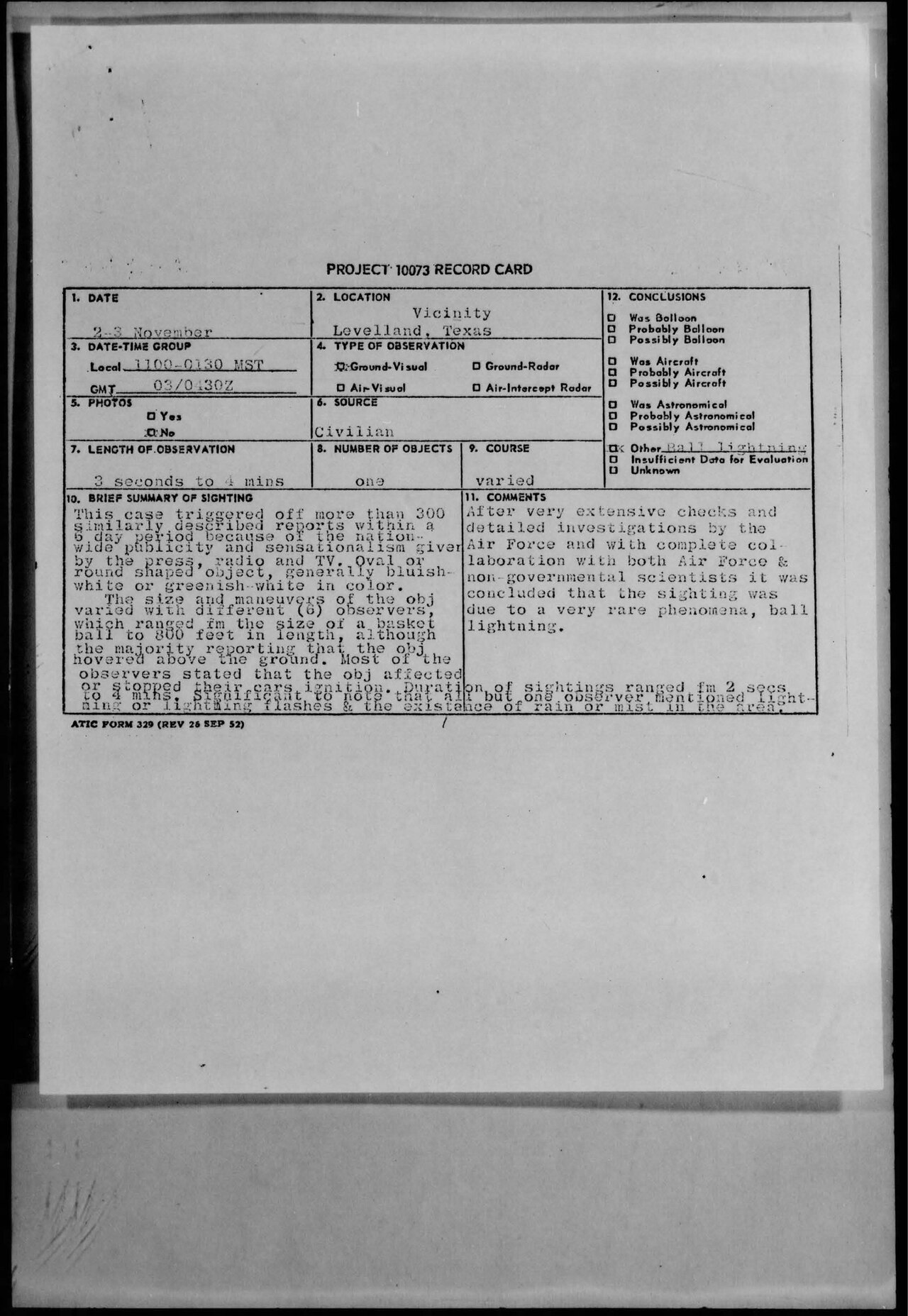
Over roughly 2.5 hours on the night of 2–3 November 1957, about seven
motorists around Levelland, Texas — strangers to one another — independently
reported a glowing egg-shaped object near the road whose presence stalled
their vehicle engines AND extinguished their headlights, with normal function
returning once it departed (of ~15 total reports that night; the county
sheriff and a fire marshal saw the light but had no vehicle failure). Blue
Book filed it as 'ball lightning.'
Levelland is the strongest single-night electromagnetic-effects cluster in
the record, and it survived a 2026 adversarial re-audit (held open): roughly
seven motorists, independent and mostly unaware of one another in real time,
reported the same specific and unusual COMPOUND signature — engine and
headlight failure correlated with the object's proximity and recovery with
its departure (Hynek called it 'out of the statistical universe'; McDonald,
'cannot be regarded as explained'). The official 'ball lightning' verdict
fails on its own terms (ball lightning needs storm activity; there was none
during the sightings), but note the honest weather record is overcast and
mist with a trace of rain — NOT the 'clear, dry skies for hundreds of miles'
sometimes claimed in the anomalist direction. It anchors the EM-effects
thread linking Socorro, Tehran, and the vehicle-interference literature.
Timeline
1957-11-02T22:30-0600
Truck driver Pedro Saucedo, driving northwest of Levelland with a
passenger (Joe Salaz), reports a torpedo- or egg-shaped object rising
from a field with a roar and a rush of heat; his truck's engine dies
and its lights go out as the object approaches, then restart after it
passes. Saucedo calls the police; the desk officer is initially
skeptical.
witnesses: Pedro Saucedo (truck driver) · Joe Salaz (passenger)
primary source: Blue Book file; Levelland PD log
1957-11-02T23:00-0600_to_1957-11-03T01:30-0600
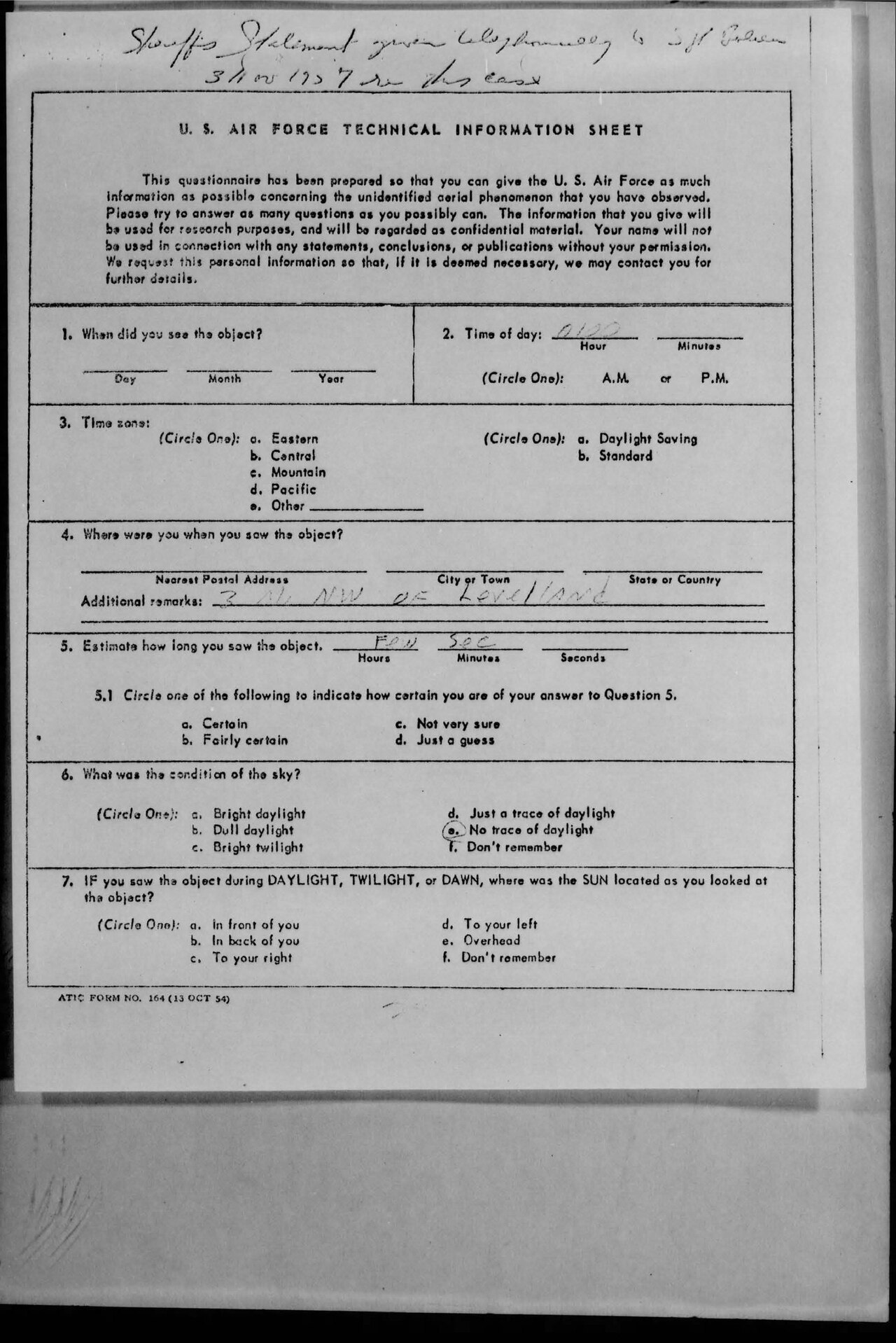
Over the next ~2.5 hours, Levelland patrolman A.J. Fowler fields a
stream of independent calls from motorists on different roads around
the county, each reporting the same pattern: a brilliant egg-shaped
object on or near the road, engine and headlights failing on approach,
and recovery after it left. Witnesses include college student Newell
Wright and farm worker José Alvarez, among others.
witnesses: Levelland patrolman A.J. Fowler (call taker) · Newell Wright (student) · José Alvarez (farm worker) · additional independent motorists (≥15 total over the night)
primary source: Blue Book file; Levelland PD log
1957-11-03T01:30-0600_approx
Hockley County Sheriff Weir Clem and deputy Pat McCulloch, responding
to the calls, personally observe a brilliant red/oval object near the
road. Fire marshal Ray Jones also observes it. Law-enforcement and
fire-service witnesses thus join the civilian motorists.
witnesses: Sheriff Weir Clem · Deputy Pat McCulloch · Fire Marshal Ray Jones
primary source: Blue Book file; Clem's report
1957-11-05
Project Blue Book dispatches a single investigator, Sgt. Norman P.
Barth, who spends roughly seven hours in the area and interviews only
three of the witnesses. On this basis Blue Book attributes the event to
'ball lightning' (and, for some reports, 'wet electrical systems').
witnesses: Sgt. Norman P. Barth (Blue Book investigator)
primary source: Blue Book file
1957-11-and-after
The official 'ball lightning' conclusion is contradicted by the Air
Weather Service record for the night, which shows clear skies, no
thunderstorms, and no precipitation within several hundred miles —
conditions in which ball lightning does not occur. The dry, calm
weather also undercuts the 'wet electrical systems' explanation.
primary source: Air Weather Service records; critical analyses
1968_and_after
The Condon Report addresses Levelland; J. Allen Hynek later criticizes
Blue Book's cursory handling — one investigator, three interviews,
seven hours — as inadequate to the scale of the multi-witness EM
cluster. Levelland becomes the most-cited vehicle-interference case in
the literature.
witnesses: J. Allen Hynek (later critic of the investigation)
primary source: Condon Report; Hynek, 'The UFO Experience' (1972)
Named personnel
- Pedro Saucedo — Truck driver; first reported witness (22:30) rank at time: primary witness to: the object's rise, the heat and roar, and his truck's engine/light failure
- Sheriff Weir Clem — Sheriff, Hockley County, Texas rank at time: primary witness to: a brilliant red/oval object near the road (~01:30), as a law officer
- Deputy Pat McCulloch — Hockley County deputy sheriff rank at time: primary witness to: the object alongside Sheriff Clem
- Fire Marshal Ray Jones — Levelland fire marshal rank at time: primary witness to: the luminous object during the night
- Patrolman A.J. Fowler — Levelland police; the night-desk officer who took the calls rank at time: role: Logged the stream of independent, geographically separated reports in real time
- Newell Wright — College student; motorist witness rank at time: primary witness to: engine and headlight failure in the object's presence
- Sgt. Norman P. Barth — Project Blue Book investigator rank at time: role: Conducted the brief (seven-hour, three-witness) official investigation underlying the 'ball lightning' verdict
Sensor record
- Vehicle electrical systems (as an inadvertent EM sensor) on ≥15 independent motor vehicles across Hockley County engines stalling and headlights failing in correlation with the object's proximity, recovering after departure — the case's defining and repeated signature documentation: witness reports collated in the Blue Book file and police log
- Mark 1 eyeballs (civilian + law enforcement) on motorists, sheriff, deputy, fire marshal, patrolman a brilliant egg-/torpedo-shaped object on or near the road documentation: Blue Book file; police reports
- Air Weather Service meteorological record on regional weather observation clear skies, no thunderstorms, no precipitation for hundreds of miles — the datum that falsifies the official 'ball lightning' explanation documentation: Air Weather Service records for 2–3 November 1957
Object — reported
shape
brilliant egg-, torpedo-, or oval-shaped luminous object; colors reported as bluish-green, red, and white-yellow across witnesses
size
estimated ~200 feet long by some witnesses (low confidence)
surface features
intensely luminous; some reports of an associated rush of heat and a roaring sound on close approach
observed behaviors
- appearing on or low over the road, sometimes rising from a field
- vehicle engines and headlights failing as it neared, restoring after it left — reported independently ≥15 times in one night
- rapid departure, often upward and away
- no lasting physical trace reported beyond the transient electrical effects
Theories that invoke this case (4)
The standard reading: a structured luminous craft emitting an effect
that suppresses vehicle electrical systems at close range, reported
consistently by many independent witnesses including law officers.
The physical-but-novel reading: a natural or poorly-understood plasma
phenomenon could in principle disrupt ignition systems and be intensely
luminous — but a sustained, mobile, vehicle-stalling plasma recurring
across a county for hours would itself be an unrecognized phenomenon,
not the textbook 'ball lightning' Blue Book invoked.
The cautious reading: a real object exerting real electromagnetic
effects of undetermined origin, treated as an EM-physics problem.
The institutional-handling reading: Levelland is a case study in
inadequate official investigation and in an explanation ('ball
lightning') chosen against the agency's own available weather data.
Theories that do NOT invoke this case — and why
the witnesses were independent strangers reporting in real time to a single call-taker, with a specific physical signature (vehicle failure); not a shared-perception wave
concrete physical (electrical) effects, not anomalous perceptual experiences
no creature element
no time-displacement narrative
Conventional explanations advanced — and their status
Ball lightning (the official Blue Book verdict)
proponents: Project Blue Book (1957) · Donald Menzel
Falsified on its own terms: ball lightning needs thunderstorm/electrical activity, and there was no active storm DURING the sightings (the night was overcast with mist and a trace of rain; Menzel leaned on thunderstorms earlier that day). Ball lightning is also brief and small, not a ~200-foot object recurring across a county for hours. Contradicted by the weather record — though note the honest record is overcast/mist, not the 'clear dry skies for hundreds of miles' sometimes overstated by anomalists.
Coincidental car trouble + a real bright stimulus + report contagion (the strongest standing prosaic reading)
proponents: skeptical reconstruction (Klass methodology; Curtis Peebles)
The strongest prosaic account on re-audit: 1957 vehicles with worn ignitions/batteries stalled routinely; a regionally-reported fireball could supply the 'bright stimulus'; and after the first call hit police/press, later callers may have reinterpreted ordinary stalls. Plausible for the peripheral reports — but it strains on the ~7 CORE cases, which it must explain having engine AND headlight failure together, recovery tracking the object's departure, clustered in one ~2.5-hour window, never recurring (McDonald: 'too many to seem pure chance').
Wet electrical systems / damp ignition causing the stalls
proponents: Blue Book (secondary)
Weak: doesn't explain the simultaneous HEADLIGHT failures (lights don't die from damp plugs), nor the proximity-and-recovery correlation across many vehicles.
Mass misperception / suggestion spreading by word of mouth
proponents: psychosocial-leaning skeptics
Strained for the core events by the real-time, independent, geographically dispersed calls and the specific shared compound signature (engine + headlight) rather than a generic 'light in the sky' — but plausible for some of the ~15 peripheral reports beyond the ~7 vehicle-disablement events.
A bright meteor (the 'great fireball') seen that night, misremembered
proponents: some skeptics
A bright fireball was reported regionally and may have primed attention, but a meteor cannot stall cars at close range, hover near roads, or recur over hours; it does not explain the EM signature.
Where further investigation has leverage
- A rigorous tabulation of all ≥15 reports with times and locations to demonstrate (or undercut) the real-time independence and the proximity-correlated EM signature.
- Engineering assessment of what field strength or mechanism could stall 1950s ignition systems and kill headlights transiently, and whether any natural plasma could plausibly do so at the reported scale.
- Recovery of the complete Blue Book Levelland file and the exact Air Weather Service observations to formally document the contradiction with the 'ball lightning' verdict.
- Cross-comparison with other vehicle-interference cases (the broader EM-effects catalog) to characterize the signature as a class.
Corpus status
phenomenologically-open
The strongest single-night vehicle-interference cluster on record, and it
SURVIVED a 2026 adversarial re-audit (held phenomenologically-open): roughly
seven independent motorists reporting the same compound electromagnetic
signature (engine AND headlight failure, proximity-correlated, recovering on
departure) within a ~2.5-hour window — a correlated physical effect across
independent vehicles that the falsified ball-lightning verdict and the
plausible-but-incomplete coincidence-plus-contagion composite do not fully
dissolve. Two honest caveats the re-audit added: the EM 'signature' is
testimony-only with no instrumented field measurement; and the defensible
count is ~7 vehicle-disablement events out of ~15 total reports (the sheriff
and fire marshal saw the light but had no vehicle failure) — earlier framing
here overstated both the witness count and the 'clear dry skies' weather. Held
open precisely because the residual is a correlated instrumental effect, not a
single ambiguous light.
status history (1)
2026-06-09 · unannotated → phenomenologically-open
— initial annotation sweep (Epic J.F4)
Threads of evidence
This case is one node in the connections that run across the record. It appears in 2 threads: