InvestigationProject Sign → Grudge → Blue Book (1947–1969)
aka Project Sign → Grudge → Blue Book (1947–1969)
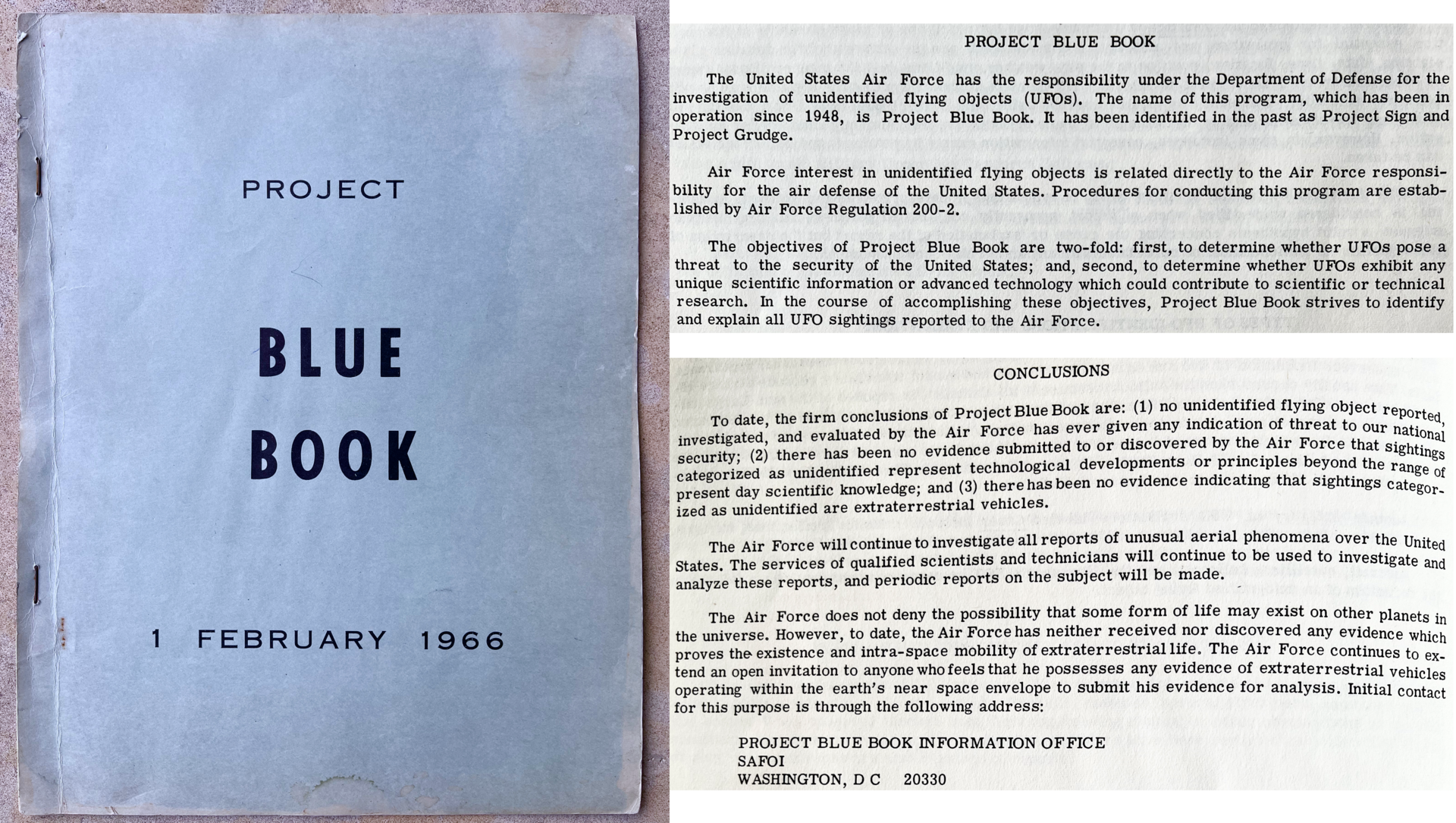
The USAF's 22-year UFO investigation program collected 12,618 sighting reports; 701 remained categorized as 'unidentified' at program closure on 17 December 1969.
status history (1)
Notable & intriguing
-
Project Blue Book accumulated 12,618 sighting reports between 1947 and 1969; 701 remained categorized as ‘unidentified’ at program closure — a 5.5% irreducible residual that the Condon Committee’s recommendation to close the program did not address.
Project Blue Book final report; Sec. of the Air Force Robert C. Seamans memorandum, 17 December 1969
-
Capt. Edward J. Ruppelt, Blue Book director from 1951 to 1953, coined the term ‘UFO’ (Unidentified Flying Object) to replace ‘flying saucer’ precisely so that case files could be organized by their actual ambiguity rather than by the pre-judged saucer shape.
Capt. Edward J. Ruppelt, The Report on Unidentified Flying Objects, 1956, ch. 1
-
Project Sign’s original 1948 ‘Estimate of the Situation’ staff study reportedly concluded the objects were interplanetary in origin; the document was rejected by USAF Chief of Staff Gen. Hoyt Vandenberg for ‘lack of physical evidence’ and subsequently destroyed. No copy is known to survive.
Capt. Edward J. Ruppelt, The Report on Unidentified Flying Objects, 1956, ch. 3 (the only contemporary documentary reference; the document itself is not extant)
Public-record items already documented about this subject. Folklore is labelled. Sources cited where the specificity warrants it.
Suggested watching
-
Project Blue Book (2019) series
History Channel dramatization with Aidan Gillen as Hynek. Cases are composites; the institutional texture of Blue Book is approximated.
fictionalized
-
UFOs Are Real (1979) documentary
Includes Hynek discussing Blue Book on camera from his post-Blue-Book vantage.
primary source
Appears in interpretive theories
- Psychosocial hypothesis — cites as evidence
- Apparatus-response theories — cites as evidence
- Multiple-phenomena / no-unified-explanation hypothesis — cites as evidence
More — investigation
- AARO (2022–present)
- AAWSAP / AATIP (2007–2012)
- Airborne Object Identification and Management Synchronization Group / AOIMSG (November 2021 – July 2022)
- COMETA Report (1999, France)
- Condon Committee Report (1968)
- GEPAN → SEPRA → GEIPAN (1977–present, France)
- NASA UAP Independent Study Team final report (14 September 2023)
- Project Blue Book Special Report No. 14 (1955)
- Project Condign — the UK MoD secret UAP study (1997-2000, released 2006)
- Project GRUDGE (February 1949 – March 1952)
- Project SIGN (July 1947 – February 1949)
- Project Stargate (1972–1995)
- Robertson Panel (14–17 January 1953)
- Sturrock Panel (29 September – 4 October 1998)
- The Pentacle Memorandum (9 January 1953)