McMinnville (Trent) Photographs (11 May 1950) disputed-optical-artifact
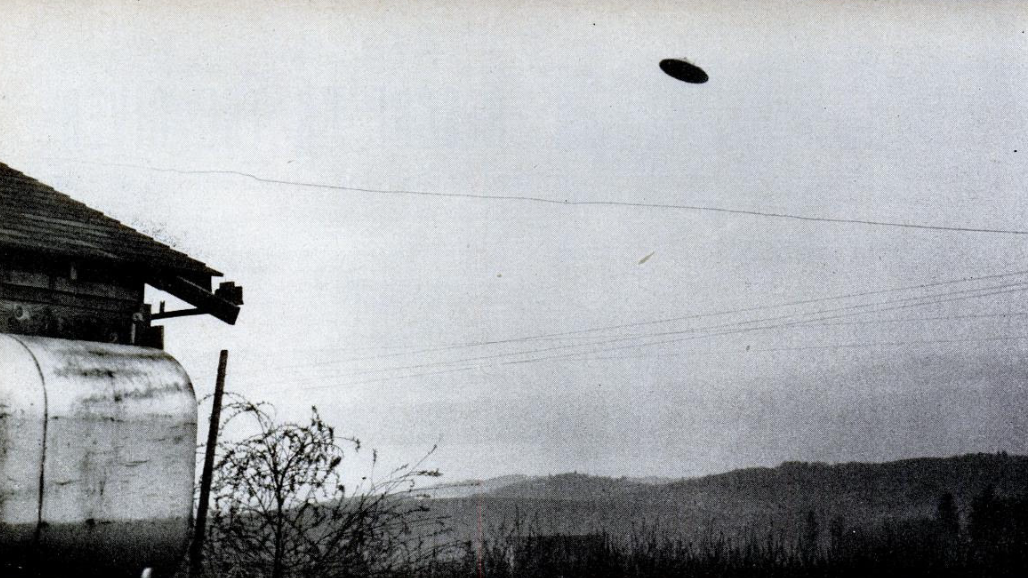
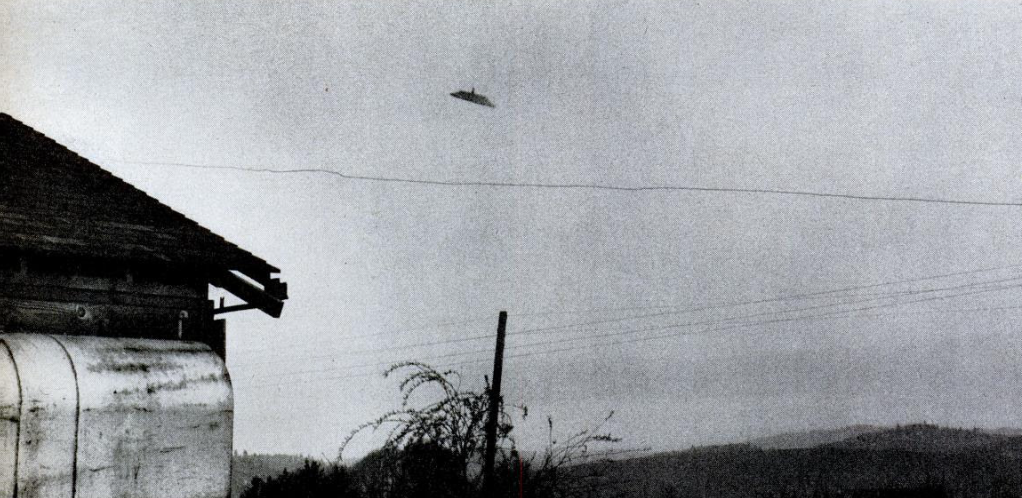
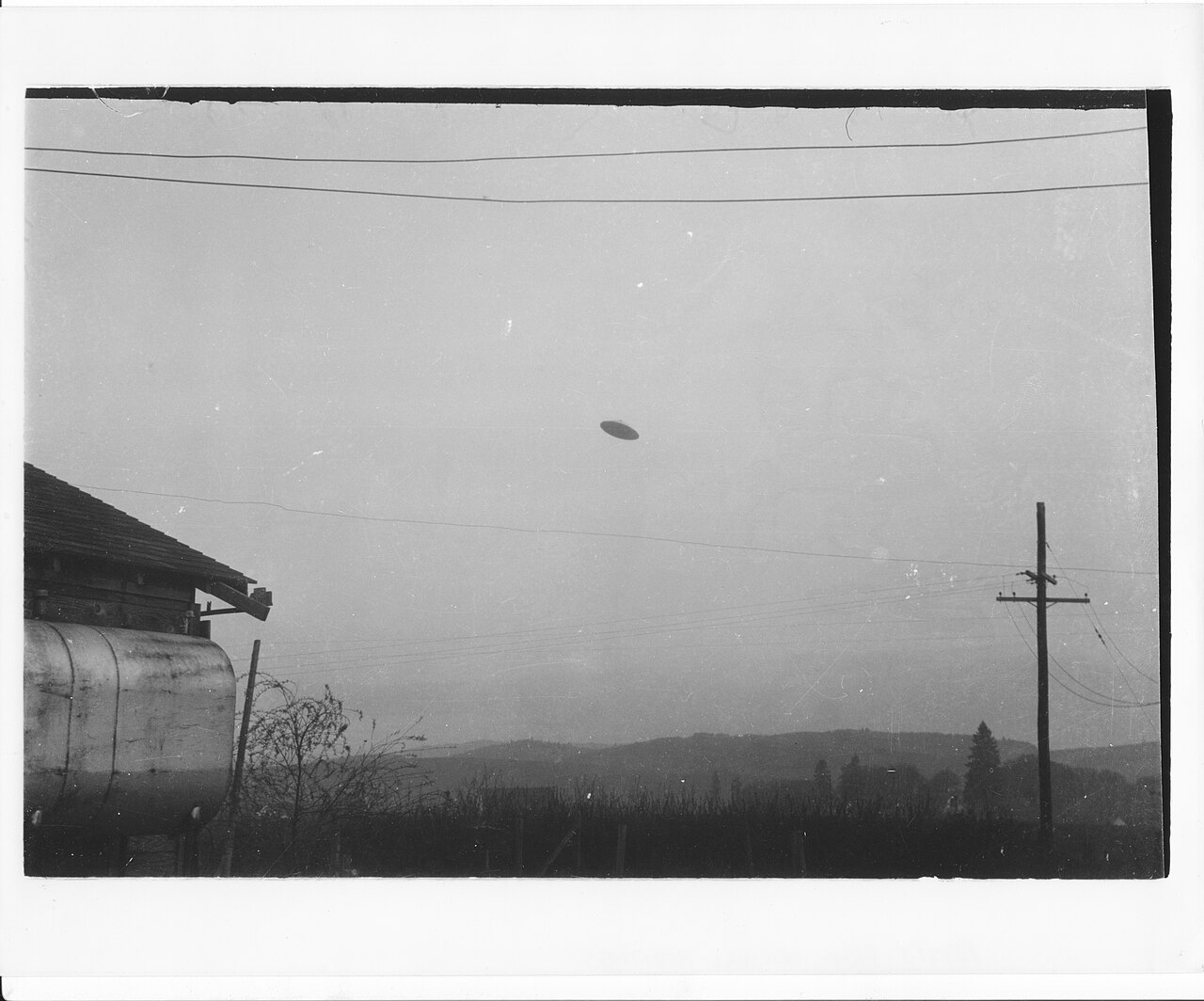
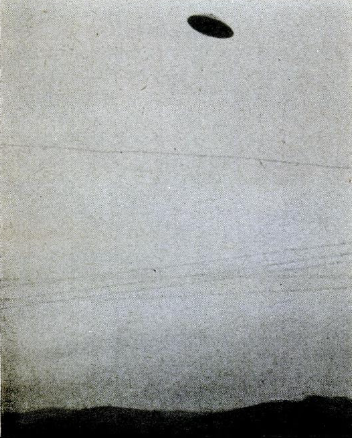
Farmers Paul and Evelyn Trent photographed a metallic disc passing over
their Oregon farm on the evening of 11 May 1950. The two frames ran in the
local paper, then nationally in Life; the Condon Committee's photo analyst
judged them to have 'all the appearances' of an authentic extraordinary
object — and analysts have argued ever since over whether the shadows and
a pair of overhead wires reveal a hoax.
McMinnville is the U.S. photographic-evidence case, the domestic Trindade.
It is unusual in that the establishment's own debunking instrument — the
Condon Report — let its photo section call the images apparently authentic,
while later independent analysts (Sheaffer for hoax, Maccabee for genuine)
fought to a draw over the same two frames. The corpus uses it, paired with
Trindade, to make the authentication problem concrete: chain of custody,
shadow geometry, photometric distance, and the eternally ambiguous overhead
wire.
Timeline
1950-05-11T19:30-0800_approx
Evelyn Trent, on the family farm outside McMinnville, sees a metallic,
disc-shaped object approaching from the northeast. She calls to her
husband Paul, who fetches his Universal Camera Roamer I folding camera
and exposes two frames of the object as it moves overhead before it
departs to the west.
witnesses: Evelyn Trent · Paul Trent
primary source: Trent accounts; Condon Report photo-case writeup
1950-05-late
The Trents develop the film and show the prints to family; they are not
initially eager for publicity. Word reaches a local banker and then the
McMinnville Telephone-Register, which publishes the two photographs on
8 June 1950.
primary source: McMinnville Telephone-Register, 8 June 1950
1950-06-26
Life magazine reproduces the photographs nationally, making them among
the most widely-seen UFO images of the era.
primary source: Life magazine, 26 June 1950
1968
The Condon Committee's photographic-analysis section, led by planetary
scientist William K. Hartmann (University of Arizona), studies the
original negatives and concludes the case is one of the few in which the
photographs are consistent with 'an extraordinary flying object, silvery,
metallic, disk-shaped' — that they have 'all the appearances of being
authentic.' This is one of the strongest positive photo verdicts in the
Condon Report.
witnesses: William K. Hartmann (Condon Committee photo analyst)
primary source: Scientific Study of Unidentified Flying Objects, 1968, photographic case 46
1970s-2000s
The case becomes a long-running analytical duel. Skeptic Robert
Sheaffer argues the shadow directions imply a morning (not evening)
exposure — suggesting the Trents misrepresented the time — and that the
object was a small model suspended from the overhead power wires visible
in the frames. Optical physicist Bruce Maccabee counters with
photometric analysis arguing the object's brightness and apparent
distance are inconsistent with a nearby small model.
witnesses: Robert Sheaffer (hoax analysis) · Bruce Maccabee (authenticity analysis)
primary source: Sheaffer, 'The UFO Verdict' (1981); Maccabee, photometric papers
Named personnel
- Paul Trent — Farmer; photographer of the two frames rank at time: primary witness to: the object and the photographs
- Evelyn Trent — Farmer's wife; first witness rank at time: primary witness to: the object's approach; called Paul to photograph it
- William K. Hartmann — Planetary scientist (University of Arizona); Condon Committee photo analyst rank at time: role: Judged the photographs to have 'all the appearances of being authentic'
- Robert Sheaffer — Skeptical analyst rank at time: role: Argued for a hoax from shadow geometry and the overhead wires
- Bruce Maccabee — Optical physicist; UFO analyst rank at time: role: Defended authenticity via photometric distance/brightness analysis
Sensor record
- Universal Camera Roamer I (120 roll film) on Paul Trent, on the farm two frames of a metallic disc-shaped object overhead documentation: the original negatives (studied by Hartmann; central to all later analysis)
- Photogrammetric / photometric analysis on Hartmann, Sheaffer, Maccabee shadow geometry, image brightness, and apparent distance — the contested measurements documentation: Condon Report; Sheaffer and Maccabee publications
Object — reported
shape
metallic, disc-shaped, with a slight off-center superstructure (a small mast/dome) in the photographs
size
indeterminate — the entire dispute is over whether it is a large distant object or a small near one
surface features
silvery/metallic; no markings
observed behaviors
- approaching from the northeast, passing overhead, departing west (witness account)
- captured static in two frames — the case is the photographs, not a behavior record
Theories that invoke this case (3)
The literal reading IF authentic: a structured metallic disc
photographed in daylight, endorsed by the Condon Committee's own
photo analyst — a benchmark domestic photo case for the ETH.
The cautious reading: a genuinely photographed object of undetermined
nature, treated as an image-forensics problem rather than a confirmed
exotic craft.
The institutional-handling reading: the case is a study in custody and
authority — local paper to Life to the Condon Report's positive photo
verdict — and in how that verdict sat against the report's dismissive
summary.
Theories that do NOT invoke this case — and why
the case turns on a physical photographic artifact and its authentication, not on mass perception
no technology-test framing fits a daylight disc over a rural Oregon farm in 1950
no perceptual phenomenology; a straightforward photographic-object claim
no creature element
Conventional explanations advanced — and their status
A small model suspended from the overhead power wires (a hoax)
proponents: Robert Sheaffer · skeptical analysts
The leading skeptical account: a model hung from the wires visible in the frames, with Sheaffer arguing the shadows imply a morning exposure inconsistent with the Trents' evening account. The corpus weighs this seriously while noting that decades of analysis have not produced a decisive demonstration of the wire-suspension, and that the Trents sought little gain and stuck to their account.
Shadow-geometry indicates the stated time of day is wrong
proponents: Sheaffer
A real analytical point; contested by Maccabee on the basis of lighting and exposure conditions. Part of the unresolved authentication dispute rather than a settled refutation.
Authentic photographs of an unidentified distant object
proponents: Bruce Maccabee · the Condon photo section (Hartmann)
Supported by Hartmann's positive verdict and Maccabee's photometric analysis, but not confirmable to the exclusion of the model hypothesis. The corpus does not grant it over the hoax reading.
Where further investigation has leverage
- Modern high-resolution forensic re-analysis of the original Trent negatives (grain, focus depth, edge effects) to test the near-model versus distant-object hypotheses directly.
- A definitive photometric reconstruction reconciling the shadow-geometry (time-of-day) dispute between Sheaffer and Maccabee.
- Establishing the precise provenance and handling of the negatives from 1950 to the Condon study, to bound any opportunity for fabrication.
- 3D reconstruction from the two frames to constrain the object's size and distance against the known geometry of the farm and the wires.
Corpus status
disputed-optical-artifact
Held disputed on purpose, the American Trindade. The Condon Committee's own
photo analyst judged the two frames apparently authentic; later analysts
fought to a standstill over shadow geometry and a pair of overhead wires.
The realistic options are a genuine distant disc or a small suspended model;
innocent misidentification does not fit. Without a decisive modern forensic
result on the original negatives, the corpus declines to resolve it and uses
McMinnville, with Trindade, as its reference pair for the limits of
photographic evidence.
status history (1)
2026-06-09 · unannotated → disputed-optical-artifact
— initial annotation sweep (Epic J.F4)
Threads of evidence
This case is one node in the connections that run across the record. It appears in 1 thread: