The Robertson Panel apparatus-event
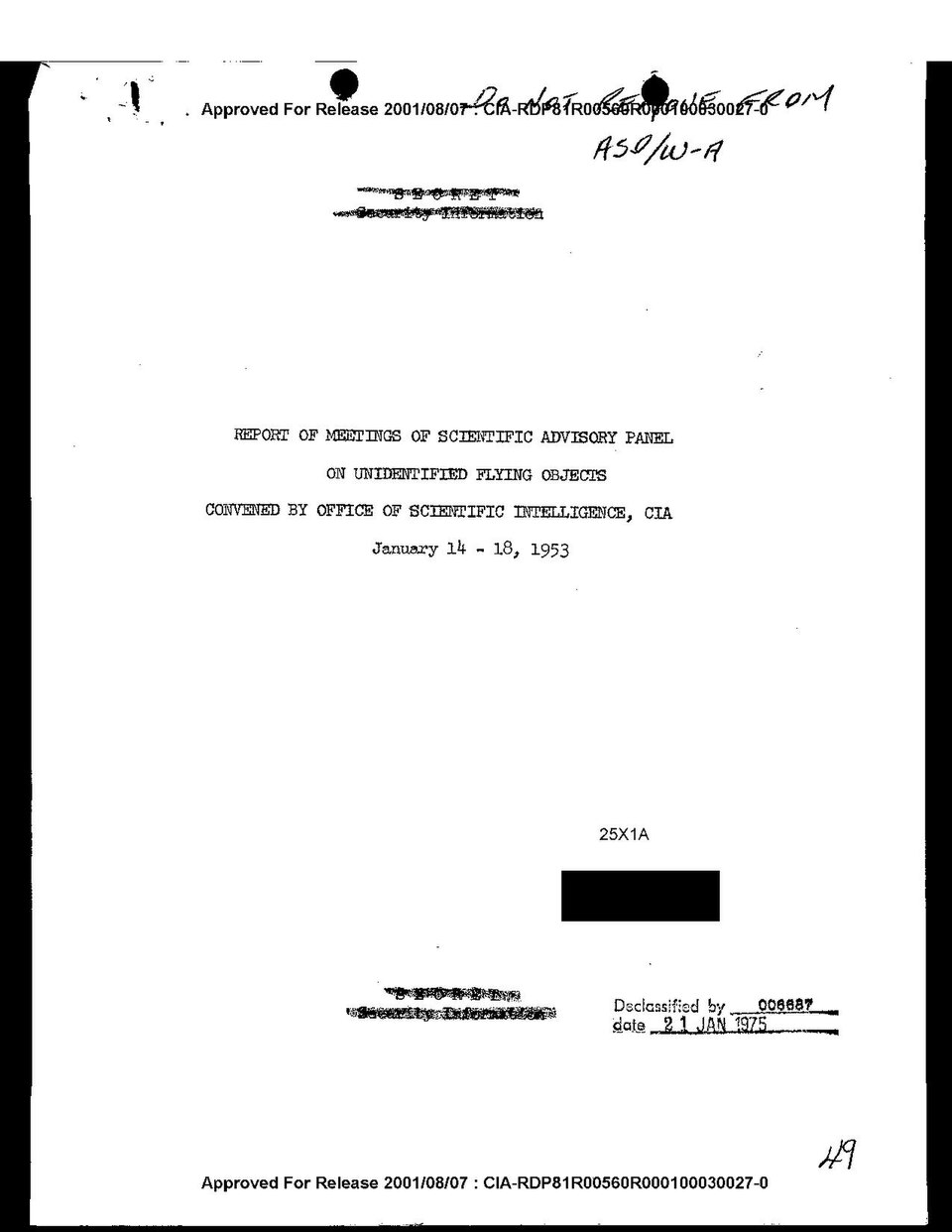
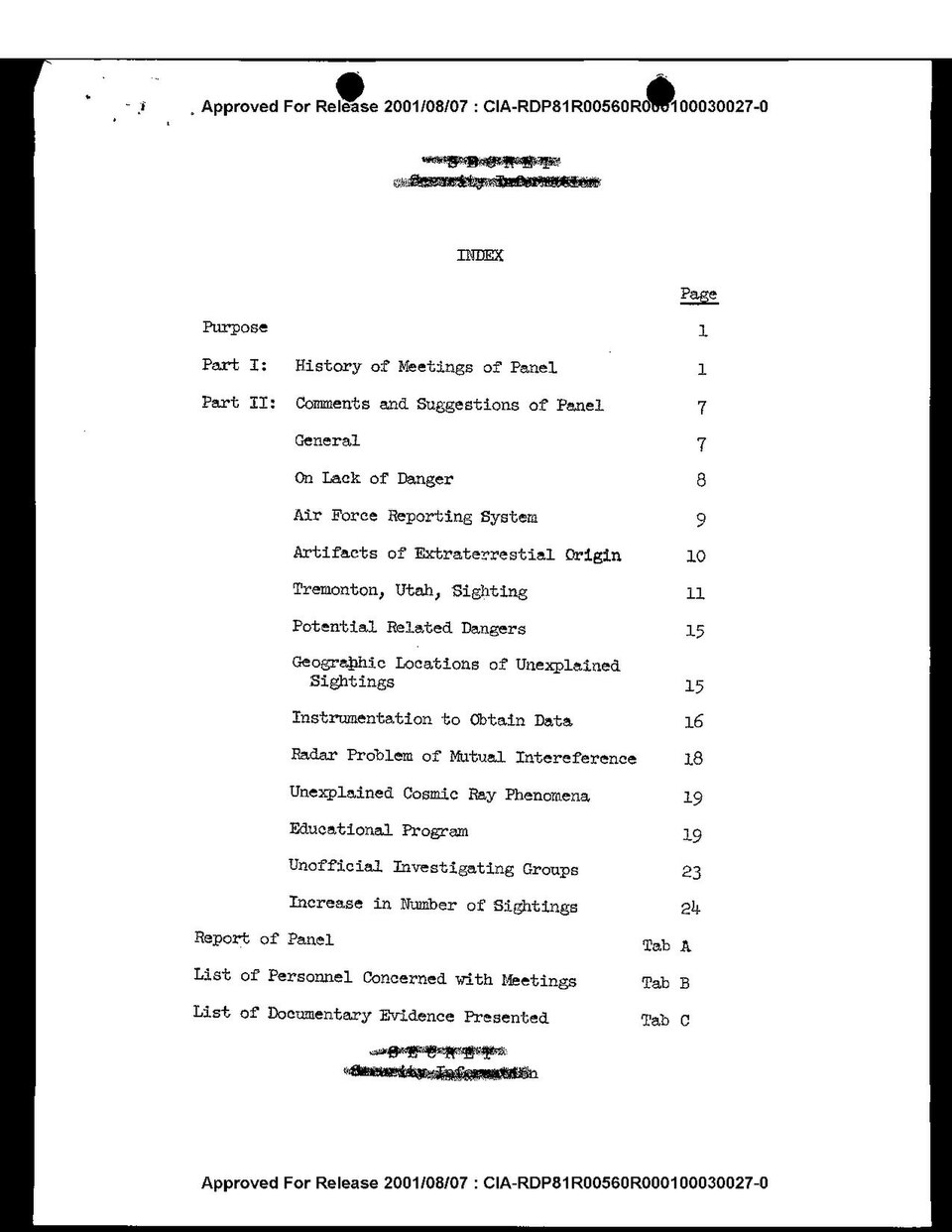
The Robertson Panel was a CIA-convened group of physical scientists that
met about twelve hours over four days in January 1953 to assess whether
UFOs threatened national security. It concluded they did not, but
recommended an official "debunking" and public-education campaign to
reduce public interest, plus surveillance of civilian UFO groups —
recommendations that hardened the U.S. government into a durable
dismissive, secrecy-minded posture.
The Robertson Panel is arguably the single most consequential government
action in official U.S. UFO policy. CIA historian Gerald Haines wrote
there is "no more pivotal event in the CIA's involvement with UFOs." It
converted an open intelligence question into a public-relations problem;
after 1953 Project Blue Book pivoted to debunking and was defanged as an
investigator. The CIA kept its sponsorship secret for decades, which — by
its own historian's account — "contributed greatly to later charges of a
CIA conspiracy and coverup." It is the corpus's keystone for how secrecy
itself manufactures the mythology it was meant to suppress.
Timeline
1952-07
The Washington, D.C. radar-visual flap and the broader summer 1952
wave alarm the CIA, whose internal memos worry about UFO reports
"clogging the channels of communication" and about Soviet psychological-
warfare exploitation. In December 1952 the CIA recommends a scientific
panel to the Intelligence Advisory Committee.
primary source: Haines (CIA, 1997); CIA memos summer-Dec 1952
1952-08
CIA Director Walter Bedell Smith pushes for a scientific review of the
problem — the push that culminates in the December 1952 recommendation
to the Intelligence Advisory Committee.
primary source: Haines (CIA, 1997)
1953-01-14
The panel meets (sessions 14-17 January), about twelve hours total,
reviewing case files and two films (the Tremonton, Utah film of July
1952 and the Great Falls, Montana film of August 1950). It examines
only a small fraction of the available cases (roughly two dozen of
some 2,300).
primary source: Wikipedia; Durant Report
1953-01-17
The panel concludes there is "no indication that these phenomena
constitute a direct physical threat to national security," but flags
indirect dangers (overloaded air-defense channels, mass hysteria, enemy
psychological warfare). Frederick Durant drafts the summary (the "Durant
Report") with three recommendations: debunk, educate the public via mass
media, and monitor civilian UFO groups.
primary source: Durant Report; Wikipedia
1953-1954
The debunking posture is institutionalized: JANAP 146 (Dec 1953) and a
revised Air Force Regulation 200-2 (1954) attach penalties to the
unauthorized release of UFO reports. Blue Book follows the debunking
policy "assiduously after 1953."
primary source: Wikipedia; Haines (1997)
1956-1978
Ruppelt's 1956 book first publicly reveals the panel's existence; in
1958 the Air Force releases only three summary paragraphs and the
members' names, with a substantially full version surfacing in 1966;
the CIA releases roughly 800 pages after 1978 litigation; in 1997
Haines publishes the official CIA account. The decades of concealed
sponsorship fuel the conspiracy narrative the panel had hoped to
suppress.
primary source: Ruppelt (1956); Haines (1997)
Named personnel
- H. P. Robertson — Chairman; Caltech physicist and CIA consultant rank at time: role: the panel's namesake and lead
- Luis W. Alvarez — Physicist and radar expert (later a Nobel laureate) rank at time: role: the radar-skeptic voice on the panel
- Samuel Goudsmit & Lloyd Berkner — Nuclear physicist (Brookhaven) and physicist/geophysicist rank at time: role: the panel's physical-science membership
- Thornton Page — Astrophysicist (Johns Hopkins) who later publicly reassessed his position rank at time: role: a panelist who came to doubt the panel's dismissiveness
- J. Allen Hynek — Astronomer and Blue Book consultant; attended as an associate, not a voting member rank at time: role: the insider who later became the panel's most prominent scientific critic, arguing it made UFOs 'scientifically unrespectable' for nearly two decades
- Frederick C. Durant — Secretary; author of the summary 'Durant Report' that carried the recommendations rank at time: role: the drafter of the debunking and surveillance language
- H. Marshall Chadwell — CIA Assistant Director, Office of Scientific Intelligence, who assembled the panel rank at time: role: the CIA official behind the panel; his summer-1952 memos prefigure its concerns
Theories that invoke this case (3)
The Robertson Panel is the corpus's paradigm: a documented, deliberate
recommendation to strip UFOs "of the special status they have been
given," to use mass media to "reduce the current gullibility of the
public," and to watch civilian groups — official perception management
in plain text.
The arc-of-disclosure reading treats the panel as the formal beginning
of the secrecy the modern era is supposedly unwinding — the policy whose
reversal disclosure would represent.
The panel is the apparatus deciding how to respond: its choice to manage
the public rather than resolve the question is the clearest single act
of institutional framing in the record.
Theories that do NOT invoke this case — and why
the panel produced policy, not evidence for or against any object's origin
a scientific review panel, not a creature report
no phenomenology — an intelligence-policy document
the institution managing mass perception, not itself a perception event (though it explicitly weaponized the psychology of belief)
Where further investigation has leverage
- CIA / FBI operational records of any ACTUAL surveillance of civilian groups (APRO, NICAP, CSI) — Haines found no direct evidence the CIA itself monitored them; such records, if they exist, may sit with the FBI.
- The full Chadwell / Office of Scientific Intelligence summer-1952 memos, to test the 'orchestration' thesis that the panel's conclusions were taken straight from pre-existing CIA concerns.
- Records of any media-coordination substantiating implementation of the public-education recommendation (e.g., later television treatments).
- The complete declassified panel file beyond the ~800 pages released after 1978.
- The unsanitized internal record behind the panel — the CIA's prepared release deleted references to its own involvement and to the psychological-warfare concern; the unredacted file would bear directly on the suppression-vs-prudent-management question.
- The accounting behind Haines's 1997 finding that over half of later-1950s sightings were classified U-2/OXCART flights 'explained away' as natural phenomena — the documented mundane cover the panel's posture facilitated.
- The original Tremonton and Great Falls films re-analyzed with modern photogrammetry, against the panel's dismissive readings.
Corpus status
apparatus-event
Documented and verbatim: the panel met in January 1953, concluded UFOs were
no direct physical threat, and recommended debunking, mass-media public
education, and watching civilian UFO groups; the downstream regulations
(JANAP 146, AFR 200-2) followed. Interpretive: whether the conclusions were
"pre-cooked" by the CIA (the panel reviewed only a fraction of cases in
twelve hours, and its concerns mirror prior CIA memos) and whether the
recommended surveillance was actually carried out — Haines says there is no
direct evidence the CIA did so. The most consequential single act in
official U.S. UFO policy, and the origin of the secrecy that, by the CIA's
own assessment, seeded the conspiracy beliefs it meant to quiet.
status history (1)
2026-06-09 · unannotated → apparatus-event
— annotated before the 2026-06-09 sweep; history begins at seeding
Suggested watching
documentary · 2013 · Tubi / Prime / various
Mirage Men
Argues the Robertson Panel's recommended debunking program created the institutional conditions for the later counterintelligence operations against Bennewitz.
documentary · 2020 · Prime / Apple / various
The Phenomenon
Fox treats the Robertson Panel as the founding institutional event of US UAP secrecy.
Threads of evidence
This case is one node in the connections that run across the record. It appears in 1 thread: