Shag Harbour Incident (4 October 1967) phenomenologically-open
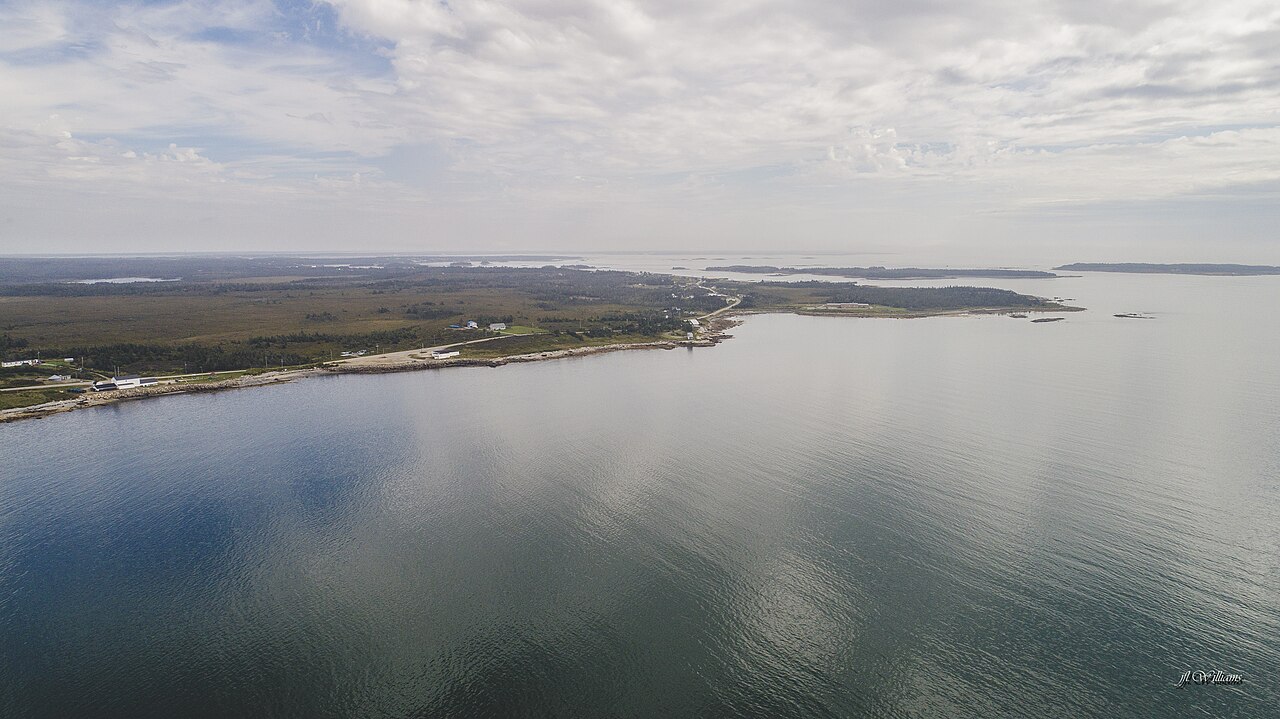
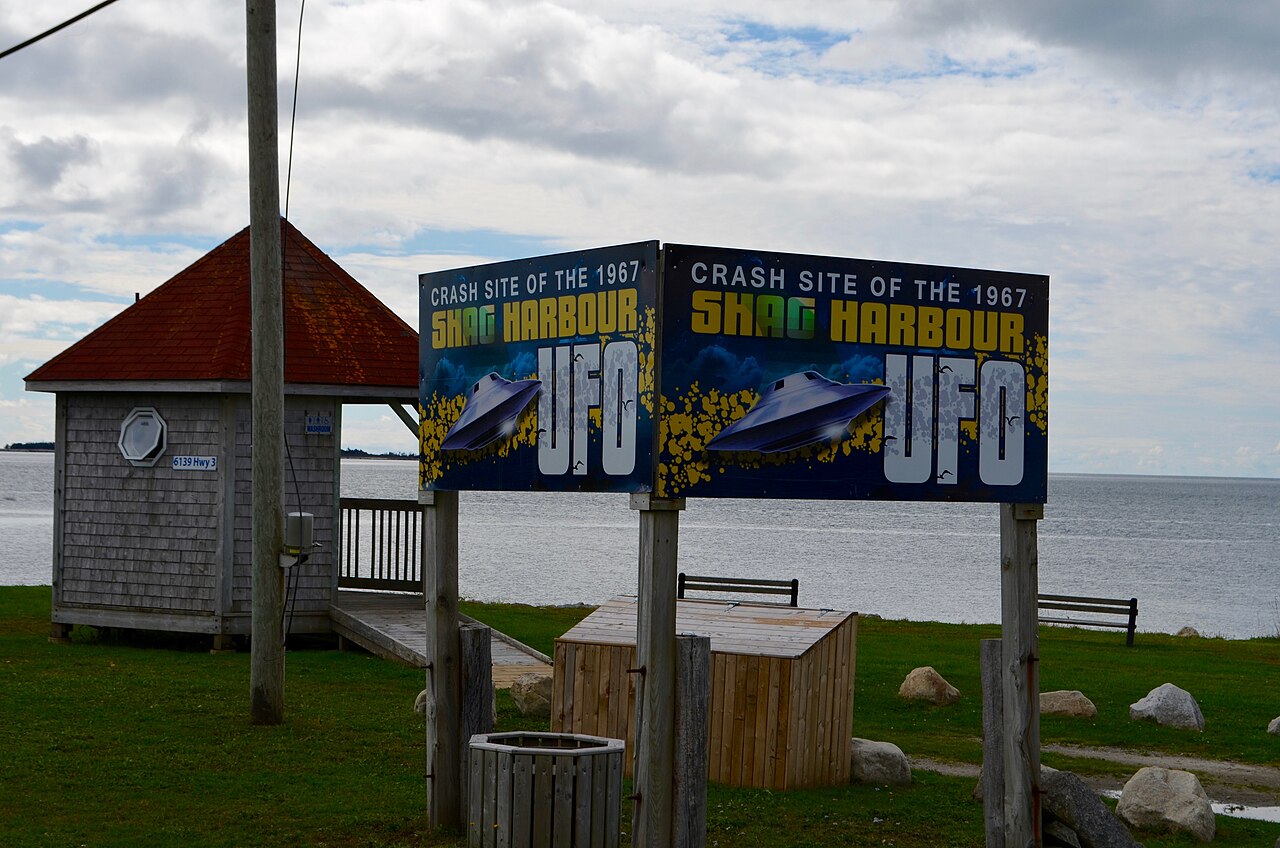
On the night of 4 October 1967, multiple independent witnesses —
including RCMP Cst. Ron O'Brien and several local teenagers — watched a
roughly 60-foot object with four sequenced lights descend at a shallow
angle and enter the water off Shag Harbour, leaving a trail of yellow
foam. The RCMP responded within half an hour and the Royal Canadian Navy
deployed clearance divers for several days. Canada's official file calls
the object 'unidentified.'
Shag Harbour is the corpus's clearest transmedium case from the radar
era: not lights in the sky but an object that descended under apparent
control and went INTO the ocean, witnessed by a sworn officer and
multiple civilians, with an immediate naval dive search and a surviving
Department of National Defence file. It anchors the 'USO' / water-entry
thread that runs forward to the modern Navy encounters and to AARO's
explicit 'transmedium' charter — and it shows what the documentary record
looks like when a government treats a splashdown as a search-and-rescue
problem rather than a UFO report.
Timeline
1967-10-04T23:20-0400_approx
Several groups of witnesses near Shag Harbour — including local
teenagers Laurie Wickens, Norman Smith, and David Kendrick — see a
low-flying object with four bright lights flashing in sequence descend
at a shallow angle and strike the water roughly 250–300 m offshore,
with a bright flash and a whistling/whooshing sound. They initially
take it for an aircraft crash.
witnesses: Laurie Wickens, Norman Smith, David Kendrick (and others, ~11 witnesses)
primary source: DND file (RG 77); Ledger & Styles, 'Dark Object'
1967-10-04T23:30-0400_approx
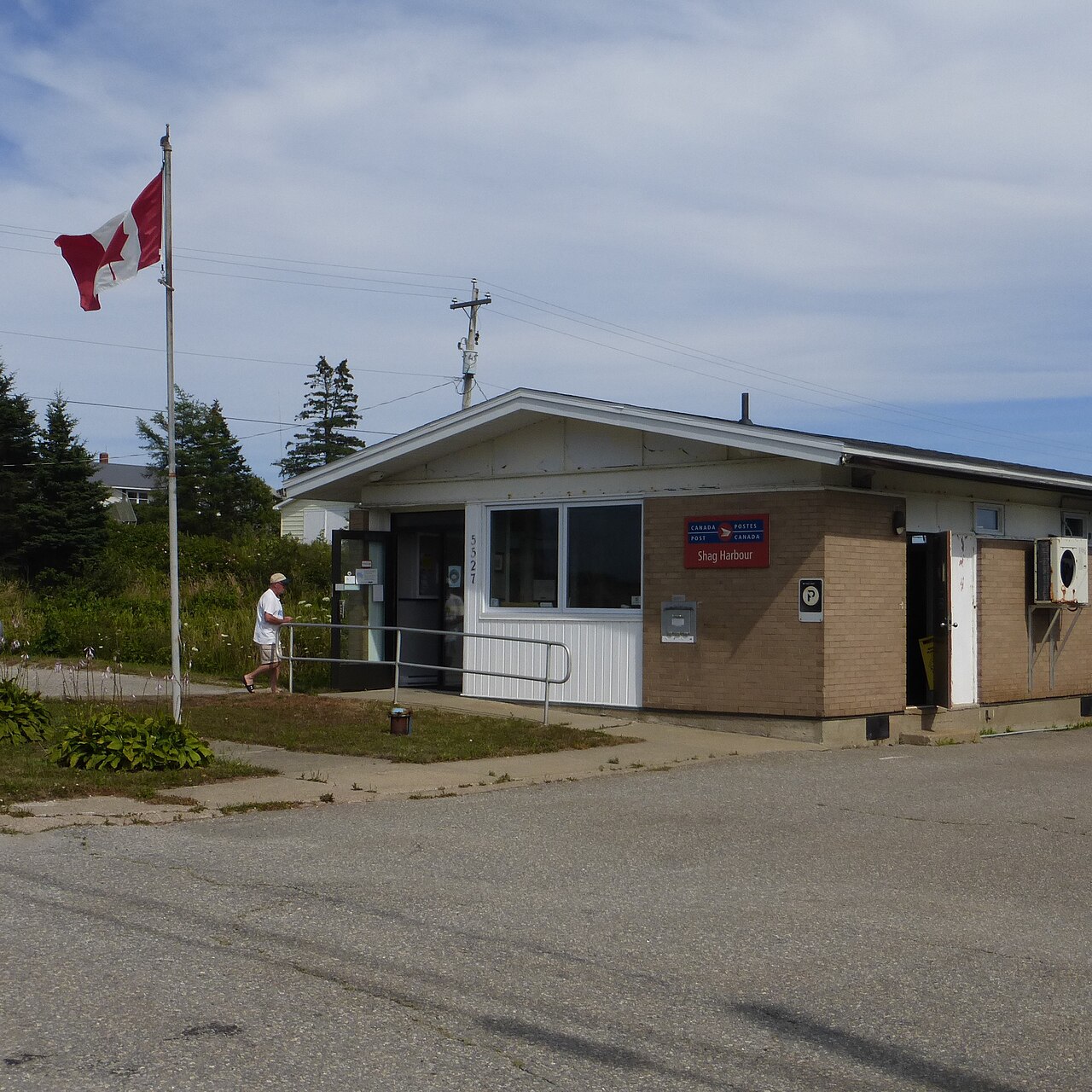
Laurie Wickens reports a 'plane crash' to the RCMP detachment at
Barrington Passage. RCMP Cst. Ron O'Brien and Cst. Ron Pound respond
and, with other officers, observe a pale yellow light still visible on
the water moving slowly, leaving a band of yellowish foam. The RCMP
contact the Rescue Coordination Centre at CFB Halifax.
witnesses: RCMP Cst. Ron O'Brien · RCMP Cst. Ron Pound (and other officers)
primary source: RCMP report in the DND file
1967-10-05T00:30-0400_approx
Local fishing boats put out to the foam site searching for survivors,
finding only the yellow foam and a sulphur-like smell — no wreckage,
no bodies, no oil slick. The Coast Guard cutter from Clark's Harbour
arrives; the area is treated as a possible downed-aircraft scene.
witnesses: local fishermen · Canadian Coast Guard
primary source: DND file; contemporaneous accounts
1967-10-05_daytime
A check confirms no aircraft (civil or military) is missing. The event
is reclassified from a crash to an unidentified object. The Royal
Canadian Navy diverts vessels (including HMCS Granby) toward the scene.
primary source: DND file; RCAF/NORAD missing-aircraft checks
1967-10-06_to_-08
Royal Canadian Navy clearance divers from the Naval Underwater Diving
Establishment at CFB Halifax search the impact area over roughly three
to four days. They recover no debris; the official record reports the
surface foam persisted for around a day after impact.
witnesses: Royal Canadian Navy clearance divers
primary source: DND file (RG 77)
1967-1970s
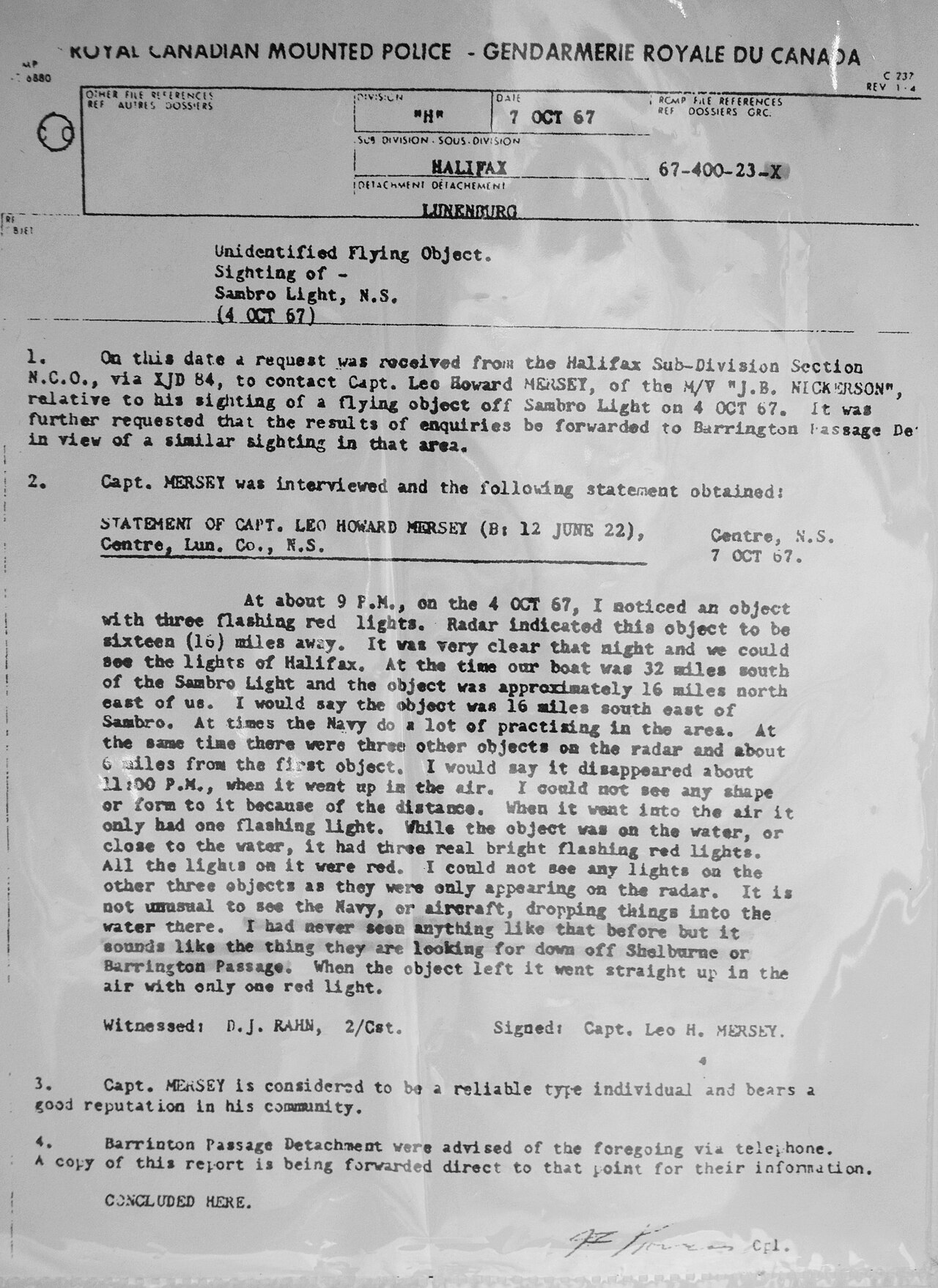
The Department of National Defence file is closed with the object
logged as 'unidentified'; no explanation is offered. The file (RCMP,
Maritime Command, and Department of Transport correspondence) is
declassified through Library and Archives Canada in stages from the
1970s.
primary source: DND file (RG 77), Library and Archives Canada
2001
Don Ledger and Chris Styles publish 'Dark Object,' the definitive case
reconstruction, compiling the witness accounts and the official file
and arguing that neither a meteor nor an aircraft component fits the
reported slow, controlled descent and structured multi-light appearance.
primary source: Ledger & Styles, 'Dark Object' (2001)
Named personnel
- RCMP Cst. Ron O'Brien — Royal Canadian Mounted Police constable, Barrington Passage detachment rank at time: primary witness to: the pale light and yellow foam on the water shortly after impact
- RCMP Cst. Ron Pound — RCMP constable, responding officer rank at time: primary witness to: the object/light on the water and the coordination of the response
- Laurie Wickens — Local witness (teenager) who first reported the event to the RCMP rank at time: primary witness to: the controlled descent and water impact
- Norman Smith and David Kendrick — Local teenage witnesses rank at time: primary witness to: the object's descent and the four sequenced lights
- Royal Canadian Navy clearance divers (Naval Underwater Diving Establishment) — RCN dive team, CFB Halifax rank at time: role: Conducted the multi-day underwater search of the impact site
- Don Ledger and Chris Styles — Investigators / authors of 'Dark Object' (2001) rank at time: role: Reconstructed the case from witnesses and the declassified file
Sensor record
- Mark 1 eyeballs (multiple independent witnesses, incl. RCMP) on ground/shore witnesses and responding officers a ~60-foot object with four sequenced lights descending at a shallow angle and entering the water; a pale light moving on the surface afterward documentation: RCMP report and witness statements in the DND file
- Underwater dive search (RCN clearance divers) on Naval Underwater Diving Establishment, CFB Halifax no debris recovered; yellow surface foam noted ~24 hours documentation: DND file (RG 77)
- Aircraft-accounting checks (RCAF / NORAD) on national air-defense and civil-aviation records no missing aircraft — the datum that reclassified the event from a crash to an unidentified object documentation: DND file
Object — reported
shape
elongated/structured object roughly 60 feet long, carrying four bright lights that flashed in sequence
size
~60 feet (witness estimate)
surface features
lights flashing in sequence; no conventional aircraft form reported
observed behaviors
- a slow, shallow-angle, apparently controlled descent (not a ballistic fall)
- entry into the ocean ~250–300 m offshore with a flash and a whistling sound
- a pale light moving slowly on or just under the surface afterward
- leaving a band of yellow foam and a sulphur-like odor, then no recoverable debris
Theories that invoke this case (5)
The standard reading: a structured craft under control that entered
the ocean and left no wreckage, witnessed by a sworn officer and
multiple civilians — a transmedium event beyond 1967 capability.
The cautious reading: a real physical object whose water-entry and
lack of recoverable debris pose a concrete physics/search problem
rather than a confirmed exotic craft.
The non-biological reading: a controlled, unmanned object operating
across air and water domains, consistent with autonomous transmedium
operation.
The Cold-War reading, with local color: the Shelburne area hosted a
NATO underwater acoustic/submarine-detection range, and some accounts
speculate a classified test. Counter-argument: a friendly test would
not trigger a genuine multi-day RCN search-and-rescue and an open
'unidentified' file. NOTE (2026 re-audit): the dramatic 'second object
near Shelburne + military retrieval' sequel rests ENTIRELY on anonymous,
off-the-record sourcing in Ledger & Styles' 'Dark Object' with no
documentary corroboration, and should carry near-zero evidential weight —
the corpus's keystone status rests on the documented 1967 core event, not
this sequel.
The institutional-handling reading: a model of a government treating
a splashdown as search-and-rescue — RCMP, RCN divers, a closed
'unidentified' file — and the contrast with the U.S. classify-and-deny
posture.
Theories that do NOT invoke this case — and why
multiple independent witnesses including a sworn officer, plus a documented naval response, make a mass-perception reading untenable
a concrete physical water-impact event, not an anomalous perceptual experience
no creature element; a structured-object splashdown
no time-displacement narrative
Conventional explanations advanced — and their status
A meteor or bolide that appeared to enter the water
proponents: skeptics · considered in 'Dark Object'
Does not fit the reported slow, shallow, controlled descent, the four sequenced lights, or the pale light seen moving on the surface after impact. A bolide is fast, ballistic, and singular. The corpus assigns it low weight.
A crashing or jettisoned aircraft / aircraft component
proponents: initial working hypothesis
Directly excluded by the official accounting: no civil or military aircraft was missing, which is precisely what reclassified the event to 'unidentified.'
Marine distress flares
proponents: Brian Dunning (Skeptoid #565) · general skeptical position
On 2026 re-audit, the single strongest prosaic candidate — and the corpus had overstated its exclusion. The official Coast Guard telex said all leads (aircraft, flares, etc.) were 'checked — nil results,' which means none were FOUND, not that flares were affirmatively ruled out; witnesses also disagree on whether there were three or four lights and on color. Flares are not excluded by the record — but they do not naturally fit the persistent pale light seen MOVING on the surface after impact, or the localized yellow foam, which is why the case is not downgraded.
A classified military test (NATO acoustic range nearby)
proponents: speculative readings in 'Dark Object'
Geographically suggestive but unsupported: a sanctioned test would not generate a real RCN search-and-rescue and an open unidentified file, and no such test is documented.
Where further investigation has leverage
- A complete, indexed release of the DND RG 77 Shag Harbour correspondence, including any Maritime Command dive-team logs and sonar records not yet public.
- Any surviving RCN sonar or dive-survey data from the search area, for a modern seabed re-survey.
- Analysis of the reported yellow foam's described properties against known phenomena (fuel, bioluminescence, sediment) to test mundane-residue hypotheses.
- Cross-checking with NATO/Canadian records of the nearby Shelburne acoustic range to definitively include or exclude a test-origin explanation.
Corpus status
phenomenologically-open
The best-documented 20th-century water-impact case: a controlled descent
and ocean entry witnessed by multiple independent observers including a
sworn RCMP officer, an immediate RCMP and Royal Canadian Navy response,
and a surviving 'unidentified' national-government file. The meteor and
aircraft-component accounts do not fit the controlled descent and
structured multi-light appearance, and the missing-aircraft check excludes
the crash hypothesis. The corpus holds it open as its keystone transmedium
precursor to the modern Navy record.
status history (1)
2026-06-09 · unannotated → phenomenologically-open
— initial annotation sweep (Epic J.F4)
Threads of evidence
This case is one node in the connections that run across the record. It appears in 1 thread: