Washington National Flap disputed-optical-artifact
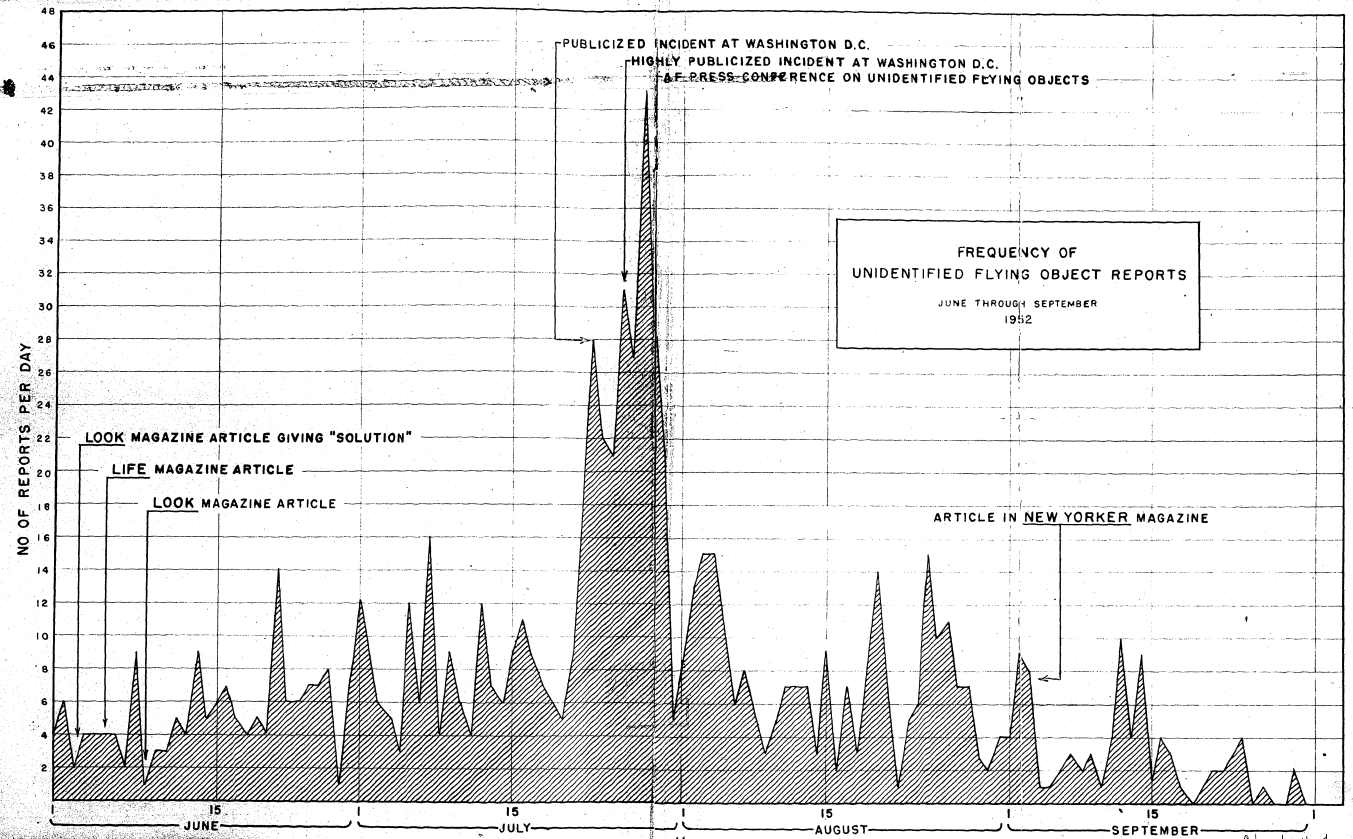
On two consecutive July weekends in 1952, multiple radar sets at
Washington National Airport and Andrews Air Force Base painted
unidentified high-speed targets over the U.S. capital, corroborated by
airline and military pilots and unsuccessful F-94 jet intercepts. The
episode triggered the largest Pentagon press conference since WWII, at
which the Air Force attributed the events to temperature inversions —
an explanation the radar controllers themselves rejected, and which
remains contested.
Washington 1952 is the corpus's keystone radar-visual case and a
keystone institutional event. Unlike most reports it combined
simultaneous multi-station radar tracking with independent visual
sightings — over the White House and Capitol. It provoked the biggest
Air Force press conference since World War II (29 July 1952) and was a
primary catalyst for the CIA's Robertson Panel (January 1953), which
set U.S. policy toward public debunking for two decades. The case is
where the phenomenon collided directly with the machinery of the state,
and where the gap first opened between what instrument operators
reported and what the official explanation asserted.
Timeline
1952-07-19_2340
Air traffic controller Edward Nugent, at the Air Route Traffic
Control (ARTC) center at Washington National, detects seven objects
on radar ~15 miles SSW of the city, on no established flight path.
Senior controller Harry Barnes confirms; a second National radar
center (Howard Cocklin, Joe Zacko) and Andrews AFB radar also track
objects. Tower personnel and pilots make visual sightings.
witnesses: Edward Nugent (ARTC controller, National) · Harry Barnes (senior controller, National) · Howard Cocklin and Joe Zacko (second National radar center)
primary source: Wikipedia; Ruppelt (1956); History.com
1952-07-20_0300
Two F-94 Starfire jets from New Castle AFB, Delaware arrive over
Washington; the objects vanish from National's radar. When the jets
depart low on fuel, the objects return. Last radar detections end
around 05:30. Capital Airlines pilot Capt. S. C. Pierman, airborne
during the event, reports six white, tailless, fast lights over ~14
minutes; Barnes reports each visual sighting coincided with a radar
pip near Pierman's aircraft.
witnesses: Capt. S. C. Pierman (Capital Airlines DC-4 pilot)
primary source: Wikipedia; Ruppelt (1956)
1952-07-26_2015
The second weekend opens: a National Airlines crew sees lights, and
the National and Andrews radars again track unknowns. Blue Book
press spokesman Albert M. Chop arrives ~21:30; radar shows targets
in all sectors. Two F-94s arrive ~23:30; flight leader Capt. John
McHugo sees nothing, but wingman Lt. William Patterson chases four
white "glows" and cannot close on them.
witnesses: Lt. William Patterson (F-94 wingman) · Albert M. Chop (Blue Book press spokesman, in the radar room)
primary source: Wikipedia; History.com
1952-07-27_0030
Maj. Dewey Fournet (Blue Book's Pentagon liaison) and Lt. John
Holcomb (Navy radar specialist) reach the National radar center. The
weather station reports a slight temperature inversion; Holcomb
judges it too weak to explain the "good and solid" returns. Fournet
reports that everyone present believed the targets were solid
metallic objects. Sightings end around sunrise. Notably, neither
Fournet nor Holcomb appears at the subsequent press conference.
witnesses: Maj. Dewey Fournet (Blue Book Pentagon liaison) · Lt. John Holcomb (Navy radar specialist)
primary source: Wikipedia; Ruppelt (1956)
1952-07-29
Maj. Gen. John A. Samford, USAF Director of Intelligence, holds the
largest Pentagon press conference since World War II. He attributes
the visual sightings to misidentified stars and meteors and the
radar returns to temperature inversion, concluding the events were
"not caused by solid material objects" and posed "no threat to
national security." Capt. Roy James of ATIC is the principal
proponent of the inversion / anomalous-propagation interpretation.
witnesses: Maj. Gen. John A. Samford (USAF Director of Intelligence) · Capt. Roy James (ATIC radar officer)
primary source: Wikipedia; History.com; Ruppelt (1956)
1952-09-24
A CIA memo to Director of Central Intelligence Walter Bedell Smith
warns of the "national security implications" of the sighting wave
and the "potential for the touching-off of mass hysteria and panic."
The concern is less the objects than the vulnerability: that the
Soviets could flood U.S. air-defense channels with false reports to
mask a real attack.
primary source: CIA memo, 24 Sept 1952; Haines (1997)
1953-01-14
The CIA-convened Robertson Panel meets (14–18 January 1953),
directly downstream of the summer wave. It recommends debunking
UFO reports and stripping the subject of its "special status" — the
institutional posture that governed U.S. handling for two decades.
primary source: Robertson Panel report; Haines (1997)
Named personnel
- Harry Barnes — Senior ARTC controller at Washington National; coordinated the tracking and went public rank at time: · later: Authored a widely syndicated account stating the targets' movements were 'completely radical compared to those of ordinary aircraft' and unlike the inversion effects he knew primary witness to: the radar tracks and their correlation with Pierman's visual sightings
- Edward Nugent — ARTC controller at National; first to detect the seven targets at 23:40 on 19 July rank at time: primary witness to: the initial radar detection
- Capt. S. C. Pierman — Capital Airlines DC-4 pilot; saw six white, tailless, fast lights over ~14 minutes, correlated by Barnes with radar pips rank at time: primary witness to: the airborne visual corroboration
- Maj. Gen. John A. Samford — USAF Director of Intelligence; led the 29 July press conference and advanced the temperature-inversion explanation rank at time: role: author of the official explanation
- Capt. Roy James — ATIC radar officer; principal proponent of the inversion / anomalous-propagation reading at the press conference rank at time: role: technical architect of the official explanation
- Maj. Dewey Fournet & Lt. John Holcomb — Blue Book Pentagon liaison and Navy radar specialist, present in the radar room on 27 July rank at time: · later: Both disagreed with the inversion explanation, judging the returns solid; both were absent from the press conference primary witness to: the live radar room's assessment that the targets were solid objects
- Capt. Edward J. Ruppelt — Head of Project Blue Book; largely out of the loop during the events while travelling rank at time: · later: His 'Big Flap' chapter (1956) records his own unease — Washington sat under a mild inversion almost every summer night, yet the radar rooms did not routinely paint UFOs role: the corpus's chief institutional narrator and an internal skeptic of the official verdict
Sensor record
- ARTC (Air Route Traffic Control) center radar on Washington National Airport the initial seven targets and subsequent tracks on no established flight path; speeds reported up to several thousand mph with abrupt reversals (figures derived from plot interpretation, the very point the inversion hypothesis disputes) documentation: ARTC plots; summarized in Blue Book file and Ruppelt (1956)
- Second National radar center / tower radar on Washington National Airport (Cocklin / Zacko) independent confirmation of targets; Cocklin maintained in 2002 'I saw it on the screen and out the window' documentation: controller statements; Wikipedia
- Andrews AFB radar and control tower on Andrews Air Force Base simultaneous tracking; at one point all three scopes reportedly held a single object over a radio beacon and lost it from all three at once documentation: Blue Book file; Ruppelt (1956)
- F-94 Starfire airborne intercept (radar + visual) on New Castle AFB interceptors over Washington inconclusive on both weekends — targets vanished when jets arrived (20 July) or could not be overtaken (Patterson, 27 July) documentation: pilot reports relayed via Chop; limited primary documentation
Theories that invoke this case (4)
The classic ETH reading: solid, fast, maneuvering objects on
multiple independent radars over the capital, corroborated by
pilots, that conventional aircraft of 1952 could not match.
The cautious reading: some real object(s) produced the solid,
multi-station returns that the live radar operators insisted were not
propagation artifacts; the physics is treated as a data point
demanding the original plot logs, not an exotic conclusion.
The atmospheric reading the official explanation rests on:
temperature-inversion ducting bends radar onto ground returns and
refracts lights, producing convincing false targets. Invoked as the
mechanism behind the Samford verdict.
The institutional reading: the case's most legible content is the
state's reaction — the largest press conference since WWII, the
absence of the dissenting radar-room officers from the podium, and
the straight line to the Robertson Panel and two decades of debunking
policy.
Theories that do NOT invoke this case — and why
no entity or creature observed — a pure radar-and-light aerial case
no associated phenomenology (missing time, witness disorientation, poltergeist effects) beyond the aerial tracks themselves
hard to sustain against simultaneous independent radar at multiple stations plus airborne pilot corroboration; instrument records are not subject to mass-suggestion explanation
Conventional explanations advanced — and their status
Temperature inversion / anomalous radar propagation (the official explanation)
proponents: Capt. Roy James · Maj. Gen. John Samford · CAA Technical Development & Evaluation Center (1953) · Loren W. Crow (Condon Report, Appendix L, 1969) · Donald Menzel · Philip J. Klass
The mainstream and skeptical consensus, and stronger than a PR verdict on re-audit: a warm layer over cool air ducts radar onto ground returns (a B-25 vectored onto one target found the Wilson Lines steamboat) and refracts stars/lights. Decisively, the Condon Report's OWN certified consulting meteorologist, Loren Crow (1969, Appendix L) — not an Air Force product — independently concluded the atmosphere 'was capable of generating anomalous propagation on weather radar displays on both nights' at both locations. The 1953 CAA radar study found inversion 'indicated in almost every instance' of unidentified returns. This makes AP a specific, documented, night-matched mechanism — which is why the case is now held disputed-optical-artifact rather than open.
Objection: the controllers' rebuttal
proponents: Harry Barnes · Howard Cocklin · the experienced National radar operators
The core objection. The radar men insisted they routinely recognized inversion effects and that these returns were categorically different — solid, consistent, behaving like real aircraft. This is the load-bearing reason the case is filed phenomenologically-open rather than solved.
Objection: the inversion was too weak (live technical assessment)
proponents: Lt. John Holcomb · Maj. Dewey Fournet
Holcomb, a Navy radar specialist in the room, judged the measured inversion too weak to produce the 'good and solid' returns; Fournet reported all present believed the targets solid. Both were absent from the press conference that asserted the inversion verdict.
Objection: inversions were near-nightly, UFO returns were not (Ruppelt)
proponents: Capt. Edward Ruppelt
Ruppelt noted Washington lay under a mild summer inversion almost every night, yet the radar rooms did not routinely paint UFOs — undercutting inversion as a sufficient cause, and noting the inversion idea was floated before any witness was interviewed.
Misidentified stars and meteors (for the visual component)
proponents: USAF (29 July conference)
Partially plausible for some visual reports; disputed by witnesses who described abrupt maneuvers and the absence of meteor trails.
Where further investigation has leverage
- The original ARTC and Andrews radar plot logs and the CAA Technical Development & Evaluation Center working data (not just its summary conclusion), to test whether the tracks are geometrically consistent with ducting or with discrete moving objects.
- The complete Project Blue Book case file for these dates (Record Group 341, NARA), including original witness statements from Barnes, Nugent, Pierman, and Patterson.
- Contemporaneous radiosonde / inversion-strength data for those nights, to quantitatively test Holcomb's claim that the inversion was too weak.
- A complete, authenticated stenographic transcript of the 29 July 1952 Samford press conference, to separate what was asserted from what was hedged.
- Any surviving gun-camera or onboard radar data from the F-94 intercepts.
Corpus status
disputed-optical-artifact
Reclassified from phenomenologically-open to disputed-optical-artifact on a 2026
adversarial re-audit. Unlike a generic open radar-visual case, Washington 1952 has a
SPECIFIC, named, documented prosaic mechanism: anomalous propagation from a temperature
inversion confirmed present on both nights, judged meteorologically capable on exactly
those nights by the Condon Report's own consulting meteorologist (Loren Crow, 1969) and
endorsed by the 1953 CAA radar study — while the pro-anomaly residual rests on operator
confidence and recollected radar-visual correlations that no preserved plot log
substantiates (operator certainty is itself the classic AP failure mode). It therefore
belongs with strong-but-specific-artifact explanations, NOT the genuinely-unexplained
tier. Held DISPUTED, not explained, because the residual is real: Lt. Holcomb's
contemporaneous in-room judgment that the measured inversion was 'too weak,' and the
original ARTC/Andrews plot logs that remain unanalyzed. Its institutional consequence —
the Robertson Panel and two decades of debunking policy — is, by contrast, fully
documented.
status history (2)
2026-06-09 · unannotated → phenomenologically-open
— initial annotation sweep (Epic J.F4)
2026-06-14 · phenomenologically-open → disputed-optical-artifact
— adversarial re-audit of the strongest open instrumented cases — Unlike a generic open radar-visual case, this one has a SPECIFIC documented mechanism: anomalous propagation from a temperature inversion co
Threads of evidence
This case is one node in the connections that run across the record. It appears in 2 threads:
The radar-visual military lineage
— The origin of the lineage: multi-station ground radar (ARTC + Andrews) + airline-pilot visual + F-94 intercepts over the capital — and the first open gap between what the radar operators reported and the official verdict.
The Blue Book / Hynek investigative spine
— The era's defining gap: the radar operators' 'solid objects' versus Samford's temperature-inversion verdict — and the press conference and Robertson Panel that followed.