IncidentBattle of Los Angeles (24–25 February 1942)
aka Battle of Los Angeles (24–25 February 1942)
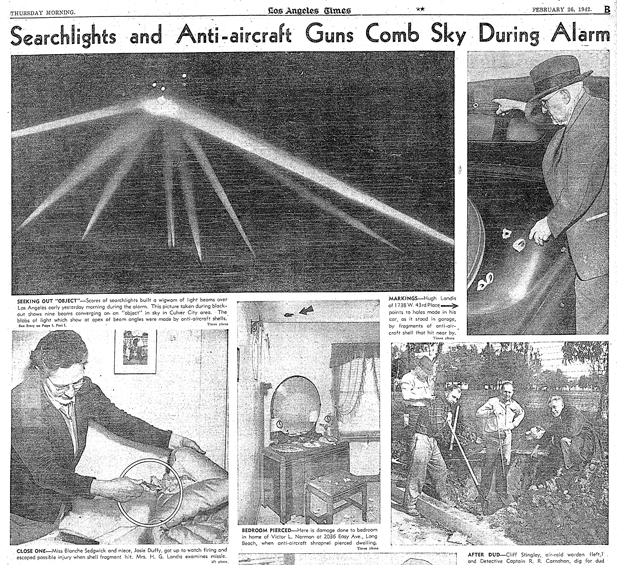
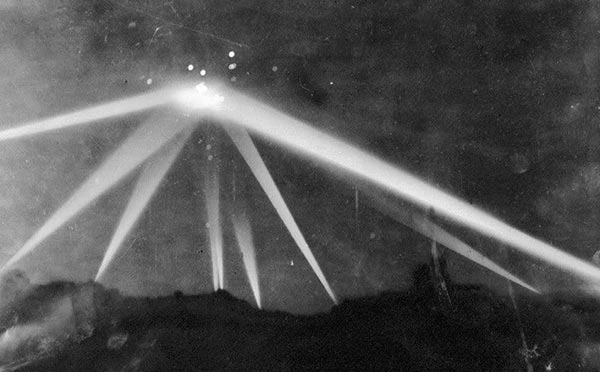
Beginning at approximately 03:00 local time on 25 February 1942, U.S. Army anti-aircraft batteries around Los Angeles fired approximately 1,400 12.8-pound shells over the city at unidentified objects; the iconic *Los Angeles Times* photograph of converging searchlight beams on a luminous object was published the same morning. Later officially attributed to 'war nerves' and weather balloons; the photograph and the official Air Force history both survive.
status history (1)
Notable & intriguing
-
U.S. Army Coast Artillery Corps anti-aircraft batteries deployed around Los Angeles fired approximately 1,400 rounds of 12.8-pound (.50 caliber and 3-inch) shells between 03:16 and 04:14 local time on 25 February 1942; the barrage covered the cities of Los Angeles, Santa Monica, Long Beach, and Hermosa Beach.
U.S. Army 4th Interceptor Command after-action report, 25 February 1942; Los Angeles Times, 26 February 1942, p. 1
-
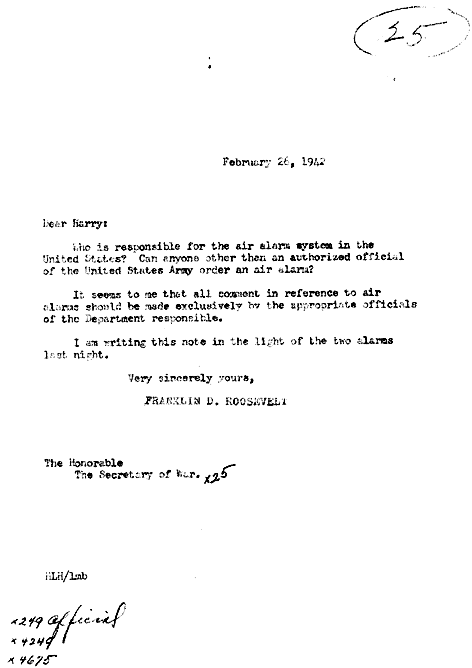
Secretary of War Henry L. Stimson stated on 25 February 1942 that as many as 15 enemy aircraft might have been involved; Secretary of the Navy Frank Knox stated the same day that the event was a ‘false alarm’ caused by ‘war nerves.’ The two services’ explanations were never formally reconciled.
Stimson statement, 25 February 1942; Knox press conference, 25 February 1942; The New York Times, 26 February 1942
-
Five civilians died as a direct or indirect result of the barrage: three of cardiac events during the firing, two in traffic incidents during the blackout. Significant property damage from unexploded ordnance falling back into residential areas was documented.
Los Angeles County Coroner’s records, February 1942; Los Angeles Times, 26–28 February 1942
-
The Office of Air Force History’s 1983 official volume The Army Air Forces in World War II, Vol. I (Wesley F. Craven and James L. Cate, eds., University of Chicago Press), attributes the incident to a weather balloon released for upper-air observation at 03:00, combined with war-nerve cascading misidentifications — an explanation that has been disputed by witnesses and later historians but remains the official position.
Craven and Cate, eds., The Army Air Forces in World War II, Vol. I, University of Chicago Press, 1983
Public-record items already documented about this subject. Folklore is labelled. Sources cited where the specificity warrants it.
More — incident
- "Rods" / "Skyfish" (the resolved photographic artifact)
- "Snippy" the Horse (September 1967)
- 'Oumuamua (1I/2017 U1)
- Aguadilla Incident (25 April 2013, Puerto Rico)
- Allagash Abduction (August 1976, Maine)
- Ariel School, Zimbabwe (16 September 1994)
- Betty and Barney Hill Abduction (19-20 September 1961)
- Billy Meier & the Plejaren Contacts (1975-)
- Bob Lazar & the S-4 / Area 51 Claims (1989)
- Cash–Landrum Incident (29 December 1980)
- Cerro Uritorco / Huella del Pajarillo — Capilla del Monte, Argentina (9 January 1986)
- Colares / Operacao Prato (1977-1978, Brazil)
- Coyne / Mansfield Army Helicopter Incident (18 October 1973)
- Crop Circles & the Bower-Chorley Hoax (1978-1991)
- Falcon Lake Incident (20 May 1967)
- Father Gill / Boianai Sighting (26-27 June 1959, Papua New Guinea)
- George Adamski & the Contactee Movement (1952-1965)
- Ghost Rockets (1946)
- Gimbal Video (January 2015)
- GoFast Video (2015)
- Heaven's Gate (March 1997)
- Japan Airlines Flight 1628 (17 November 1986)
- Jellyfish UAP (2018, Iraq)
- Joe Simonton's "Space Pancakes" — Eagle River, Wisconsin (18 April 1961)